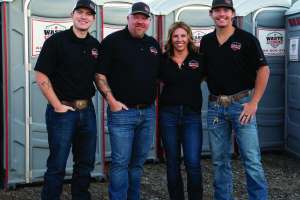
When business owner Eric de Jong, 58, launched Diamond Environmental Services in San Diego in 1998, he had one simple goal in mind: “I wanted to expand in such a way that I could drive to one of our locations, be there for a few hours, come home at night and sleep in my own bed.”
He’s achieved that goal in spades. From his current headquarters in San Marcos, California, this PRO can get to any one of nine other company locations renting and servicing 21,000 portable restrooms — and be back in time for dinner.
Before buying this company, de Jong previously operated a solid waste disposal business. The purchase of the restroom business came along with an inventory of about 500 portable restrooms and a list of 150 customers. However, half the portable inventory was in bad shape.
“We realized the company had lost its reputation among its customers, and it was our job to build it back up again,” he says. “About 90% of our customers were construction contractors, along with a few city contracts with schools and parks. We started knocking on doors, introducing ourselves as the new owners, providing the service that people expect and just rebranded and cleaned up the company image.”
Acquisition fuels growth
The business quickly grew. As de Jong gained experience and networked with other professionals in the industry, he began to acquire companies in the region.
“They all come with restroom inventory, trucks, equipment and a customer base,” de Jong says. “And some of the purchases got me into different territories. It didn’t seem long before we headed north into Orange County, to Los Angeles, Riverside and the high and low deserts.”
The company currently operates from 10 facilities in SoCal, including its headquarters in San Marcos — Miramar/San Diego, Perris/Inland Empire, Fullerton, Huntington Park/L.A., Indio/Palm Springs, Hesperia/High Desert, Seeley/El Centro, Yucca Valley and Ventura. From these locations, Diamond serves San Diego, Orange, Los Angeles, San Bernardino, Riverside and Ventura counties.
“We have great locations in the middle of town that we’ve purchased over the years,” de Jong says. “We overbought land in the area so we can expand, and we’ve been grandfathered at nine out of 10 of our locations to make that expansion easier.”
While portable restroom rental and service continues to make up about 75% of company revenue, its mission has also grown to: pumping (septic, RV/motorhomes, holding tanks, nonhazardous wastewater); trailer rentals (portable restroom, shower, laundry) and service; fence rentals; generator rentals; dumpster rentals; emergency services support; and potable water delivery.
“We’re everywhere from construction and federal and state parks, to schools, border support and emergency police and fire support,” de Jong says. “For example, we provided considerable support for CAL FIRE during the wildfires in north Los Angeles — pumper trucks, septic trucks, shower trailers, holding tanks and potable water delivery.”
An impressive inventory
The contractor’s portable restroom inventory of 21,000 is primarily supplied by Satellite Industries and J&J Portable Sanitation Products and includes about 500 ADA-compliant units from Satellite.
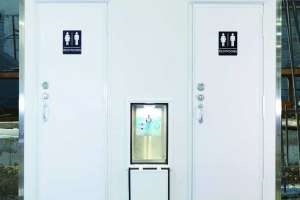
Diamond Environmental uses JAG Mobile Solutions as its preferred vendor for more than 140 trailers. The mobile fleet includes portable restroom suites from two units up to as many as 10, and 25 shower trailers ranging from two to eight shower heads per trailer. The company also offers Bunkhouse sleeper trailers providing from eight to 12 beds, as well as laundry trailers featuring two to nine washers.
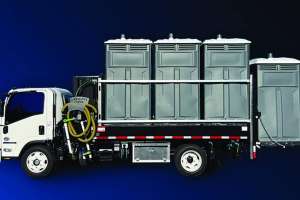
They’re hauled on restroom trailers from a wide range of manufacturers, each carrying from 12 to 14 units.
J&J Portable Sanitation Products also provides most of the company’s 4,000 double-sink handwash stations and deodorants.
Diamond’s enormous pumper truck inventory includes 191 portable restroom pumpers and septic trucks, primarily Kenworths, Peterbilts, Hinos, Freightliners and Internationals, with model years ranging from 2012 to 2024.
“We tend to specify Cummins engines and transmissions from Allison Transmission,” de Jong says. “These specs seem to be more reliable, and it’s better for us to stick to the same engine-transmission brands across the inventory.”
Diamond has also recently invested in four EVs from RIZON to assist with transporting portables and delivering potable water.
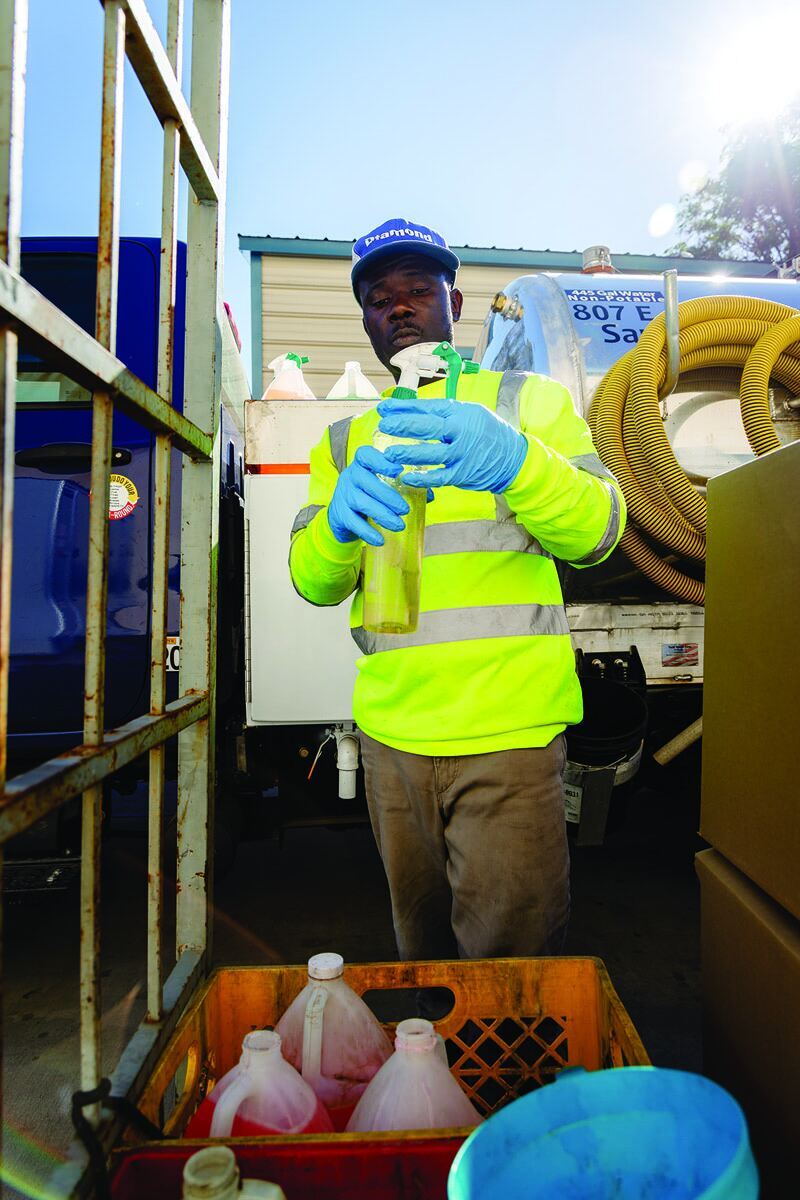
Under the company’s washing program, trucks are washed daily and inspected for cleanliness weekly.
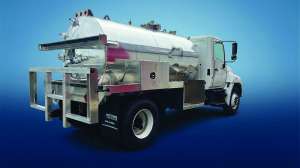
The majority of the portable restroom service trucks’ tanks are made of stainless steel and aluminum. Sizes range from 500 waste/495 fresh to 1,000 waste/500 fresh.
The 20 septic service trucks range from 2,500 gallons to 3,600 gallons and the 13 semis range from 5,400 gallons to 6,500 gallons. Tank materials include steel and aluminum. Many of the tanks are supplied by Southern California Tank of Perris, and Tank World of El Mirage, Arizona. The trucks are outfitted with vacuum pumps from Fruitland Manufacturing.
Diamond has recently started taking delivery of an additional 75 Kenworth trucks supplied by Inland Kenworth, with about 50 slated as replacements for older vehicles and 25 supporting company growth.
“California businesses have faced some uncertainty on whether the state will impose a ban on the purchase of new diesel trucks,” de Jong says. “Buying them now gets us in under the wire, should that regulation be enforced.”
Some of the bigger events the company has serviced over the years include contracts supporting the Super Bowl, Coachella/Stagecoach music festivals (annually) and the Miramar Air Show in San Diego.
“We could put out as many as 700 portable restrooms for these events,” de Jong says. “However, to put it in perspective, on any good summer weekend we might deliver 500 pieces without even blinking an eye.”
Simplifying management
This PRO breaks down managing the 10 locations by treating them as a single company with a straightforward top-down management structure, instead of independent yards.
“San Marcos was the first location we chose without acquiring another company,” de Jong says. “We chose this location as the headquarters where everything happens — all the phones get picked up, all the orders are taken, all of the payroll and HR operate and where upper management makes all the major decisions. The other nine locations are glorified dispatch facilities where you have yard specialists, mechanics, dispatchers and drivers. The biggest logistics issue for those offices is managing the people that show up to work every day.”
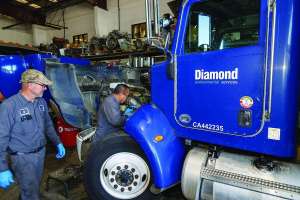
A single site manager manages all of the yards, and a fleet manager handles the entire fleet with the assistance of two superintendents. All purchasing is executed in bulk at the main office, and supplies are distributed to each location. The team of mechanics is also managed centrally.
While each office sets its own routes, Diamond has assigned a single manager to oversee companywide routing.
“He cleans up the routes to maximize efficiencies,” de Jong says. “Based on the number of contracts or based on sales levels, we might move a route from one yard to another and move a truck from one facility to the next to make sure that all of our locations grow at the same rate.”
All new hires are trained at headquarters in a two-week onboarding program so they understand the company culture and can work across all locations.
Marketing like a Fortune 500 company
The company operates a sophisticated e-commerce website and markets heavily both to existing and new customers. All trucks and portable restrooms bear the Diamond logo and the same distinctive blue coloring.
“We’re trying to be the Coca-Cola of branding in our industry,” de Jong says.
The biggest challenges facing the company include California’s exacting labor laws, which require, for example, minute-accurate timing for meal breaks, and extensive reporting to the state’s workers’ compensation system.
“The rules are very strict,” de Jong says. “And the more rules you put in place, the more oversight and management you need to satisfy regulations.”
Making connections
In an effort to grow and learn, de Jong has attended the Water & Wastewater Equipment, Treatment & Transport Show about 15 times over the years.
“If you show up and stick to yourself, you’re going to walk away with very little,” he says. “But if you interact and create relationships, you’re going to benefit and learn a lot. There’s not one company that can do it alone. We need each other to get it done.”
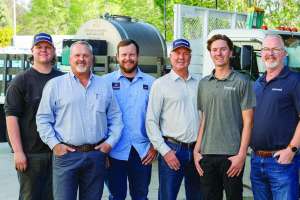
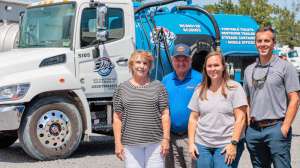
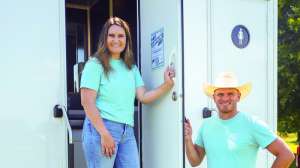
That concept extends to the close-knit group that forms the company’s core. Long-time friend Warren Van Dam is now the company’s operations manager. de Jong’s wife Silva, son Robert, daughter Ella, nephews Cole and David and Van Dam’s son, Jake, all play roles in the business, from management to operations, accounting and the company welding shop.
“The only shareholders are people within the family and we’re not beholden to Wall Street owners who are pushing us to meet certain margins,” de Jong says. “We’re big, but we’ve never lost the personal touch. If you’ve got a question, comment or concern, call me — I’m still the type of guy who answers the phone.”