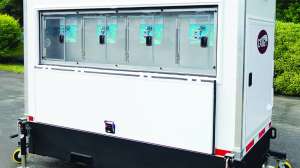


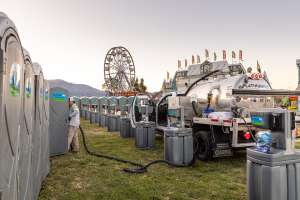
Business in the front and party in the back. Platinum PRO Portables technician Avi Sanchez works to clean this long lineup of restrooms and hand-wash stations (Satellite Axxis and Tag 4) placed just inside the event gates.


As PROs, you know event season logistics require precision, flexibility and coordination. By adding clear communication, site scouting, on-call and cross-trained staff, and better preseason prep, you’ve just smoothed operations from delivery to service to pickup, and back again. Your drivers and service techs will thank you.
Set expectations early
Strong communication with event planners is your foundation for successful event service. Every event has unique requirements, and early coordination ensures your team can meet expectations without surprises.
Confirm essential details well in advance, including event dates and hours of operation, expected attendance numbers, unit quantities and types required, delivery and pickup windows, and service frequency. Clarify site access conditions, including gate access times, vehicle restrictions and security protocols. Many large events restrict vehicle movement during certain hours, which can affect your delivery and service timing.
Written service agreements can help ensure both parties understand expectations, while regular communication leading up to the event ensures any changes are addressed early, reducing the risk of disruptions.
2. Prevent delivery and service delays
Whenever possible, conduct a pre-event site visit. Physically walking the site helps identify potential logistical challenges that may not be obvious on maps or diagrams. Key factors to evaluate include ground conditions and terrain stability, truck access routes and turning space, unit placement locations, distance between unit clusters, and service vehicle access points.
Weather can create muddy or unstable ground conditions, especially in open fields. Identify issues early to allow planners time to adjust placement locations or prepare access routes. Site scouting also helps optimize unit placement for both accessibility and efficiency. Units placed too far from access points increase service time and reduce productivity.
3. Manage high-expectation assets
Restroom trailers and specialty units require additional planning and care. Before an event, coordinate with event planners to ensure utility access is available and functioning for restroom trailers. Similarly, deliver VIP units early for setup, inspection and cleaning before guests arrive.
Service frequency is also critical; high-end units typically require more frequent cleaning and restocking to maintain appearance and functionality throughout the event. Assign experienced technicians to service VIP units. These technicians understand the importance of presentation and customer service in high-profile environments.
4. Prepare for real-time staffing needs
Events rarely go exactly as planned. Attendance may exceed expectations, weather conditions may change, or units may require unexpected service. Maintain on-call staff during major events to ensure you can respond quickly to service requests, relocations or emergency issues. On-call staff can handle situations such as restocking supplies, servicing high-use units, addressing damage or vandalism, and relocating units to improve accessibility
Quick response times protect customer satisfaction and prevent minor issues from becoming major problems. Staff scheduling can and should also account for driver fatigue and workload limits, while cross-training yard staff or technicians to assist with event service provides additional operational flexibility.
5. Coordinate delivery, service and pickup
Event logistics involve carefully planning in three distinct phases: delivery, service and removal. Units need to be delivered early enough to avoid conflicts with event setup, and if the event is complex enough, restrooms may need to be on site and ready to use at setup. This is the time to coordinate with event planners to ensure that delivery and service vehicles can access restroom areas.
You want your cleaning service schedules to be timed to minimize disruption, for the users and your workers. Early morning or late-night servicing is often preferred to avoid interference. Be sure to document it all as you go — detailed records of deliveries, service and pickup ensures accurate billing and inventory tracking.
Prompt removal after the event helps maintain positive relationships with event organizers and gives you time to prepare units for future deployments. However, be sure to clearly schedule pickup times with the event organizers to avoid traffic during breakdown.
Continue reading for free