When Antonio Robinson was 17, a knee injury — with only one tournament left to go — prevented him from competing in karate in the 1988 Summer Olympics. But that unfortunate event did — in a roundabout way — change the course of his life for the better.
As a teen, he turned those dashed Olympic dreams into entrepreneurial gold, launching his very first business venture selling gear as he traveled to karate tournaments.
That early drive to succeed eventually led Robinson, 41, to start King John Portable Toilets in Worthington, Ohio, as a certified minority-owned portable sanitation business.
“I’ve been a business owner for the last 20 years,” he says, launching businesses as diverse as restaurants, international trading firms and pallet companies. But he has high hopes that King John will be one of his most successful ventures.
Since its startup in April 2008, King John has grown to about 300 portable restrooms and, according to Robinson, doubled its original sales projections. Along the way, King John has been recognized through media coverage as a minority-owned service provider.
GAINING MINORITY STATUS
A few years ago, Robinson was approached by longtime friend Pernell Horton, who hoped the two could start a business together. Robinson had a shrewd strategy for finding the right new industry to enter. “I was interested in a business that had no African-Americans,” Robinson says.
While he initially considered publishing and toilet paper manufacturing, Robinson eventually found his niche in the portable sanitation industry. Even though the Columbus metropolitan area — with a population of a little over 1 million — already had two major competitors (with thousands of units each), Robinson didn’t think bigger was necessarily better.
“Whatever industry we went into, there were going to be challenges,” he says. “There’s not an industry you can go into with no competition.”
Instead, Robinson focused on gaining the certification necessary to qualify King John to bid on jobs requiring minority contractors — a move that would differentiate them from competitors statewide.
King John has three state-certified designations — Disadvantaged Business Enterprise, Minority Business Enterprise and EDGE (Encouraging Diversity, Growth and Equity). The first designation is certified by the Ohio Department of Transportation; the latter two are issued through the state’s Department of Administrated Services.
“You have to be in business for at least a year before you can qualify to be a certified minority-owned business,” Robinson says, and, “You have to be at least 51 percent minority owned.” Each owner, as well, can have no more than $750,000 in personal assets.
PROGRAM OVERSIGHT
The minority status “allows other companies to use us … and they get credit for it,” Robinson says. Certain construction projects, he says — funded either by federal or state governments — often require a percentage of minority participation, and companies or agencies can lose contracts if they fail to meet that percentage.
“The programs typically set as a goal of 15 percent for minority inclusion, yet based on recent reports, many agencies and companies that do business with the state are way below that number even with set-aside programs in place,” Robinson says.
But government projects aren’t the only potential clientele. “Some corporations would like a very diversified workforce,” Horton adds. “And the government and state agencies keep a database … where companies can tap in and see a listing of those minority companies.”
While gaining the certification was a long paperwork-laden process, Robinson and Horton, both African-American, believe the process has paid off for their fledgling business. Robinson estimates the certifications have accounted for 25 percent of King John’s business so far.
Robinson and Horton began their journey to certification with the state’s Department of Development. “The paperwork is very extensive,” Robinson says. “You have to show everything. It’s very intense. You have to provide tax information, birth certificates and (undergo) a site visit. It’s quite involved.”
The entire process took as much as 90 days, Robinson says, including filling out and submitting the paperwork, having a site visit and getting the certification approved through the city council.
Now that King John has the certifications, Robinson says the status has to be renewed each year — with the certifying agencies reviewing corporate minutes, lease agreements and other company paperwork to ensure the certifications are still valid and that King John remains a legitimate minority business.
ADDING EQUIPMENT
In the face of a lagging economy, King John has grown steadily enough to add to its inventory and fleet. The company launched with about 100 restroom units; today, just two years later, they have about 300 rentable items, about 225 PolyPortables Inc. and 60 PolyJohn Enterprises Corp. restrooms, 10 sinks, one single shower and four eyewash stations.
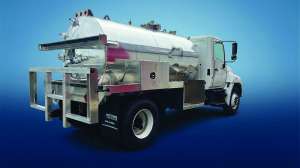
In the garage, King John keeps three vacuum service trucks, a 2006 Ford F-550 with a 900-gallon waste/300-gallon freshwater stainless steel tank and Conde pump, a 2001 Ford F-550 with a 600-gallon waste/250-gallon freshwater tank and Conde pump — both built by Progress Tank — and a 2001 Isuzu with a 600-gallon waste/200-gallon freshwater steel tank with Masport pump, built by Keith Huber Inc. A 2001 Ford E-350 box truck is used for deliveries and pickup.
While their growth has been strong and incremental, Horton says he’ll watch the inventory closely. “We don’t want to get too big where we lose the touch of our business,” he says. “We still want to have that hands-on approach. About 1,000 units is about as big as we want to be. Our main focus right now is (making) King John the best it can be.”
ON THE CONSTRUCTION SITE
King John reigns strong in the construction sector, which makes up about 75 percent of its business. One major project it is involved in is the three-year, $300 million expansion of Nationwide Children’s Hospital in Columbus. The portable sanitation contract is worth $108,000. Horton credits major project sponsor Nationwide Insurance with having strong goals for diversification, which may have ultimately led to King John winning the bid.
King John also has a presence at Ohio State University events, regularly supplying about 30 units for Buckeye football games. The partners are hopeful they will win a bid to contribute units for a $1 billion medical center construction project at OSU.
Though it was an important starter for King John, Robinson and Horton don’t want to rely on a minority status alone to realize their growth potential.
“Business is challenging due to a lot of socio-economic reasons, and as a result, some minorities in the past have been excluded from winning business in the construction industry,” Robinson says.
Still, some companies continue to have a reluctance to work with minority-owned companies or may feel the minority advantage is unfair, Robinson says.
“There has been some backlash because of what is perceived as preferential treatment because projects are given to minorities who may or may not have the expertise or experience and could possibly charge more due to the inclusion or set-aside program,” he adds.
“As business owners, we are simply using every advantage available to run and grow our business. We think that a company would be crazy not to take advantage of anything that would sustain their business. If the shoe were on the other foot, our competitors would do the same thing.”
Horton adds, “We don’t shout, ‘Hey, we’re black.’ We approach our business as being a good sanitation company with good service.”
“We have made some mistakes like every startup company, but we learned from them and will continue to learn and grow from them,” Robinson says. “This is why we will be successful … not because of our race or a program.”
MARKETING MAGIC
Despite their successes, Robinson and Horton realize they are the new kids on the portable sanitation block. And they admit they’re addressing their startup stumbling blocks head on. Robinson says one of their initial hurdles was “going into a business you don’t know about.
“It’s like reading about riding on a roller coaster,” he says. “You don’t know the feeling until you actually get on one.”
Now that they’re on the roller coaster, however, they’ve decided to focus on providing great service — and making the most of marketing.
“We have new units; we have identified ourselves with red units with black trim. If you’re going down the street, we stand out,” Robinson says. “We wanted to be able to differentiate ourselves from our competitors — they use blue, green or gray, for the most part. We consider our units as a billboard. We advertise on all four sides and place a decal inside the unit.”
King John’s marketing goes beyond the restrooms and beyond their slogan: “Your throne away from home.” The owners attend many local networking events, which Robinson says is one of their most valuable marketing tools.
“There’s not an event I go to that someone doesn’t know who we are,” Robinson says. And because of King John’s concerted efforts, the company’s visibility is steadily increasing.
King John has made some headlines. It won the micro-entrepreneur trade division award from Increase Community Development Corporation in Columbus, were featured in Columbus CEO magazine and have been nominated for the Columbus Chamber of Commerce’s Business of the Year award.
And they’ve also added another element sure to get them recognized locally; they recently became certified through the mayor’s initiative as a “Green Spot” company. To accomplish that, King John uses eco-friendly products, including Earth Friendly Chemicals and PolyPortables’ Green Way Products, in its tanks and is working to go paperless in its office, using e-mail for most of its communications.
“We are conscious of the environment, and it has been a marketing tool for us,” Robinson says, adding that King John touts the Green Spot certification through its literature, in its local cable TV commercials and on restroom signage.
THINKING BIG
On TV and in person, Robinson and Horton are keenly aware of their public personas, but even though they’re a small company (fewer than 10 employees), they’d like the public to perceive them as larger.
“We really try to distance ourselves from being the mom-and-pop company,” Robinson says. “We want more of a corporate feel. We’re dominant online; we’re dominant in the phone book. You don’t know if we’re the small guy or the big guy.”
Size and minority status aside, Robinson and Horton stress that providing an excellent product backed up by superior service trumps everything else.
“Just because you’re a minority doesn’t mean you don’t have challenges,” Horton says. “People may be looking at you to see if you’re going to give them good service. The onus is on us to do a good job.”
Continue reading for free