When Richard Swenson and Kathy Bristow of Park Rapids, Minn., bought out a Fargo-based portable restroom business in August 2007, they really didn’t need one more business. Kathy has a full-time day job. And when Richard’s not raising beef cattle and growing crops on 200 acres or dealing with his gravel pit, he is trucking everything from hay and seed corn to nursery plants and log homes.
“It was a no-brainer,” Swenson says. The price was more than right for 350 units and two service trucks. He calculated that the 53 Satellite Maxim Model 3000 units with solar lights were worth about half of the total cost of the business. And, as an entrepreneur, he recognized growth potential in the Fargo area, with its boom in oil production, construction and agribusiness.
The couple took a cashier’s check as a down payment when they traveled to Fargo to make the deal. As soon as they agreed to the price, they were told the business was theirs to operate starting that day. They made a quick decision to rename it Potty Shacks, arranged to use the former owner’s facilities for a month, and Swenson was in business — again.
Explore Five CHALLENGES that affect RICHARD’S PORTABLE SANITATION BUSINESS:
BUILDING CREDIBILITY
While Swenson knew nothing about the portable sanitation business, his son Michael did. He had worked for the company his dad bought out. So did a Fargo shop manager who Swenson hired part time. Besides learning everything he could about the business, Swenson’s first concern was building the business’s reputation. The prior business had customer service concerns.
“Our business — Potty Shacks — is built on service,” Swenson emphasizes. Former customers agreed to continue old contracts, but only for one year — on a trial basis.
Swenson started driving the longest service route himself, maintaining units at the pipe yards set up for an oil company in North Dakota. The yard owners were so satisfied with the service they agreed to pay higher fees to cover mileage as the yards extended into South Dakota and Nebraska. Swenson’s route lengthened from 600- to 1,100-mile roundtrips to service 35 units. Later he set up 35 units for another company’s pipe yards.
Swenson purchased four new power washers for his employees. All portable restrooms are power-washed and sprayed with a lemon scent, hospital-grade biodegradable disinfectant purchased from Fargo-based Cole Papers Inc., with each service (except in winter) — at least once a week at jobsites. In the beginning, Swenson checked units, and if they didn’t meet his standards, he showed workers exactly how he wanted them cleaned.
The work paid off. Contracts have been renewed, and at the 2009 Fargo AirSho, where he had 135 units, a woman told Swenson they were the cleanest portable restrooms she had ever seen.
FINDING RIGHT PEOPLE IN THE RIGHT JOB
Swenson lives 90 miles from a site he leased in Fargo, so delegating duties and having dependable workers is important. Through trial and error, he is figuring out the skills and talents of each employee to make the operation more efficient. One employee works well in the shop, handling truck maintenance. Another has organizational skills to plan routes and do paperwork. A young employee is learning the basics.
All employees know that when they are not servicing or doing other work, they should be fixing and maintaining older units in the shop. Swenson answers the phone 24-7.
CUTTING COSTS and PRICING SERVICES
Before Potty Shacks, Swenson never thought he’d be paying attention to the price of toilet paper. But recently it was a pretty big deal to find a better quality tissue that was less expensive than what he had been buying. He watches ads and mailings to learn about available products.
“You pay attention to what does work,” he says, adding he’s finally happy with a product to remove graffiti, for example. “Good ol’ W-D 40 seems to work the best.”
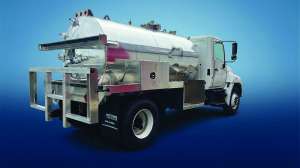
Swenson likes the 2001 and 2003 Ford F-550 service trucks that came with the business. They had been set up by Satellite Industries with 550 gallon waste/250 gallon freshwater tanks. When he decided to expand, he purchased a service truck from a New Jersey PRO, added a power washer to the 2002 Ford F-450 with a 700 gallon waste/300 gallon freshwater and put it to work right away.
On the other side, he is learning how to competitively price his services. He sweetens his service offer by throwing in amenities such as hand-wash stations or other upgrades. “The solar units are a big plus. We use them for all our events,” Swenson says. He’s added eight handicap units, several wash stations and plans to add more solar lighting to units he already owns.
ADAPTING TO MOTHER NATURE
About 95 percent of Potty Shacks’ units are made by Satellite Industries — Maxim 3000 and Tufways — for construction sites and special events. Potty Shacks are scattered along the oil pipe yard route as well as in fields for migrant workers and even on an American Indian reservation near a sweat lodge. To keep the restrooms from blowing through the prairie, Swenson stakes them down with 4-foot rebar. During the area’s harsh winter he provides heaters and tapes the vents shut. Methanol brine keeps the units operational during cold weather.
Besides the environment, the distance to cover is challenging. Owning a semi with a step-trailer comes in handy to haul as many as 24 units at a time.
MULTI-TASKING TO RUN THE FAMILY BUSINESSES
“I incorporate the farm with the Potty Shacks business,” Swenson says, explaining that when he’s selling hay, he’s looking for portable restroom business and vice versa. A business logo depicting a horse, dog and outhouse captures the merger of businesses.
The Park Rapids farm he shares with Bristow and their daughter, Chelsea, is also a satellite for Potty Shacks, which takes the business in other directions besides Fargo. Through his various enterprises Swenson knows many people, and he continuously stops in at new businesses and asks for the opportunity to provide service.
He and Bristow read newspapers carefully to find regional events that take them in other directions besides Fargo and North Dakota — rodeos, community celebrations, charitable events. They offer nonprofits better deals to accommodate tight budgets.
While Swenson says he prefers events that need 30-60 units, he and his crew easily handled the 135-unit Fargo AirSho contract. As they work at growing the event side, they are careful not to ignore the year-round construction end of the business. When he sees a new residential development, Swenson tries to get Potty Shacks to be the first unit on site.
Continue reading for free