

QUESTION: I have been told all about the primary shut-off on the top of the tank. What can you tell me or show me that would make it more understandable? What about maintenance, etc., and things like that?
Roger Trimble
Dayton, Ohio
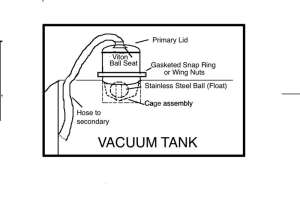
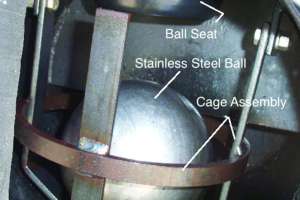
ANSWER: Here is a drawing of the primary and its location on the vacuum tank. The basic parts are listed:
• Primary lid
• Gasketed snap ring or wing nuts or nuts and bolts
• Ball seat (inside primary)
• Stainless steel ball
• Cage assembly
The primary lid is domed because, like the dished ends of the tank, it has to deal with the vacuum created by the pump. Primary covers are commonly between 8 and 12 inches in diameter and are made from 10-gauge (slightly over 1/8 inch) through 7-gauge (just under 3/16-inch) steel.
The primary is located on top of the tank as close as possible to the pump. If the pump is behind the cab, then the primary will be to the front of the tank. The opening coming out of the primary is 1 1/2, 2 1/2 or 3 inches, with the fitting size calculated by the airflow from the vacuum pump.
Some manufacturers secure the lid with a gasketed snap ring while others prefer using two or three wing nuts depending on the size of the tank and airflow. Still others simply use nuts and bolts. The technician can remove the lid and the upper half of the primary to check the condition of the primary components. The primary should be inspected on a monthly basis.
Most primaries have a built-in gasket in the housing to help seal the lid. The cage assembly is made of carbon steel and will rust. Over time, the rusted cage assembly fails and breaks away, leaving the stainless steel ball on the floor of the tank. More than one PRO has discovered the broken cage assembly by driving around and listening to the rattle of the stainless steel ball as it bounces around inside the tank. Or even worse, the PRO hears the pump bog down on a job and realizes too late that the primary is not working properly.
The primary performs a very simple, but important task. As waste rises in the tank, it pushes up the hollow stainless steel ball toward the top of the tank. There are some plastic primaries on the market, but they tend not to be as durable as steel. There are some plastic balls on the market, but you want a ball to have enough weight to make sure it will not be drawn up by the force of vacuum alone.
As the tank reaches capacity, and with the vacuum pump operating, the ball works its way into the ball seat and stops the filling. Some primaries even have a two-ball system with a smaller ball sitting on top of the larger ball. As the larger ball “floats” up, the smaller ball seals off the airflow.
The last thing you want is unlimited waste flowing through the system, into the secondary, and then on to the vacuum pump. The secondary will not handle unlimited waste, and the pump will not handle the intake of waste. If your primary fails, you not only have a damaged primary, you have damaged the pump.
It is possible to special order stainless steel primary systems, as they would not fail due to rust. But there isn’t a big market for the more expensive option, and it’s not difficult to inspect and maintain carbon steel. The technician should check the cage assembly for corrosion and make sure the ball is in good condition. Finally, get a good look at the ball seat to make sure it is in good condition and free of debris to ensure a good seal. If repair is needed, it’s a fairly simple job to replace the cage and get back to work.
Like anything made of steel, the primary will last a long time, and odds are that it won’t break down until you need it most. So it’s an ounce of prevention type thing.
To replace the primary, a welder can cut out the cage assembly and housing. The bottom half of a primary can be purchased directly from the manufacturer. This ensures you get a replacement to work best with your system. After cleaning the area where the old housing was removed, a new bottom half can be tacked in place and seal-welded.
There is no set rule about the durability of the cage assembly and bottom half of the primary. It depends on what materials are being pumped. Some are more corrosive than others so it’s hard to predict how long the parts will last. That’s the reason for regular monthly inspections. If you need parts for your primary, manufacturers usually have them sitting on the shelf and ready to go.
Operating a vacuum truck is only as mysterious as you want it to be. Learning and understanding how it works will possibly save you thousands of dollars over the life of your truck.
Continue reading for free