


It’s sad to say, but human defecation and urination on public streets is reaching epidemic proportions across America, from large West Coast cities with a major problem of homelessness to the heartland in Springfield, Illinois. More frequent news accounts throughout 2017 included headlines of a major hepatitis A outbreak in San Diego that’s linked to a lack of public restrooms, and the problem is sure to worsen throughout 2018.
I’ve written in the past about how portable sanitation companies can provide part of the solution to this troubling trend, suggesting that PROs who serve urban centers open lines of communication with city leaders about their products and services. I regularly read about pilot programs to place restrooms and restroom trailers in city streets as cities look for ways to curb the problem.
Yet, I also read that some of these government leaders prefer to look for more permanent public restroom facilities. One of those is the Portland Loo, a modern, stainless steel unit plumbed to a city sewer and becoming popular in several major cities. While I agree we need to explore a wide range of options to attack this problem, I noted with interest a recent letter to the editor in The Sacramento Bee in which writer Erika D. Smith advocates for the portable sanitation industry.
“I read that Sacramento spent $173,000 for a (more permanent) restroom. I called a local portable restroom company. Its units cost $195 per month and are serviced weekly,” she writes. “Why not contract with one of them to install units in alleys and along the bike trails where the homeless people congregate? Hepatitis A may be coming, and E. coli is at infectious levels at the local beaches. It is time for a common sense approach. I’m sure the taxpayers would much prefer portable toilets to having to step around feces.”
CRISIS POINT
As local governments grapple with this serious sanitation crisis, they may disagree on the best way to provide access to restrooms. But they don’t disagree that more bathroom facilities are necessary, and they should be added as soon as possible.
San Diego saw about 500 cases and 19 deaths attributed to the hepatitis A outbreak in 2017, traced to a large homeless population. The highly contagious liver disease is typically spread where thousands of homeless gather in cities and is linked to contact with feces. San Diego, San Francisco and many other cities have an ongoing problem with people defecating on sidewalks, in alleys, and anywhere restroom facilities are difficult to find.
According to a news account out of Los Angeles, the skid row neighborhood where about 1,800 people sleep had only nine public toilets available. Homeless advocacy groups there have reported that the restroom situation is worse than what Syrian refugees were encountering and violates the United Nations standards for hygiene.
In Illinois’ state capitol, Springfield, advocates for the homeless are asking local officials to place portable restrooms, at an estimated cost of $170 each per month, in front of the library and a location where the homeless population gathers for food.
“I just think something needs to be done, and I just think for us to keep ignoring it would be ridiculous,” says Julie Becker, from the Helping the Homeless ministry, in a news story.
TEXAS PILOT STUDY
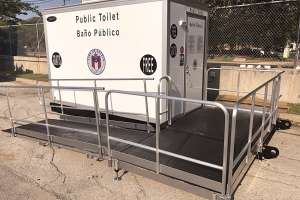
Austin, Texas, is using a portable restroom trailer to address a growing sanitation problem in the downtown area, and a City Council member promoting the effort would eventually like to buy permanent restrooms like the Portland Loo. Kathie Tovo says the city is using a $272,000 pilot program to place a restroom trailer in several locations and keep track of its usage. The city purchased a two-place Advanced Containment Systems trailer with air conditioning and a wheelchair ramp for the pilot program.
“We have an issue with sanitation in our downtown areas, and it has impacted the quality of our urban creek water quality,” Tovo says. “We have had nothing of the scale of San Diego, but as you walk some of our streets, you can tell people are urinating and defecating. We’re looking to end that and provide a clean place to use the restroom.”
And in Austin, like other urban cities, the issue isn’t only about serving the homeless. Tovo says there is a general need for more bathroom facilities for public use in downtown entertainment districts. People barhopping in the evening, coming and going to shows and concerts, need restroom services as well. When you read about this issues in several city centers, you get the impression that public restrooms have been removed over the years and businesses are more carefully reserving their restrooms for customers rather than people coming in off the streets.
Austin has used standard restroom units in several locations, but that’s not considered the preferred solution. The restroom trailer poses some challenges, too, as it provides a more private restroom cabin, which may encourage illegal activity inside the unit, Tovo explains. The advantage of the Portland Loo or other custom permanent bathrooms is they can be designed in a functional way to discourage illegal activity and be built to handle more abuse, she says.
Tovo says the city preferred to own the restroom trailer and staff it with attendants subcontracted from the Downtown Austin Alliance partnership rather than hiring a portable sanitation contractor. She says handling it this way will ultimately save money and ensure better control over restroom monitoring.
“We’ve already noticed with the (portable restrooms) what a tremendous difference it’s made. People have welcomed it,” Tovo says. “No one wants to use a street or an alley and go to the bathroom in front of other people. (The standards units) are being well-used, and I anticipate the restroom trailer will be as well.”
KNOW YOUR ROLE
How do PROs figure into the equation in these urban centers? Clearly some cities, like Austin, believe the solution is in buying permanent restrooms to install on the city streets and hiring municipal workers to manage and service them. This makes some sense, especially if the bathrooms can tap directly into the sewer system and pumping is not part of the maintenance program. But PROs can help out even in places like Austin, where mobile restrooms are being employed on an emergency basis to deal with a homeless population, or to determine usage patterns before governments buy and install permanent bathroom facilities.
In some cities, PROs can play a more significant role, placing and servicing a wide variety of portable sanitation equipment. You can use your expertise to help cities figure out their long-term sanitation needs for the benefit of the homeless population and tourists alike. You have a knowledge base they don’t have, being able to predict how many restrooms are needed in any situation and understanding a service protocol that protects both the users and the technicians who clean the units. And you have, unfortunately, a lot of experience dealing with graffiti and vandalism and can suggest ways to secure and protect restroom facilities in these sometimes troublesome placements.
When you approach cities and offer your expertise, you may very well encounter governments that are looking beyond the private sector for their restroom solutions. However, some municipalities may also welcome your input, lease your equipment … or maybe even consider hiring your staff to maintain their more permanent facilities.
One thing is certain, as illustrated by the reaction to the hepatitis A outbreak in San Diego: People everywhere are now recognizing the important public health role played by the portable sanitation industry. And that’s a positive development.
Continue reading for free