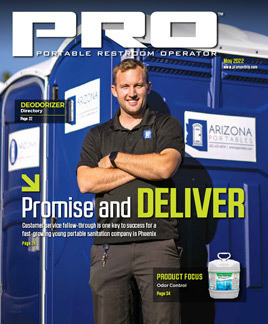



As I reviewed the editorial content for this issue of PRO, I was struck by stark differences between the two companies in our main features. One has been in business for 55 years, surviving through many economic hills and valleys. The other is freshly minted during the COVID-19 pandemic and hoping for longevity. One has been a savvy industry leader built on experience and knowhow. The other is an upstart driven by enthusiasm and a backbreaking work ethic more than dollars and a conventional business approach.
The established company is run conservatively, though its leaders are willing to make well-reasoned investments in its future success. The newcomer is taking chances, and has an unorthodox — some might say controversial — approach to building the customer base.
And the leader of one company is nearing retirement, while the leader of the other is just getting started.
Contrasting these two companies is a thought-provoking exercise, for sure. And in the end, each has its own lessons to pass along to PROs and offers a different kind of wisdom about making it in a competitive business environment.
THE OLD GUARD
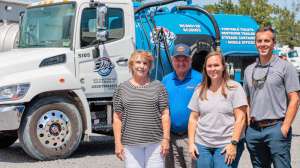
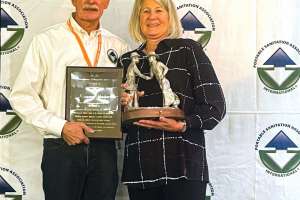
Anderson Rentals in Mims, Florida, has been a respected fixture in the restroom industry for a long time. So long that I have been acquainted with Eric Anderson — who owns it with brother John and relative Woody Donnelly — for almost 20 years. As you will read in writer Ken Wysocky’s PROfile story, Anderson, 60, is planning on retiring next year and ushering a new generation into leadership roles at the family business.
With the benefit of looking back at his career, Anderson explains how he learned it is better to be more profitable than to own more restrooms. At the apex of an expansion, the company had an inventory of 10,000 restrooms and about 100 employees covering a 15-county region. The last economic downturn made Anderson smarter, and he focused more on margins than swinging the biggest stick.
“Would you rather be a $10- million- a- year company making 10% profit or a $7-million-a-year business doing 30%? I’ll take the latter every time,” he said. “Profit should always be the ultimate measurement of success. … I don’t worry about trying to be the largest operator in Florida anymore.”
You might call it right-sizing. And while they may have reduced inventory, the truck fleet and payroll, Anderson is investing in other ways to secure the future of the business for generations to come. One, they embraced diversification, buying a roll-off container business so they could offer existing construction customers another product they needed. Two, they have constantly upgraded equipment and built a mechanic’s facility to properly care for trucks. Three, they have employed software to raise productivity. And four, they are working on creation of a projected $3 million treatment facility to control disposal costs over the long haul.
“This company could have virtually no disposal costs after six years of operation — who wouldn’t want that in their corner?” He asked. “I don’t want the next generation of ownership to ever have to worry about waste disposal again.”
Anderson Rentals is in an enviable position to learn from the past and tweak the business plan for greater success. That the Anderson family has persevered through stock market and real estate booms and busts shows they have had quality leadership at the helm. They are where many smaller companies want to end up, with a rich family legacy worth protecting.
THE YOUNG GUN
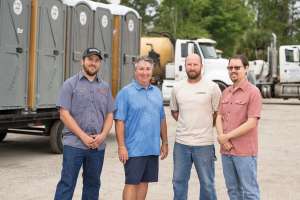
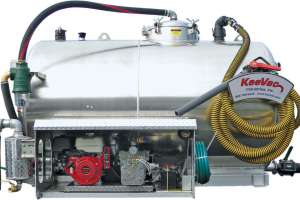
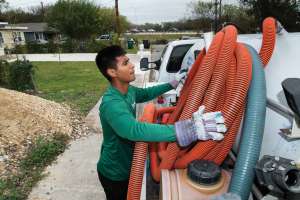
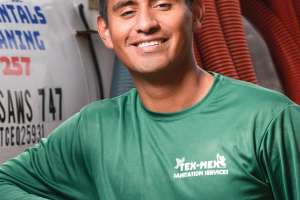
Mario Hernandez powers Tex-Mex Toilets of San Antonio on youthful energy and an aspirational spirit. Highlighted in one of our newer features, Business Incubator, Hernandez started from scratch in 2020 with 13 used restrooms and an older vacuum truck. For the first year, Hernandez worked full time for someone else, then pulled night and weekend shifts growing the fledgling business.
Hernandez is not without some background in the wastewater industry. His parents, Mario Hernandez and Mercedes Reyes, operate a septic service business, and though he obtained a degree in biomedical engineering and worked in other jobs, he felt a calling for portable sanitation. As he told writer Betty Dageforde in our Business Incubator feature, the restroom business fed an entrepreneurial hunger he felt all along. Most PROs could relate to that.
“I felt I could achieve more that way — not by myself but with my ideas,” he remarked. “I felt my own ideas could drive me in the direction I want to take my life.”
One idea drove him more than any other: a need he saw to provide service for Mexican immigrants in the construction industry. An immigrant himself, Hernandez felt Hispanic workers in southern Texas weren’t getting the type of service they desired. He reasoned that they wanted to deal with PROs who could speak their language and in what he termed “the Mexican way.”
This is where many folks in the portable sanitation industry might take issue with Hernandez’s business plan. He recognizes that immigrant companies want low-cost service, so he doesn’t require contracts, deposits or insurance from his customers. PROs may argue these practices put established companies at an unfair competitive disadvantage.
Does this fall under the category of low-balling, a practice derided by many in the industry? That’s when new companies greatly reduce their prices in an effort to gain market share without regard for profits and quality service. Or is Hernandez simply offering more flexible service an overcoming a language barrier because that’s what his customers want? Hernandez would argue the latter.
“I take a higher risk by not asking for (contracts or deposits) but I just try to do it the Mexican way. I understand their needs. They like that,” he explained. “Things happen and so they need to cancel. But the next time … you’re going to be happy to rent from me because I didn’t take your $50 deposit.”
Hernandez’s hard work is paying off so far, and we hope to follow up with him in years to come. Meanwhile, he’s going to take satisfaction in building the business.
“Either you really love this business — and are willing to put in the hours, the effort, learn everything you need to learn, go the extra mile, without doubting yourself — or this is not for you,” he summed up his entry into the industry.
NOW IT’S YOUR TURN
Where does your company fit into the broad spectrum of portable sanitation? A multigenerational company deeply rooted in your community? Maybe you just bought your first truck and shipment of restrooms hoping to build your own success story? Or somewhere in between? Whatever the case, we’d love to tell your story to add additional insight into running a small service-based business in a great industry.
Continue reading for free