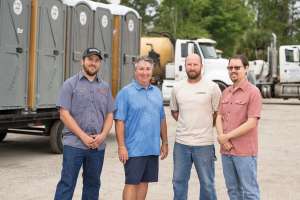
“We’re more efficient than when we were bigger,” says Anderson, who owns the business with his brother, John, and Woody Donnelly, his brother Bob’s son-in-law.
“Bigger isn’t always better,” he continues. “Would you rather be a $10-million-a-year company making 10% profit or a $7-million-a-year business doing 30%? I’ll take the latter every time.
“I always was very proud to say we were the largest family-owned-and-operated portable restroom company in Florida,” Anderson adds. “But profit should always be the ultimate measurement of success. … I don’t worry about trying to be the largest operator in Florida anymore.”
The company’s makeover offers several key takeaways for PROs, including the value of offering diverse services, using data to increase efficiency, and striving for waste-disposal independence. It also illustrates the power of resilience and flexibility in the face of economic adversity, which is what spurred the company’s makeover.
ADAPTIVE STRATEGIES
In this case, that economic adversity emerged in 2006 in the form of a housing bubble in Florida that burst in 2006, far ahead of the deep national recession of 2008. Itw was a devastating blow to Anderson Rentals, which relied heavily on restroom rentals to residential home-building companies.
But in a bend-but-don’t-break survival move, the company downsized to about 2,500 restrooms and 26 employees. At the same time, it slowly pivoted into rentals to contractors that build commercial buildings, a sector that wasn’t affected as much by the housing market implosion, Anderson says.
The downsizing also opened the door to two other strategies in the company’s resurgence: converting its restroom inventory from fiberglass units to polyethylene, the modern industry standard, and taking a calculated risk buying a roll-off container business, he says.
“The owner of a roll-off company that also was heavily tied into residential construction asked us if we wanted to buy the business, which at the time had only 10% of its roll-offs rented,” he explains. “So we bought the business for pennies on the dollar.
“Because we already had connections through renting portable restrooms, we had 95% of the roll-offs rented within a year,” he continues. “And during that time, we also bought another roll-off company that was dying on the vine, which gave us a total of about 300 roll-offs.”
The lesson here for other PROs? Be alert for opportunities to diversify into complementary businesses — something the company’s accountant had recommended for years — and then cross-market the services, Anderson says.
“Roll-offs helped us get a foot in the door to rent restrooms to commercial contractors,” he notes. “That helped us generate more and more revenue from restrooms, so the acquisitions were a big win for us. In a way, I guess the housing bubble burst did us a favor in some respects.”
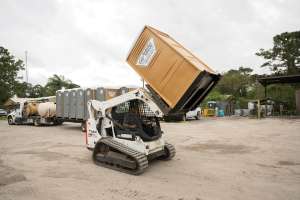
Today, the company owns 450 roll-offs, mostly 20-cubic-yard units. The company also owns eight trucks — mostly Internationals and Sterlings — to transport roll-offs, he says.
INVESTING IN EQUIPMENT
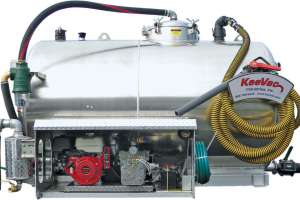
The company owns a large fleet of other vehicles, too, including 42 restroom service trucks, all equipped with Masport HXL4 vacuum pumps. One truck was built out by Progress Tank on an International chassis, featuring a 1,000-gallon waste/300-gallon freshwater stainless steel tank with a Masport HXL4 pump.
The rest of the restroom trucks are self-fabricated, featuring International chassis and 1,000-gallon waste/300-gallon freshwater steel tanks.
The business also relies on a 5,460-gallon steel tanker trailer from Macom. The tanker is used to collect waste off-loaded by drivers into storage tanks — a 10,000-gallon tank at the main yard in Mims and two 2,000-
gallon storage tanks at facilities in Lakeland and Fort Pierce — and hauls it away for disposal, Anderson explains.
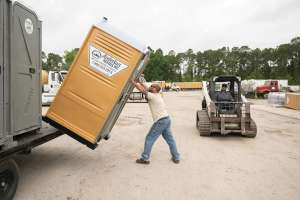
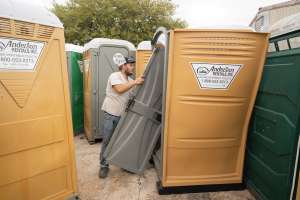
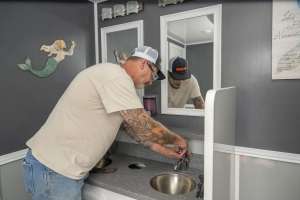
The company also owns 5,000 Armal restrooms, about 160 handicapped-accessible units from Satellite Industries, 180 hand-wash stations from PolyJohn and more than 100 holding tanks from Satellite.
In addition, the company has invested in more than a dozen restroom trailers, seven from Satellite Suites, one from Advanced Containment Systems Inc. (ACSI), one from Black Tie Products and five from Wells Cargo; others are self-fabricated.
KEYS TO SUCCESS
Anderson says the company is data driven to improve efficiency and productivity. As an example, he cites the firm’s emphasis on services per hour as a productivity benchmark, which is tracked with business management software called Tower, from the AMCS.
“We focus heavily on services per hour, not on how many restrooms or trucks we have out,” he says. “We know we’re making a profit if they do more than three restrooms per hour.” The software was written for the waste disposal industry, but it also covers roll-offs and restrooms.
“You can keep track of individual restrooms, but the software also pushed us to look at services per hour,” he continues. “We get a weekly report and know how many restrooms per hour drivers are doing. We also know exactly who’s the most profitable route driver.
“The software also does a great job of optimizing our routes.”
Another factor in the company’s success and longevity is a 5,625-square-foot mechanic shop that helps minimize truck downtime and makes repairs more cost-effective than relying on outside mechanics. Five full-time mechanics work in the facility, including Anderson’s nephew and head mechanic, Ben Anderson.
John Anderson also contributes heavily as supervisor who also performs maintenance on all service trucks and restroom trailers.
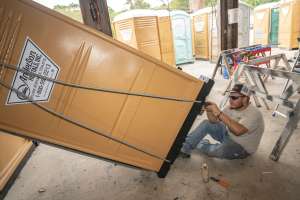
Built in 1998, the facility is equipped to do everything from major engine repairs to transferring tanks from one truck to another to welding and fabrication work on roll-off containers and other machines and equipment, he says.
“It makes you stronger in every aspect when you’re more self-sufficient,” Anderson says. “You give a repair shop a truck that needs a clutch or transmission repair and you won’t see it for maybe two weeks. That’s time and money right down the drain.
“We can do that kind of work in one day and have the truck back on the road the next day.”
Providing simple and fundamental elements of customer service also play a key role.
“When potential new customers ask me how they can be sure we’ll do what we say we’ll do, I tell them that we’ve been in business for more than 50 years,” he says. “And you don’t achieve that if don’t do what you tell
customers you’re going to do. We’re as reliable as the day is long.”
FAMILY OWNERSHIP MATTERS
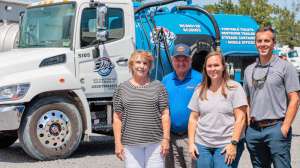
Family ownership has been a major selling point for the company, and has helped attract and retain new employees, Anderson says.
“The ace up our sleeve is we’re family-run and our employees like the fact that we’re family run,” he notes. “I can’t tell you how many employees have come to us looking for jobs because of that or how many have left to work somewhere else and then came back.
“It also helps that our employees see us get into trucks and make
deliveries,” he adds. “We’re not just sitting in an office. … We don’t ask our employees to do anything that we wouldn’t do ourselves.”
Furthermore, the company actively seeks out new ideas from employees. At annual end-of-the-year planning meetings, for example, Anderson will ask everyone present what they would do if they had a blank check to improve the business.
“It really encourages out-of-the-box thinking,” he says. “Sometimes you get so tied into running the business that you don’t have time to stop and think about what you really need.”
Great family relations also paved the way for growth. The company was established as Handy House in 1967 by Anderson’s parents, Ray and Marguerite Anderson, and four of their seven sons — William (now retired), Bob, John and Eric — worked at the company and eventually became co-owners.
“I can count on one hand the number of spats we’ve had,” he says. “We’ve always operated with the same philosophy: If everyone doesn’t say yes to something, we step back and discuss it further — or we don’t do it at all.”
SUCCESSION PLANS
Anderson never planned on a career in the portable sanitation industry. He was intent on going to college to study advertising. But then he met his wife, Betty Ann, and decided to stay at home and work in the family business.
Now age 60, Anderson plans to retire in January 2023. And he’s confident the family business will continue to thrive, thanks to a succession plan that properly incentivizes the next generation of ownership.
“My younger brother John may retire soon, too,” he says. “And Woody Donnelly basically is already at the helm. When we retire, we sell our shares back to the corporation in phases.
“In corporate America these days, the third generation usually runs the business into the ground,” he continues. “To avoid that, our next generation has that carrot — accumulation of shares of stock — at the end of the stick. They see what we have and they want that, which hopefully motivates them to keep investing in the company and running it profitably so they can get those shares of stock.
“We’re super proud of what we’ve built,” he concludes. “My dad was the proudest peacock in the land and I feel the same way. It’s been a really fun ride.”