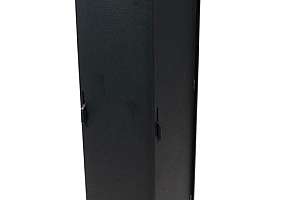
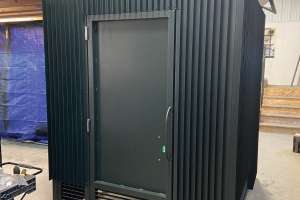
The interior of the first Portland, Maine restrooms utilize holding tanks from Satellite Industries.

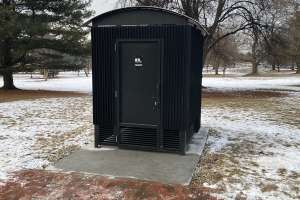
One of the first units was bolted to a concrete slab in a park.

A new metal restroom is ready to install in Portland, Maine.

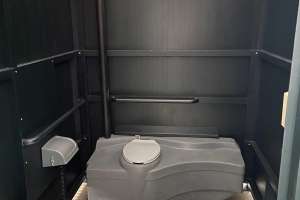
The interior of the first Portland, Maine restrooms utilize holding tanks from Satellite Industries.
One of the first units was bolted to a concrete slab in a park.
A new metal restroom is ready to install in Portland, Maine.
You don’t really buy beer — you rent it.
And that’s a good argument for improving restroom access in the popular Atlantic Coast city of Portland, Maine, according to Cary Tyson, executive director of Portland Downtown, a nonprofit that promotes city development.
“We are a tremendous craft beer city and have the most craft breweries per capita in the country,” Tyson says, noting there the number of local beermakers numbers in the hundreds. “You can’t be a great craft beer city without restrooms. Ultimately with beer, you only rent it.”
Access to public restrooms became a major issue during the COVID-19 pandemic, when most of the established bathrooms closed in places like City Hall, the library and at restaurants and retail establishments. In fact, Portland Downtown counted only three remaining public bathrooms in the city center during the pandemic.
Local leaders have developed a multipronged approach to the problem of limited bathroom facilities — and portable restrooms and restroom providers have been and will remain a part of the solution. Working with provider Troiano Waste Services, of South Portland, the city maintains 20-30 standard portable restrooms placed in parks and other strategic locations to serve the public, says Alex Marshall, director of parks, recreation and facilities for the city of about 70,000 on the southern end of the expansive northeast state.
Like many urban centers, Portland leaders have found that traditional plastic restrooms — though exceedingly practical — are not the complete answer to sanitation needs. Both Marshall and Tyson say they receive complaints from residents and business owners who don’t like the plastic units dropped in busy areas where they can be seen. They do also generate complaints about odors when units are not serviced regularly. And Tyson says there have been concerns over unhoused people who use the restrooms as a shield for drug use.
“This has prompted safety concerns. The units are not locked at night and people will go inside them. If they were locked, folks would get aggressive and try to break into them and you get a lot of vandalism,” Marshall explains. “They go in and shoot up and use drugs. There have been some overdoses.”
TIME FOR CHANGE
Especially for the downtown area, city officials are looking to try something new. They are exploring permanent plumbed outdoor restrooms like the all-aluminum Portland Loo (which was invented to solve similar problems on the West Coast's Portland, Oregon). These are self-contained rugged units now placed in parkways and sidewalks in several cities. The downside is cost, which Marshall explains is about $250,000 per Loo.
Marshall says the city has found another solution that falls somewhere between the economical cost of its portable sanitation contracts and buying something like the Portland Loo. It is dedicating part of $600,000 in American Rescue Plan funds to construct several all-aluminum units that incorporate some of the safety and cleaning features of the more permanent facilities, but utilize a holding tank that is pumped out by Troiano Waste Services along with the standard restrooms.
The city worked with DSO Creative Fabrication, in Saco, Maine, to design and build the new units. The company delivered the first three a few months ago and is in the process of building three more after making some changes based on the city’s early experience. The first units have come at a cost of $20,000 to $25,000 each.
The new restroom is all metal in construction, with wall panels, louvers near the top and bottom that allow for ventilation and to see if a person or persons is inside. They are built to Americans with Disabilities Act standards with a 65-inch turning radius for wheelchairs. The first units include 68-gallon holding tanks and some accessories produced by Satellite Industries. They are bolted onto poured concrete slabs. They also are fitted with solar lighting and motion sensors.
So far the units have been deemed a success, Marshall says, but there is constant tweaking in the works. First, the holding tanks have proven too small for the application, so DSO is going to fabricate 130-gallon aluminum tanks that will not require daily pumping. Also, users are kicking and damaging some of the lower louvers, so they are going to be built to a sturdier spec. Also, the city is looking for more rugged components like paper holders and hand sanitizers, as well as using a stouter door closing design to prevent damage from the wind.
KEEPIN’ IT CLEAN
The local PRO will remain an integral part of the process as the city adds the new units. Marshall said there will always be a place for portable restrooms in many parks, ballfields and in front of sports facilities. Troiano pumps the new units on their routes servicing the standard restrooms. In addition to the routine service, the city has 1.5 staff positions responsible for monitoring and cleaning (but not pumping) all of these restrooms on a daily or even twice-daily basis. Troiano also pumps two 1,000-gallon vault toilets at parks.
“The goal with these units is to make them safe for folks to use and that they can withstand abuse and be aesthetically pleasing, and fit into our historical locations,” Marshall said of the new restrooms.
Troiano has been responsive in handling the pumping and the city has not considered buying its own vacuum truck to service restrooms, Marshall says. The PRO has been a good partner in working with the city on the best placement for restrooms, always considering safety and security and allowing for effective monitoring of units by police.
Though the standard portable restrooms are kept clean and in good condition, it’s been an uphill battle to gain widespread acceptance for them in many parts of the city, Marshall says. PROs are used to negative reactions for some placements, so we all understand.
“They’ve developed such a stigma over the years and it’s kind of hard to break it,” he says. “But we have many different uses for them and they are very practical. We will likely always have a need for them.”
MORE COLOR OPTIONS
Marshall and Tyson agreed on a few suggestions that would might make it easier for PROs to place restrooms in urban areas and historic and entertainment districts. First, they say users would like roomier restrooms where they don’t feel as closed in or have to touch inside walls. Think handicap or ADA-compliant units for these municipal customers.
And they also said looking at offering units in different colors that would either blend in or stand out as needed by the customers. Tyson also suggested artistic wraps or creatively painted or decorated units would be a nice option to offer when units are placed in an arts and entertainment district.
The need for more sanitation in general is a goal of Portland Downtown. Tyson explains. The city’s near-term goal is that pedestrians will find a public restroom in a minimum five-minute walk from wherever they are. In the future, they’d like to cut that to 2-3 minutes. In a fantasy world, officials could offer an interactive online map linking people to restrooms wherever they are in the city, Tyson says.
“In a downtown where visitors double or triple the population in summer, we want to have a more permanent solution,” he says. “I’ve learned more about portable restrooms than I ever thought I would.”
And in the spirit of the craft beer capital of the Northeast, I’ll drink to that!
Continue reading for free