In spring 2020, Brian Labrie called a portable restroom company to rent a unit while his septic system was being repaired. Before the call was over, he made the decision to get into the portable sanitation business. As the owner of several businesses, he knew an opportunity when he saw one and could see it would fit well into his 30-year-old landscaping business.
He wasted no time. His next call was to his wife Kerry who quickly signed off on the idea. Then he called PolyJohn and bought 100 units, and finally Robinson Vacuum Tanks to order two vacuum trucks. A month later, on June 23, Drop One Portables was in business.
“Owning and starting a company was nothing new to me,” Brian says. “It was a bit newer to Kerry who had never started a business from the ground floor where you file for your Tax ID, set up bank accounts, hire employees. So, she was a witness to all that as we went through it.”
What Kerry did have was 20 years of sales and customer experience so she makes sure service is the foundation of everything the company does, from how the phones are answered to how the units are maintained. Working in the landscaping industry, Brian says he was familiar with portable restrooms on job sites and knew how everything worked mechanically but had to figure out the business aspects — pricing, marketing, service procedures, government regulations.
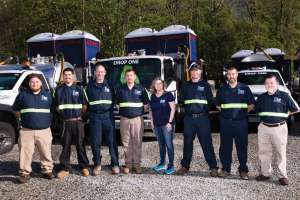
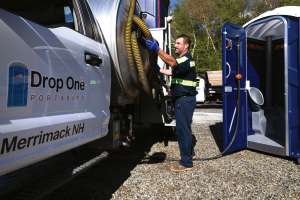
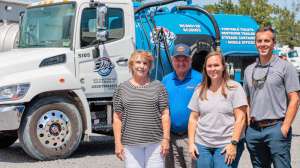
The company is located in Merrimack, New Hampshire. Kerry oversees office functions and handles phone answering, bookkeeping and sales, while also holding down a full-time job with Sysco Food Service. Her uncle, Mike Fritschy, manages inventory and purchasing; Brian’s aunt, Laurie Labrie, does the marketing; and Jane Schofield is their accountant and financial planner. They have six service technicians — field supervisor and mechanic Joe Fritschy (Kerry’s brother), Lenny Coleman, Ryan Larocque, Zachary Clegg-Marrama, Paul Drone and Mike Shultz.
GROWING FAST
The company started out at the landscaping office but several months later moved down the road a few miles to accommodate the growing inventory. They’re now outgrowing that location and considering another move. But Brian says prices have gotten a little crazy during the pandemic so he’ll probably wait until the market calms down. “We’re busting at the seams but we’re in a holding pattern,” he says.
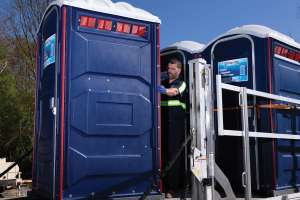
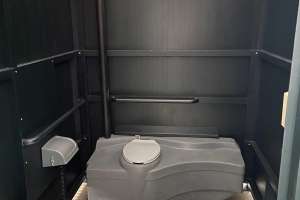
The company’s inventory now stands at 500 PJN3 standard units, 50 Comfort XL wheelchair-accessible units, and 50 hand-wash stations, all from PolyJohn. All units are supplied with proprietary industrial foam hand sanitizer. They chose their colors purposefully. “We are very patriotic, regardless of political affiliation,” Brian says. “So we asked PolyJohn to design and build us red, white and blue units that are unique.” Unit bodies are navy blue, roofs are white, and a red pinstripe runs down the sides.
The company generally works within a 50-mile radius but will go anywhere in the state for customers who don’t need weekly servicing. About 15 miles to the south is Massachusetts but they don’t cross the border. “The regulations to run in Massachusetts are very different than New Hampshire,” Brian explains. “In New Hampshire, you buy one state permit and you’re good to go. When you move over the border you have to deal with every town individually. It’s just a lot of paperwork and hassle.”
THE SERVICE FLEET
The company’s five vacuum trucks were all built out by Robinson with aluminum tanks and Fruitland pumps — 2022 and 2021 Isuzu NPR HDs with 300-gallon waste/150-gallon freshwater tanks, 2020 and 2019 Ford F‑550 XLs with 600-gallon waste/300-gallon freshwater tanks, and a 2012 Chevrolet 3500 Silverado with a 400-gallon waste/200-gallon freshwater tank. Their delivery truck, a 2013 International MaxxForce DuraStar, is a 10-unit carrier with a rack body. Their two flatbed trailers (8-place and 12-place) are from
Big Tex Trailers.
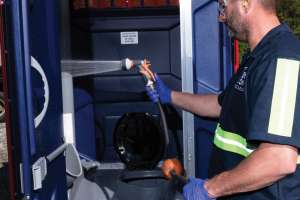
Technicians operate off of a 10-point checklist which includes everything from washdown procedures to making sure everything is working properly. They use deodorant products from PolyJohn. Waste is taken to a treatment plant in Allenstown, 15 miles away.
Northeast winters are challenging for the company and special precautions have to be taken, Brian says. The trucks must be stored in heated garages to avoid freezing. For the portable restrooms, they’ve come up with a proprietary biodegradable antifreeze blend to put in the tanks.
“We are extremely environmentally friendly,” Brian says, “So, although it doesn’t work perfectly, it helps us to at least maintain the units throughout the winter. Coming from the landscape business, I do work with the New Hampshire Department of Environmental Services, so I’m very aware of what chemicals do to the world around us.”
DAILY SCHEDULE
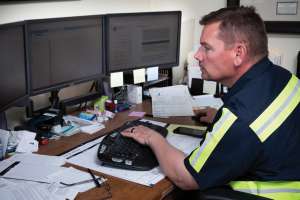
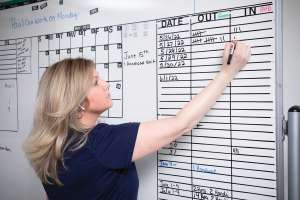
Brian is usually out of the house by 4 a.m. to prepare for the day. He gets the guys going then shuttles between the landscape business and Drop One. Meetings are held most mornings to go over issues or procedures, either one on one or with the whole crew. There is lots of communication during the day with everyone. Drivers use a routing program and service sheets supported by Google Maps and Excel spreadsheets, designed with the help of a couple of local computer programmers.
Kerry heads to the office after putting in a full day at Sysco. As a result of their schedules, she and Brian rely heavily on their employees. Three of their technicians came over from the landscaping company and enjoy the less physically demanding nature of the sanitation business. The couple also taps the landscaping company when they need extra hands for a project.
“Landscaping is viewed by Drop One as the AAA minor leagues of baseball,” Brian says. “We have plenty of employees to pick from if Kerry needs them. It’s worked out very well and helps a ton.”
Initial customers came from the landscaping business, which also provides a foot in the door for their construction work. They gradually moved into the event market, which now accounts for about 40% of their work — weddings, school activities, foot races, fairs, fall festivals.
COVID has been responsible for some of their work. Ice cream and farm stands that in the past allowed customers to use inside restrooms now want customers to stay outside. That’s also the case with private home gatherings, more of which are now held outdoors.
“Folks just don’t want people in their bathrooms, especially if they have people who are compromised health-wise, and they’re willing to spend a few hundred bucks to get a nice unit,” Brian says.
CUSTOMER CARE
Although Kerry works another job, she’s determined to be the face of the company. She handles most of the phone calls and customer contact. “I just think having the connection with the owner helps to build that relationship,” she says. “We’re not a huge company where customers are dealing with multiple people. I think it’s a huge part of our success.”
Contracts are simple and easy to read. “We are very transparent,” Kerry says. “When I give someone a quote, it’s the full price. It’s not broken down by cleaning, sanitizer, waste removal.” She doesn’t want customers to get progressively more upset as they see an initial number escalate with additional line items. Requests are responded to quickly.
“I always set the expectation that I’ll definitely get a unit to them by tomorrow. But I will try to get it out that day,” she says. “That way I didn’t overpromise, I overdelivered.”
Kerry makes a point of listening to customers and incorporating their comments into business practices, whether it’s a suggestion, a request or a complaint. When they can’t fill a request, the company refers the work to one of their friendly competitors, who does the same for them. But when that happens, they also think about whether they should make some changes, as, for example, when they couldn’t fulfill a request for 150 units needed for a race.
“We learned we need to keep an inventory of dedicated units to fill these events,” Brian says. “That’s a costly endeavor — to keep a bullpen of units that you do not release to the general public and only use for events. But the events are very important to us.” On the other hand, they’ve had requests for restroom trailers but don’t yet feel there’s enough demand to justify the cost.
As for the future, Brian hopes to add 200 to 300 units a year over the next 10 years and ultimately phase out divisions of the landscaping business. And Kerry will eventually leave Sysco and concentrate on Drop One, ensuring the growth they’re planning does not come at the expense of service levels and keeping customers happy.