When PRO first wrote about POTCO in 2007, owner Bobby Little Bear described the logistics involved in providing portable sanitation for a festival on top of a 367-foot mesa near
Grants, New Mexico, as well as year-round units for mesa residents. She and her husband Jeffrey Fink had been in business only a few years, having left a busy life near Washington, D.C., where she worked as an art director, and wanting to raise their daughter Josclyn in a small town.
The following year the recession hit, construction work dried up, and the couple got a taste of what a rollercoaster ride they were on. Over the years, industries have come and gone, weather and terrain issues have challenged them, and a worldwide pandemic threw a wrench into everything.
But Little Bear and Fink have learned to take it all in stride and trust that everything will work out. “I have to find the silver lining no matter what happens,” Little Bear says.
COMPANY ASSETS
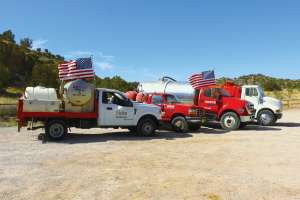
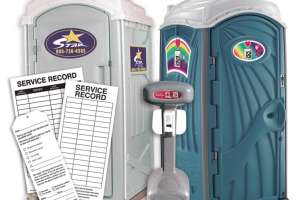
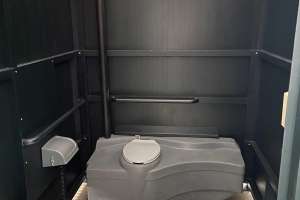
The company has 250 Satellite Industries portable restrooms, 24 EndureQuest hand-wash stations, and 12 220-gallon and 250-gallon Satellite holding tanks. Vacuum trucks include a 2007 Ford F‑750 built out by West-Mark (Certified Stainless Service) with a 2,200-gallon waste/300-gallon freshwater aluminum tank; two Ford F-350s, the latest built out by Best Enterprises with 600-gallon waste/125-gallon freshwater steel tanks, and a 1998 International from Progress Tank with a 2,200-gallon steel tank. All have Masport pumps.
They continue to use only environmentally safe products from J&J Portable Sanitation Products and Chempace, along with PureGreen24 disinfectant. They still store their equipment in an old carrot-packaging plant, but Little Bear now has the luxury of an office in the middle of town, away from the dirt and wind.
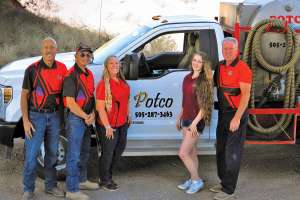
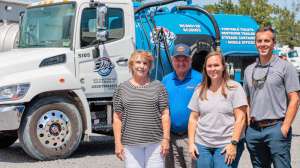
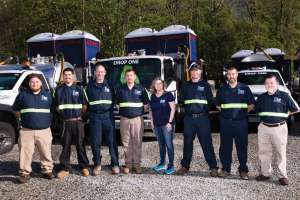
The team includes Patrick Gonzales (eight years) and James Bonnett (six years) who handle the portable restroom side, while Fink focuses on septic work. They are pros at working together on their schedules, seamlessly adding in new jobs and avoiding route backtracking. Constant communication is the key to making it all work, says Little Bear.
“The guys are absolutely amazing and we’re lucky to have them. We really are doing this as a team. We’re protective of our staff. They all know if the company does well they will do well. We’re not millionaires, but this has been a good living for all of us.”
CUSTOMER CHALLENGES
The company works in an 80-mile radius of Grants (population 9,000), a high-desert town surrounded by the Cibola National Forest. Their clientele is diverse — Navajo, Zuni and Acoma Native American tribes; solar and wind farms; prisons; industrial plants; hunting camps; firefighting command stations; construction companies and event planners.
Many customers, whether in the mountains or on the desert floor, are reached only by dirt roads, often narrow. Drivers have difficulty accessing properties and are often without cellphone service in the more remote areas. The rough conditions take their toll on company trucks.
Being the only portable sanitation company in the area, they don’t need to advertise. So when their webmaster went out of business, they weren’t too concerned and just let the website go. But losing their email address when the internet service provider they’d had for 17 years shut down was a nightmare. “Luckily I caught wind of it and printed off my entire contact sheet,” Little Bear says. “It’s the only thing that saved me.”
A REVOLVING DOOR
When their first major construction job ended, Little Bear had a brief moment of panic. “We had everything new and shiny and branded, we were figuring out our identity, building our reputation, then that job ended and my first thought was, ‘Now what do we do?’ But, lo and behold, the next project opened up.”
That turned out to be a recurring theme. The mesa work ended, but then they got a call from an oil refinery. Now the refineries have closed — along with the power plant and coal mines — but there’s talk about a hydrogen plant, a glove plant, and cannabis growing facilities. The huge bike rally is gone but the 7 Trails of Gold ATV/four-wheeler event came in. When portable restroom work declined, septic work increased. “Over the past 20 years, the one thing I found is every time we lose something, something else comes up,” Little Bear says. “It always balances out.”
TRIAGE, COMMUNICATION AND EDUCATION
In 2007, septic was about 30% of the company’s work, but eventually grew to 50% — until the pandemic hit and then increased to 65% as sheltering-in-place taxed people’s aging systems.
“I was fielding five emergency calls every morning,” Little Bear says. “I had to get enough information from everybody to triage and figure out what grandma is home with the five grandkids. They had to go first. I had to triage for the health issues and make sure we did our part to help keep everybody safe.”
Not wanting to slight her maintenance customers, she was upfront with them about the situation, asking for their patience. For the first few months they worked seven days a week, eventually cutting back to six, and after two years they’re finally getting their weekends back.
Little Bear beefed up customer communication during COVID. Some customers didn’t want to be around people and were afraid to see them; others needed service and were afraid they wouldn’t see them. All were given assurances that, yes, they were still in business — they were considered essential workers — and yes, they worked in a manner that kept everyone safe.
“The guys were so courteous and careful being on people’s property and interacting with them, not upsetting anybody or getting anybody nervous,” Little Bear says.
Educating customers on their septic systems also became essential, says Little Bear. “I would literally say, ‘I’m going to annoy you right now but you need to hear this.’”
She sent out announcements describing the products they used and their cleaning and disinfecting process. The problems caused by wipes that people started using during the bathroom tissue shortage were so severe she changed her answering machine message to explain what should not go into a septic system — which
annoyed a few people, but most were glad to learn something they didn’t know.
GO WITH THE FLOW
The company no longer works on the mesa as composting sanitation facilities have been installed. Their daughter is now working her way toward becoming an orthopedic surgeon. And Little Bear finally has some time to continue teaching a few college classes and was recently accepted into graduate school in an advanced problem-solving program.
What hasn’t changed in the last 15 years is the company’s commitment to providing good service and being an asset to the community. “Our stuff is clean, it’s maintained,” says Little Bear. “If we say we’re going to be there we’re there, if there’s an emergency we show up. We have always bent over backwards. We’re here to be a resource for the community in any way we can, not just for the restrooms or the septics.”
The couple’s positive attitude and adaptability have gotten them through the ups and downs over the years.
“It seems to work out for us that when one door closes, another opens,”
Little Bear says. “And who knows what’s around the corner? You’ve just got to believe things are going to work out — and for 20 years now they have.”