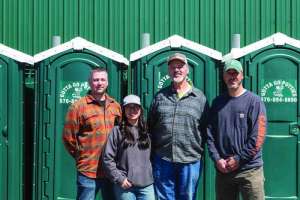
Bucky Potter graduated from Virginia’s Hampden-Sydney College in 2017 with an aim to start his own business. After researching a number of opportunities, he chose portable sanitation and launched Potter’s Potties that same year.
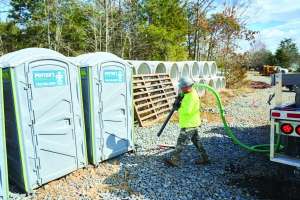
Beginning with just 28 restrooms and a single truck, the company now employs 18 people, and fields 1,500 restrooms, mostly from PolyJohn, with a few from Satellite Industries. Lang Specialty Trailers supplies three restroom trailers and A Restroom Trailer Company (ART Co.) supplies two. The company plans on buying an additional pair of trailers this year.
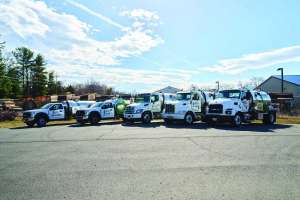
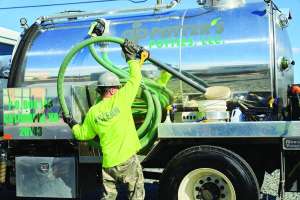
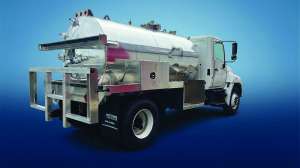
They’re serviced by 14 vacuum trucks with aluminum tanks and NVE pumps, all from Robinson Vacuum Tanks. A dozen of the trucks feature 1,500-gallon waste/500-gallon freshwater tanks — eight Hinos, three Peterbilts and a Mack. Two Ford F-550s from PortaLogix carry 800-gallon waste/350-gallon freshwater tanks.
The company serves five northern Virginia counties around its home base of Warrenton. About 70% of the company’s business comes from construction, with the remainder in long-term agricultural rentals and special events.
Potter’s brand stresses service, cleanliness and environmental responsibility. The company is devoted to recycling cardboard and other materials, and recently committed to cleaning up Rector Tract, a public park in Remington, Virginia.
“Our whole industry is based on ensuring the proper treatment of wastewater,” says Potter, 28. “Cleaning up a river in that park fit right into our philosophy.”
Although Potter’s Potties currently rents its facilities, the company recently purchased a 17-acre lot and is looking to rezone it with an eye to moving there permanently in a few years.
“With more space, we’re looking at the possibility of providing lateral services to our customer base,” Potter says.
EXPLORE FIVE ISSUES THAT AFFECT BUCKY’S PORTABLE SANITATION BUSINESS:
1. CHOOSING THE RIGHT MENTORS
Potter was inspired by two uncles who operate roll-off container businesses. “They’re both entrepreneurial people,” Potter says. “I watched them build successful businesses and I liked the way that this put them in control of their lives.”
Prior to graduating, Potter knew he wanted to enjoy those same benefits. He asked one uncle in Florida about potential entrepreneurial career paths and was introduced to his friend, Terry Powers, owner of portable restroom business T&S Professional Rentals, in Apopka, Florida. Powers invited him to visit for a few weeks to learn about the portable sanitation industry following his graduation.
“Terry put me in a truck with a service driver and let me sit in the office for a few days,” Potter says. “It helped me understand industry lingo and to learn things like operating a pump properly and how to handle my first clog. He also introduced me to suppliers he found reliable, including contacts at PolyJohn and Walex.”
Potter continues to network with local entrepreneurs, including Kristen Bush, owner of Johnny Blue in Winchester, Virginia. “I can give Kristen a call and ask her a question about winterizing the restrooms or anything else, knowing we share the same issues,” he says.
2. BUILDING A PERSONAL RELATIONSHIP WITH CLIENTS
Potter’s experience through his first year in business demonstrated the importance of building personal connections with his clients. “To begin with, every day that I wasn’t servicing those units, I was out trying to sell more service contracts,” he recalls. “I made a point of remembering the name of each new client, who they were and the conversation we had.”
Potter believes the early traction the company enjoyed was the result of personal connection, with the same person who priced each contract servicing the unit and taking full responsibility for it. “As we’ve grown, I’m not necessarily the person who completes the work, but it taught me an important lesson about building personal relationships in the industry,” he says.
3. DEBUNKING INDUSTRY STEREOTYPES
Potter is on a mission to demonstrate that the industry has evolved beyond stereotypes of the dirty portable restroom. “We’re no longer seeing companies providing old units covered with concrete that offered one of the worst experiences you had that day,” he says.
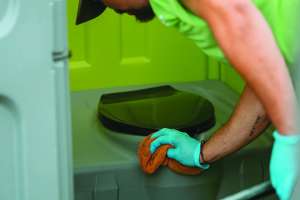
But Potter is pushing the envelope on the meaning of clean by advertising his restrooms as the freshest, cleanest and newest in the area — then living up to that promise. Employees even receive a “clean cash” monthly bonus for maintaining the units to a high standard, as determined by a random inspection of restrooms they service.
“When I send restrooms to a client, they’re all the same style and color instead of a mix and they’re spotless,” he says. “Customers have started to take notice and it’s become part of our brand.”
Potter notes that he even sends brand new units to construction site clients, instead of separating out older stock. “We don’t want to create two classes of restrooms,” he says. “Everybody deserves our best.”
4. SOURCING NEW VACUUM TRUCKS INSTEAD OF USED
When Potter launched Potter’s Potties he already owned a snow plow, and told his uncle about his plan to convert it into his primary service truck. “My uncle told me to stop right there,” he recalls. “He told me that the first time I promised a customer I’d be there in an hour and the truck wouldn’t start that my word and reputation would be out the window. I wouldn’t be considered reliable any longer.”
Potter took the advice to heart and purchased his first truck new, and has been doing that ever since. It’s not easy for the business to swallow the expense of buying new vehicles, but there’s more to the strategy than simple reliability. “Once you have your company name painted on that new vehicle, it’s going to light a fire under you and make you work a little harder,” he says. “So even if buying new hurts a bit, I will work hard enough until it doesn’t.”
5. PAYING EMPLOYEES A COMPETITIVE WAGE
Potter doesn’t believe that workers would rather sit at home and collect government checks than work for a living. Instead, he believes the market is more competitive because workers have more opportunities.
“Instead of carrying 50 pounds of mortar on their back in construction for $13 an hour, that same person can be driving a truck for Amazon at $19 an hour with full benefits,” he says. “Portable restroom businesses are competing against opportunities in the logistics sector for workers whose primary job is to drive a truck.”
Instead of losing out on hiring good workers, Potter decided it was time to not only offer more money to new hires, but also provide an incentive bonus to existing staff for finding new employees.
“Yes, increased labor costs will be charged back to the customer,” he says. “And you may have to have a difficult conversation with them about absorbing the price increases, but ultimately this is about better and more reliable service.”