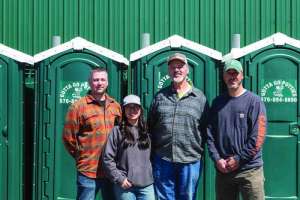
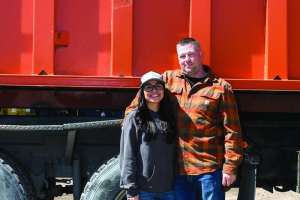
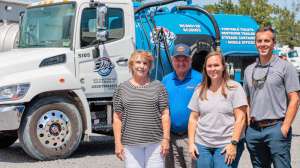
Their company, Gotta Go Potties, is located in Tobyhanna, Pennsylvania, in the Pocono Mountains. They work within a 60-mile radius and operate out of an 8,000-square-foot garage on a 25-acre lot. Eliana, an accountant, is the company’s controller and handles all the finances. McWilliams says the two of them blend well. “I’m always like, ‘Let’s do more and more!’ and she’s like, ‘Okay, if we’re going to do that, we need X, Y and Z.”
WORKING THE PLAN
Kevin McWilliams started the portable restroom business in 1994, growing it to 500 units. In 2004 son Jake McWilliams took over management of the business when his father bought a septic company. After a few years, he was ready to seriously grow the business and make it a sustainable occupation for himself and Eliana.
His first step was to take a job as a police officer working the night shift. “We had a plan — that I would keep working as much as I physically could so we could buy new equipment, get good drivers and make sure everything was paid as it should be,” he says.
Eliana also held a second job as an accountant. By 2016 she was able to quit and work full time for Gotta Go. A year later McWilliams did the same and the couple officially took over ownership of the portable restroom and excavation work, while Kevin broke off and kept the septic pumping business.
PLAIN AND SIMPLE
McWilliams likes to simplify things and keep everything organized for both customers and employees. Each of the companies has its own color scheme which appears on everything from file folders to equipment. They minimize the number of brands of equipment, vehicles and vendors they use.
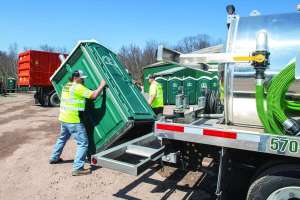
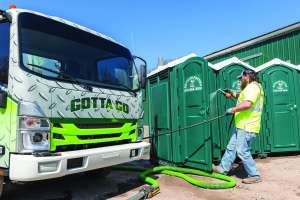
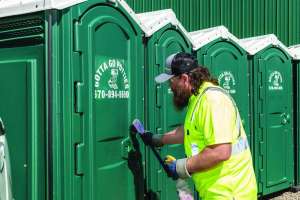
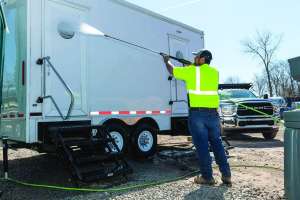
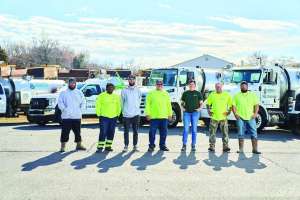
Hunter green is the color for portable sanitation. General manager Carlos Miranda oversees 15 technicians, while office manager Nancy Scalia and Christina McFadden-Serfass handle routing, dispatching, billing and phones. Their inventory (PolyJohn, Satellite Industries) includes 2,000 standard restrooms, 200 ADA-compliant units, and 120 hand-wash stations. They also have 14 restroom trailers (Rich Specialty Trailers) in sizes ranging from two to five stations.
The company has streamlined the ordering process with vendors. For example, when they need more restrooms or another pallet of Walex deodorant tabs, a quick text message is all it takes.
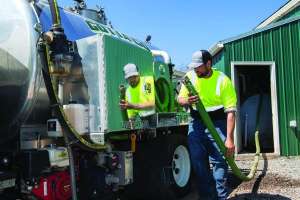
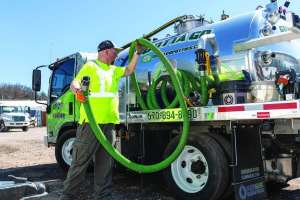
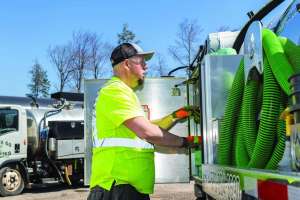
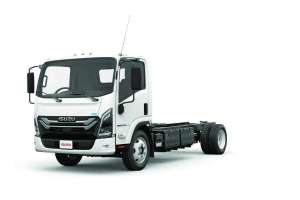
The company has 10 identical vacuum trucks — 2019-2022 Isuzus built out by FlowMark with 900-gallon waste/300-gallon freshwater aluminum tanks and Masport pumps. Their five transport trailers (Liquid Waste Industries) carry eight to 18 units. They also have an Avant loader. Linxup is their tracking software.
Safety orange is the color for the roll-off business, which employs office manager Candace Babiarz and four drivers. McWilliams purchased the business from a friend in May 2022. “I had wanted to do it for years but didn’t want to step on anyone’s toes and have to fight somebody I knew,” he says. They have four trucks (Volvo, Hino, Ford) and 90 roll-off containers, mostly from Custom Container Solutions, with SwapLoader USA hook lift hoists.
Lime green is the color for the excavation company, which employees two technicians along with “septic mound guru” Samantha Miranda. They install sand mounds, septic tanks, drainage ditches and driveways, and do lot clearing and minor foundation work. Here, again, they keep it simple.
“We do one job at a time,” McWilliams says. “We start it and finish it before going on to the next one so we’re not jumping all over the place.” Equipment includes Bobcat E35 and E50 excavators, a Bobcat C64 skid-steer, a Peterbilt tri-axle dump truck and a Dodge Ram 5500 dump truck with a mason dumpbody.
LOOKING FOR OPPORTUNITIES
When McWilliams sees other companies avoiding or pulling back on certain projects, he sees a door open. “Whatever other companies aren’t willing to do is what we are going to do,” he says.
“A lot of people lay off in the winter — we decided not to. People cut their advertising in the winter — we hammer down on it, pushing toward construction.” They try to buy at least one or two restroom trailers a year to upgrade product offerings. “People don’t mind paying more money when they’re getting a better product,” he says.
The company answers phones 24/7. He and Eliana personally answer them after hours. Drivers are on call on a rotating schedule to handle emergencies.
McWilliams says they should probably do more with social media but admits he has mixed feelings. “For big job sites, when they’re building a warehouse, I just don’t see the foreman sitting in a truck covered in mud looking at TikTok to see who he’s going to use for port-a-potties.”
A VARIETY OF WORK
About 65% of the company’s portable sanitation work is for construction projects. Other work includes long-term seasonal rentals at wineries, parks and schools; emergency situations such as power outages and water main breaks; and events which include everything from small family weddings to large festivals.
They especially like the large events where it’s all hands on deck from all three companies. With the addition of roll-offs, they’re now able to offer one-stop shopping for clients who need portable restrooms and trash service.
Celtic Fest is an especially fun event for the company. They bring in 175 units, which they service Friday and Saturday nights after the crowds leave. But they also do daytime servicing on Saturday.
“We bring in four to six trucks and clean all the units in about an hour and 15 minutes,” McWilliams says. “We go in and just bang it out so fast it’s crazy.” The best part is, they don’t just sneak in and unobtrusively take care of business. They are paraded in by security and a bunch of guys in kilts playing bagpipes.
EMPLOYEE RETENTION IS KEY
For the portable restroom side, employees are found through referrals and the Indeed website. “As long as someone is a good person, you can teach them the rest,” McWilliams says. “If they act like they don’t care and they’ve got a bad attitude, it doesn’t matter what the job is, it’s not going to work.”
Because McWilliams says he knew nothing about roll-offs when he got into that line of work, he did not recruit online but instead talked to people in the industry who pointed him in the direction of guys who were seasoned and knew what they were doing,
McWilliams says they do whatever they can do to make sure people are happy. Employees are always treated with respect, they’re well trained, have good equipment and get a lot of support.
“Retaining employees has been a huge contributor to our success,” he says, “because training new people all the time is just horrible, and having seasoned people is so valuable. We have a lot of guys who have been with us 10, 12 years. We have great employees.”
Benefits are also an important factor in discouraging people from jumping ship. In addition to good pay, insurance and a 401(k) plan, team members receive a gift card for their birthday, a gift card and a pie at Thanksgiving and a gift card and a honey-baked spiral ham at Christmas. They are given jeans, boots and hoodies. And the company buys a couple thousand T-shirts a year not only for the team but to occasionally pass out to customers — “little billboards,” McWilliams says.
WHEN THE WEATHER TURNS
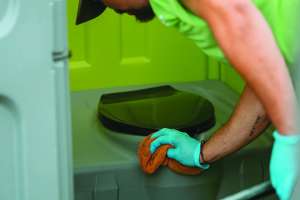
Winters in the Poconos are cold and snowy, but the company stays busy, mostly with construction and emergency work. Trucks are stored inside, rock salt is used in the units, and technicians go to four-day routes. The holidays they weren’t able to take in the summer are taken in the winter linked to Thanksgiving, Christmas and New Year’s. When work is slow they winterize trailers, detail the trucks and polish the aluminum tanks.
Gotta Go hasn’t laid anyone off in the winter for eight or nine years. Doing layoffs is a dangerous game, McWilliams says.
“You could make a business smaller in a weekend — lay off the guys and sell the equipment — but it’s so much harder to get bigger again. It could take years to get back to where we were. I’d rather pay people to come into the shop and clean their truck for a day than lay them off and then hope they come back in the spring,” he says. “It’s worth every penny to have them there all winter.”
Winter is also a time for planning, McWilliams says, “In the winter, you have to figure out how many units you’re going to need for the summer events. And when winter’s coming, you have to get ready in the summer. If you’re not doing that, you’re done.”
ALWAYS PLANNING
McWilliams says one of his challenges is learning when to say no. “It’s hard,” he says, “because you always want the work but it’s not always worth it. You can’t make everybody happy.”
He says one of the best things about this type of business is there’s always a demand for it.
“You can be as busy or as slow as you want,” he says. “There are so many different things you can get into — start with a portable restroom, get a trailer, pump out septics, install systems, put a driveway in, take care of garbage. When you do something nobody else wants to do, and you do it the right way, it’s endless.”
Planning is still the foundation of the company. “We plan and over plan,” McWilliams says. “We have plan A, B and C at all times.”