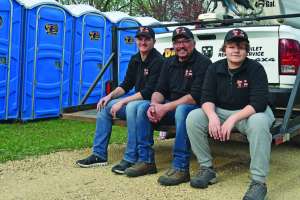
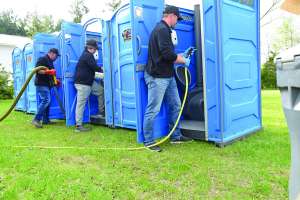
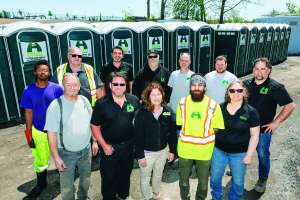
Stacey Nelson has served as captain, officer corps and crew of Drop Zone Septic & Portables in Eau Claire, Wisconsin, since he bought out a business with 25 restrooms in 2018.
Nelson, 48, still prefers working alone and answering the company phone himself, even after boosting his inventory to nearly 300 restrooms this spring. His only concessions to outside help are hiring out the company’s billing and bookkeeping chores, and enlisting his sons, Dustin, 28, and Carter, 13, as needed.
“I get lots of compliments from customers for answering my own phone,” Nelson says. “They like talking to the owner. They know I’ll answer their questions now, not tomorrow. It works for me, too. I don’t have to worry about workers taking out their bad day on a customer just for double-checking that we’ve got them scheduled.”
Nelson’s phone rang, beeped and buzzed more than usual in mid-January as he watched a hunting show on TV. Friends, family and complete strangers near and far were calling, sending texts and sending emails, asking how his company became a $1,000 answer on the TV game show Celebrity Jeopardy! airing on Jan. 16.
Under the category, “Yup. It’s a Port-a-Potty,” the final answer in that row read: “Based in Eau Claire, Wisconsin, this port-a-potty company shares its name with the target where a skydiver lands.”
Nelson never learned how Jeopardy! came to use his company’s name for that answer, but he knows it boosted business.
“Whenever I talk to new customers, I ask how they found us,” he says. “Was it Facebook, my website, word-of-mouth or maybe seeing our name on a toilet? When I ask that question now, lots of callers say they saw our name on Jeopardy! You can’t beat free national advertising like that.”
No matter the job or how he lands it, Nelson prides himself on buying and using the right equipment to work reliably and efficiently. And to help Nelson track and assess his expenses and efficiencies, his bookkeeper monitors what each restroom earns. Nelson won’t buy “newer and better” equipment unless he expects it to improve or maintain those averages.
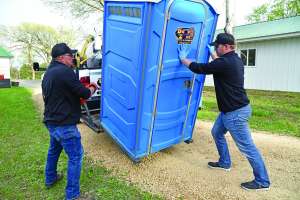
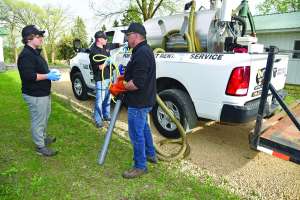
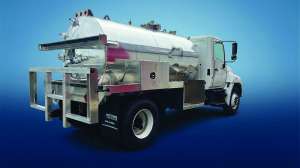
For instance, eight years into his business, Nelson still relies on his 2014 Dodge Ram 2500 service truck with a slide-in unit. This rig features a Conde pump (Westmoor Ltd.) and 300-gallon waste/150-gallon freshwater stainless steel tank from Imperial Industries. Nelson said this compact setup and four-wheel-drive pickup helps him get around tight, icy or muddy construction sites, which make up much of his year-round work across west-central Wisconsin. The truck can also carry two restrooms on its rear rack, and easily pull Nelson’s 10-unit or 12-unit self-built transport trailers for bigger jobs.
Most Drop Zone units are blue, and the inventory is mostly PolyJohn PJN3s, with about 40 Satellite Industries Global models and other single units that Nelson picks up along the way. He also enjoys easy access to two nearby dump stations, so he can conveniently make two or more trips with the pickup truck and slide-in unit. Even so, he plans to buy a full-size vacuum truck this year to handle his increasingly large jobs.
Nelson’s other equipment includes a CASE 1840 skid-steer for loading and unloading equipment around his yard; and a Polaris Ranger side-by-side UTV for working large summer events when he camps onsite. “I work county fairs and music festivals, and sometimes I need to buzz up there to restock supplies, haul in a unit or two, or keep an eye on things,” he says.
FIVE THINGS TO KNOW ABOUT DROP ZONE SEPTIC & PORTABLES
1. His family has industry roots
Nelson learned his prudent, methodical business approach by watching family members work in the septic service trade during his youth. His grandfather, Jerry Pfund, owned a septic business from 1981 through 2009. Jeff Pfund then bought out his father and ran the business until selling it in 2023. Nelson’s business included septic work when he bought it in 2018, but he sold that equipment to avoid competing with his uncle.
“I helped my grandpa all the time while I was growing up,” Nelson says. “I always wanted to be in this business. I had hoped to eventually buy out my uncle and merge his business with mine, but the timeline didn’t work out.”
Will Nelson’s sons extend the family trade to four straight generations? “My oldest son shows interest in the company, so it’s possible,” Nelson says.
2. Customers prefer lighted restrooms
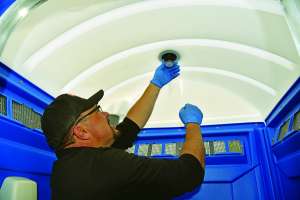
As daylight fades on a work site or outdoor party, visitors are pleasantly surprised when stepping into a Drop Zone restroom and triggering its overhead light. Nelson installs 40- to 45-lumen motion-activated solar lights like the J-Light from J&J Portable Sanitation Products in each unit, and makes sure his customers know about it.
“Customers have no problem paying a little extra for those lights,” Nelson says. “Most people only use a portable toilet two or three times a year and don’t really know their interiors, especially at night. They’re more comfortable when they can see everything. The light won’t turn off until there’s no motion for 45 seconds.”
3. The Jeopardy! mention has legs
Months after Jeopardy! made Drop Zone famous, Nelson said he still receives congratulatory postcards from Texas, California and other states. Meanwhile, he regularly schedules requests from families and construction companies. “Total strangers call or write to congratulate me,” Nelson said. “People like the idea that a real business got mentioned like that on Jeopardy! The feedback was crazy at first, but now it comes in streaks maybe every two or three weeks. I hear from a lot of people once, but I haven’t heard from any strangers a second time.”
4. What’s in a name?
Some customers assume Nelson named his company “Drop Zone” to make light of the service he provides. They’re wrong, however. When he was younger, Nelson raised homing pigeons and often released them from distant sites like Minneapolis, 90 miles to the west. When homing pigeons return home, they often arrive in a small group called a “drop,” and soon retreat into their loft to rest. Nelson named his pigeons’ loft the “Drop Zone,” and simply transferred the name to his business.
5. Squirrel dogs provide slow-season fun
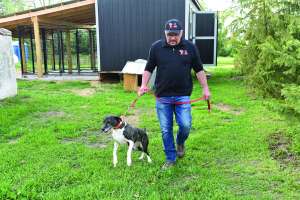
As autumn ends and daylight fades sooner each afternoon, Nelson’s work hours become shorter and more predictable. That downturn coincides with his favorite hobby and activity: hunting squirrels with his three mountain curs — Elvis, Duke and Juice — a breed of tracking dog with good treeing instincts that make them ideal for squirrels by day and raccoons by night.
Nelson was already a serious raccoon hunter in 1992 when his uncle Ardeen Pfund brought home the family’s first mountain cur when Nelson was 16. Nelson respected how mountain curs patiently hunt within short range of hunters, rather than ranging out 600 yards like many trailing hounds while hunting bears, bobcats, coyotes and raccoons.
“I’ve had quite a few hunting dogs over the years, but I always go back to the mountain cur,” Nelson says. “They’re versatile dogs, but they’re really good for hunting squirrels. I’ve hunted with them near home, and in Ohio, Iowa, Illinois, Minnesota and Tennessee. Squirrel hunting is a lot of fun, and you don’t have to stay up all night like we do when hunting raccoons.
“That’s another advantage of working alone. I can juggle my schedule a little bit easier so I can take my dogs hunting. But the work must still come first. You have to get things done. But I usually have a little more time in winter to go hunting with my dogs.”