After 32 years of working as an electrician, Dino Collini was looking for a new challenge as a business owner. A friend who worked for an investment firm suggested HALCO Portables, a Welland, Ontario, company that provided portable restroom rentals and services, but also built its own units.
“Once you’re a construction guy, you’re always a builder,” Collini says. “I liked that we were building as well as providing rentals and I wanted to see how far we could push the envelope on construction and design. We wanted to make them easy to maintain and efficient to repair, so that we could profitably extend their service life.”
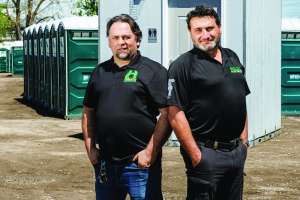
He and several silent partners purchased the company in 2017 and Collini, 60, made the transition from employee to employer.
HALCO was founded by Bob Halcovitch in 1997. The former owner specialized in heated, self-contained restroom units which he manufactured on site. Intending to retire, he included three vacuum trucks, a handful of pickup trucks, 80 self-built restrooms and about 300 plastic restroom units in the sale.
MAKING AN IMPRESSION
Collini’s first order of business was to upgrade the premises and choose a unified gray color for all of the company’s self-built restrooms.
“You want to shake the image of a rural restroom outfit with a barn for an office and an electric wire spool for a desk,” he says. “I invested a lot of time and pride in improving the infrastructure of the property because it convinces customers you mean business and attracts better employees.”
Collini hired Kevin Dyson in 2018, following a 20-year career as a manager at Sears, which was closing its retail outlets.
“I no longer wanted to work nights and weekends,” says Dyson, 45. “I went to one of those employment places and told them I didn’t care what the job was, I just wanted to work regular hours. The guy came back and said there’s a portable restroom company looking for an office assistant.”
Dyson applied his management experience at HALCO and began to find efficiencies in the business, as well as handle sales calls. A year later, he was promoted to general manager.
BUILDING THEIR OWN
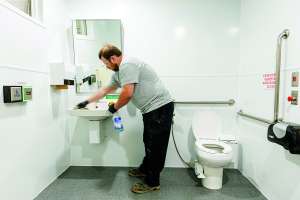
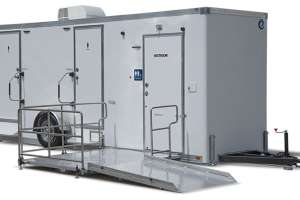
The company describes its fully-plumbed, self-built units as a “washroom in a box.” Built using wood construction, they range from small single-toilet washrooms to triple-toilet models. Among the current offerings are single-toilet units designed to be moved by crane, single and double washrooms for weddings, and barrier-free models. Using the same basic construction, HALCO also offers portable lunchrooms, sheds and offices.
“We can offer them on skids or trailers and put whatever you want inside,” Dyson says. “You want a shower, we can do that. Right now, demand is so great that we’ve got rental contracts in place for some units as we’re building them.”
The largest purpose-built unit covers a footprint of about 10 by 12 feet. Although the company has been asked about six-unit trailers, Dyson says these models would become too heavy and expensive if they were built to the same specifications.
“We don’t want to build lighter and cheaper, so that when someone backs into it there’s a big hole in the wall,” he says. “We want this stuff to last forever. I think we’ve got one unit going on 25 years.”
Dyson and Collini spent much of the early years improving the design of the company’s self-built portable restroom line. “If something is failing, we want to fix the design permanently so it doesn’t happen ever again,” Dyson says.
He recalls at one time the maintenance room was filled with leaking poly water supply tanks that had been removed from the units over the years.
TWEAKING THE DESIGN
“We discovered that in the original design, the brackets holding the tanks were mounted too high,” he says. “There were a good 12 inches at the bottom where the weight of the water was bulging the tanks out and eventually causing a leak. The simple fix was to move the steel bracket to the bottom of the tank. We haven’t replaced a tank on any of those units since.”
HALCO also replaced the brass bolts fixing toilets to the floor of the units with a stainless steel assembly that also provided a tighter connection to the waste tank underneath the floor.
“Nine out of 10 times, leaks on these units were caused by a brass bolt breaking,” he says. “The new system holds the tank flat to the floor and the new bolts never break. As we replace the hardware, service calls for leaking toilets are slowly disappearing.”
HALCO replaced porous, nonskid flooring on the units with a material that was easier to clean, topped by a nonskid mat. Instead of spending a half-hour cleaning floors, the service crew now switches out the mat and gives the floors a swipe with a damp mop.
While the company continues to develop its own portable restrooms, demand for traditional plastic units has continued.
“We have full confidence in our manufactured products, but we were able to grow out the business faster on plastic rentals,” Dyson says. “When customers are renting these units over and over, we’re happy to provide them.”
MORE POLY UNITS
The company has rapidly ramped up its rental stock, currently having just under 1,600 portable restrooms, 90% from PolyJohn Canada; 60 PolyJohn Canada barrier-free models; and five luxury restroom trailers from Forest River Mobile Restrooms.
HALCO has built more than 300 of its self-contained units, available for sale or rental.
Deodorizers are supplied by Johnny’s Choice.
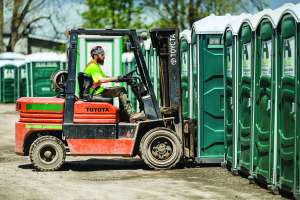
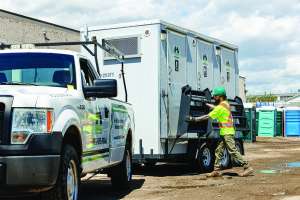
Portable restrooms are transported using three trailers — two 12-unit haulers by McKee Technologies and an eight-unit trailer built by HALCO.
In addition, HALCO offers 60 Bravo hand-wash stations from PolyJohn Canada.
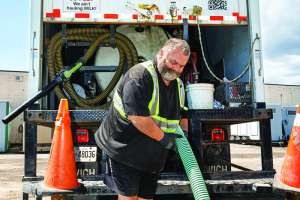
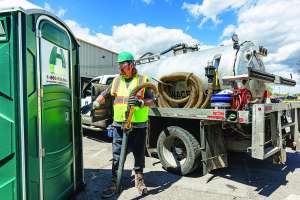
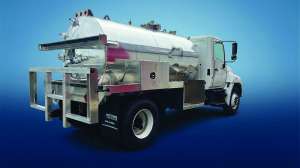
The company’s vacuum truck fleet are all Fords built out by Vacutrux, and feature steel tanks and Wallenstein pumps. Tank sizes range from 300 to 1,400 gallons waste and 150 to 600 gallons freshwater, and six delivery trucks are all Fords.
Dyson says choosing a straight inventory of Ford and Vacutrux products is all about promoting efficiency.
“We initially had a mix of truck manufacturers and pumping systems,” he says. “Some of the big trucks were just overkill and we sold them. We decided to pick a brand, pick a pump truck manufacturer and streamline everything. That way training is the same and our employees can jump from one truck to another. We have our own mechanic, so it’s also easier to stock parts and fix them faster.”
GROWTH STRATEGY
HALCO bought out Canadian Portable Services and its stock of PolyJohn units in 2020, largely as a cost-effective way to expand its portable restroom stock. The company continues to use the Canadian Portable brand. A year later, Collini bought out the portable restroom trailer sideline of a cleaning supply company, Clean Sweep.
“I was primarily interested in taking on their clients,” Collini says. “I rebranded the luxury trailer arm of our business as Platinum VIP, as a way to differentiate the luxury market from our construction restrooms.”
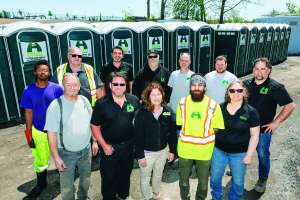
Today, the company employs 35 people, with a core of five workers generally employed in portable restroom construction and renovation. The service area has expanded significantly from the original Niagara Region. In 2023, the company established a satellite office in Brantford, a little more than an hour’s drive west. A small yard with a few trucks and 50 portables has allowed the company to expand its service area as far as London, 125 miles west of home base.
HALCO’s business is roughly 60% construction, 20% farms, orchards, wineries and events, and 15% municipal contracts such as parks. A niche market for the remaining contracts was developed during the COVID pandemic.
“When transfer trucks drove up to loading docks, they didn’t want drivers using the washrooms inside,” Dyson recalls. “These companies had never rented portable restrooms before, and they ultimately realized they didn’t want drivers to enter their buildings at any time. Most of those contracts have continued.”
HALCO’s biggest events have included the one-off 2024 solar eclipse, the Winona Peach Festival and New Year’s Eve at Niagara Falls, each requiring more than 100 units.
LOOKING AHEAD
On the horizon, HALCO is considering entry into water delivery and septic service when the time is right. The company is also ramping up its construction division to offer more of the units it builds for sale to clients and other service providers. Sales within its service area require customers to sign a three-year contract to service the units.
“We want the opportunity to demonstrate that these portable restrooms will perform well if they’re serviced properly,” he says.
Although Collini isn’t contemplating full retirement, he’s looking to reduce his involvement by age 65.
“I’m confident that Kevin can keep things moving as my eventual successor,” he says. “Sometimes I realize that this building and this company would have been gone if we weren’t here. Today it’s a livelihood for 35 people. It would be hard to retire from that.”