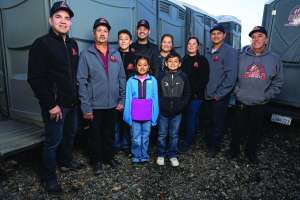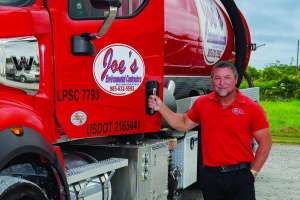

Chad Boudreaux wasn’t born with a silver spoon in his hand, but rather a hand-me-down rusty shovel.
Joe’s Septic Contractors began when Joe Boudreaux, Chad’s father, found a shovel and wheelbarrow in a junk pile, refurbished both and started a business of digging cesspools. After many years of growing business and demand, the shovel was upgraded to a 1954 Ford backhoe.
What that old shovel represented was passed on to Chad: hard work and dedication to the business. In 1993 when Chad left college to focus on the family business, he saw a need for portable restrooms in their service area. “The portable units were kind of a sideline for us,” Boudreaux says. “Installing sewage treatment facilities and cesspools were the main jobs. Now it’s totally reversed.
“The portable toilet part of the business has snowballed. The more porta-rent units you put out with your name on it, the more business that comes back to you.”
A segment of the market that Joe’s Septic practically owns is portable toilets for offshore oil work. The company has 300 of the special units. They are an all-aluminum design and sit within a custom-fabricated lifting frame for handling by crane or forklift. Boudreaux patented the design after talking to Shell and Chevron and other oil companies operating from Louisiana’s shore.
Along with the offshore oil work, Joe’s Septic markets and tackles a lot of work centered around disaster events. Boudreaux’s first real introduction to disaster recovery work was in 2005 when Hurricane Katrina slammed the coast. The Category 5 hurricane devastated the Gulf, and Boudreaux retains vivid memories of scenes across the region.
“We got hit pretty hard,” he says of his home and business in Cut Off, Louisiana, southwest of New Orleans. “But we went to St. Bernard Parish and it was like a bomb had hit the place. Houses were sitting on the highway. A vehicle was sticking out of the roof of a two-story house. It was like a movie. I thought, ‘How are we even going to go to work?’ It was one of my first disasters and — wow.”
He and his crew did go to work, however. It was a pretty intense, monthslong recovery effort that involved pumping sewage after lift stations failed and supplying portable toilets for encampments of storm survivors, plus a variety of other emergency responses. Then, five years later, a BP offshore oil drilling rig dubbed Deepwater Horizon exploded, sank and precipitated a historically disastrous spill of crude oil into the sea. Joe’s Septic had portable units and pumpers working on the beach with cleanup crews for over a year.

Five things that are different about servicing disaster areas:
1. The sense of urgency
When asked about servicing disasters compared to basic servicings like community events, Boudreaux says one of the biggest differences is urgency. “It gets chaotic in disasters. Basically, it’s … ‘How many portable toilet units can you get to me and how fast can you get them here?’ You’re constantly getting bombarded.”
In disastrous times, emotions overflow too. Consequently, someone in Boudreaux’s position must deal with public officials, community leaders and business executives, all of whom are trying to cope with disruption and, sometimes, with tragedy.
“What I have learned is not to overpromise,” he says. “When you’re younger, you’ll say yes to anything. I’ve learned you need to give whoever calls you an honest service schedule. Someone wants 200 toilets in one spot, you need to be honest with them about how long it will take to do that. We strive to provide excellent service, but I am not going to overpromise because you absolutely have to live up to whatever you say. I’ve learned to be totally honest. It goes a long way to keeping your sanity.”

2. A service range without borders
The company’s service area for disaster response is not the same as its day-to-day service. For disaster recovery, the company will respond no matter where the call comes from, anywhere in the country. After the Category 4 Hurricane Harvey pounded Houston, Texas in 2017, Joe’s had five toilet and washroom trailers positioned at the Astrodome.
Hurricane Laura, another Category 4 storm, swamped Lake Charles, Louisiana, in 2020 and for several months Joe’s had in position throughout the community temporary fencing, shower trailers, wash trailers, holding tanks and, of course, toilets. Hurricane Ian, still another Category 4 storm, hit Fort Myers, Florida in 2022, and Joe’s had seven trucks there pumping sewage day and night in lieu of pump stations.

3. A diversity of clientele
Who are Joe’s biggest clients after a storm or human-made hazard? “Bulk orders usually come from state or parish officials and also from power line companies like Entergy,” says Boudreaux. “But we still get a good fair share of commercial and residential property owners.”
Boudreaux observes that emergency situations are not all of the magnitude of a hurricane. They come in many sizes. “You would be surprised how many times we have delivered portable units to office buildings where the water has quit running or there’s a plumbing issue and they need a unit now.”

4. Expect increased damages to property
For many companies like Joe’s, being situated in disaster-prone areas are what bring them into the business. Because of that, assets are more susceptible to damage even when in the yard.
In 2021, it hit Cut Off with 228 mph winds, punching hard at the company itself. “We suffered damages and lost about 300 of our portable toilets,” Boudreaux recalls. “Within a week, we sent out every piece of equipment we had on inventory and had to sub out equipment for out-of-state companies to help meet the tremendous demand. We are still not back to 100% almost three years later.”
Disaster-stricken areas can create a challenge to navigate when delivering and serving toilets as well. Debris blown into roadways can damage vehicles. A little extra thought into making sure you have a plan to cover the costs and replace damaged property will pay in the end.
5. Inventory - toilets and people
“First thing, you have to have an inventory of, in our case, portable toilets and washrooms. You can’t rent out what you don’t have. You’ve got to keep up with the inventory. When we need extra people, we can go to a third-party company who in a single phone call can provide us with, say, 20 people. We keep our own people on call 24/7. We stay locked and loaded.”
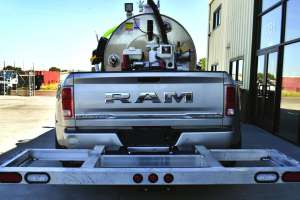
Today, Joe’s Septic Contractors has 2,000 portable toilets rented on any given day and another 2,000 in inventory. They all are the standard 35-40-gallon capacity. While the service mostly has grown organically, says Boudreaux, he also purchased two smaller competitors along the way to capture segments of the market.
Other portable sanitation units that Joe’s Septic markets for both disasters and outdoor gatherings include shower trailers, with six-shower/lavatory units in 20-foot-long trailers and 10 shower stall units in 30-foot trailers. Also available from Joe’s are restroom trailers ranging from one to 18 toilets, portable eye-washing stations and luxury air-conditioned restroom trailers — some of which include a TV and fireplace. While the company has used several brands of trailers, it relies heavily on Lang Specialty Trailers.
No matter what the immediate need is, Joe’s is ready to go. They have the people, the equipment, the restrooms and a business plan to accommodate and deliver
Continue reading for free