Question: As we begin a New Year, we would like some suggestions to encourage a higher rate of PPE usage in our company. Could you please help?
Answer: Personal Protective Equipment, while mandated by the Occupational Safety and Health Administration, monitored by health inspectors on job sites and managed by the company, depends on each company employee to be used effectively.
The basics of PPE for our industry, and the most common violations that are cited when not followed include the following:
1. Always wearing rubber gloves when using a hose for either pumping or disposing of waste.
2. Protective eyewear when servicing units as well as disposing of waste. In fact, in some areas, protective face shields are required when disposing of waste.
3. Steel-toed boots, preferable waterproof, should be worn at all times. Although not as obvious as failure to wear gloves or eye protection, boots prevent or minimize a significant number of safety incidents in our industry.
4. Hard hats, mandatory on all construction sites, and a situation in which the contractor can be cited as well as the PRO, are an extremely important piece of protective equipment.
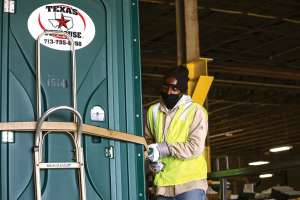
5. Reflective vests allow for the wearer to be more easily seen among the multitude of activities going on a job site or when the PRO is working in high traffic areas.
6. Other PPE as required by the customer such as hearing protection.
7. Not a specific PPE violation; however, in our “Age of COVID,” face masks where required by customers on their site, at their event, or in their place of business.
The goal of establishing a PPE usage strategy is to make employees feel comfortable wearing this safety equipment. A dear friend and a legend in our industry, Barry Gump, with Andy Gump Temporary Site Services, had a saying that is appropriate to this topic: “Are you a have to, a will or a want to? We need the want to’s.”
Discuss OSHA with employees
Provide background to your employees as to the importance and the history of OSHA. Convey the fact that this is a federal program and not a company program. As an entity in the U.S. Department of Labor, OSHA is responsible for assisting employers in “their responsibility for providing a safe and healthy workplace for their employees.”
Management and supervisors should become familiar with the “OSHA Personal Protective Equipment Guide.” Found at www.osha.gov, this manual provides a general overview of basic safety standards and equipment needed for compliance.
The Occupational Safety and Health Act of 1970 establishes four categories of safety concerns:
1. Eye and face protection
2. Head protection
3. Foot and leg protection
4. Head and arm protection
Present PPE equipment industry standards to employees
The PSAI Training and Certification Program, founded in 1992, has established the minimum PPE standards for portable sanitation:
1. Hard hats
2. Eye protection
3. Steel-toed boots – preferably waterproof
4. Waterproof gloves
The PSAI also established additional suggestions:
1. Reflective vests
2. Face shields
3. Face masks
4. Headlamps
5. Hearing protection
In the era of COVID-19, additional PPE should also include the following:
1. Disposable face masks
2. Plastic gloves
3. Hand sanitizer
4. Cleaning wipes
Employee participation is necessary
Are there other pieces of PPE you feel would be necessary in our company? Particularly where COVID is concerned, elicit employees’ thoughts and opinions.
Concerning the specific equipment itself, solicit employee input and feedback:
1. Is the PPE comfortable and easy to wear?
2. Are there better alternatives? Perhaps noise canceling headphones worn under a hard hat are more desirable than ear plugs.
3. Consider brands, colors and styles. Is certain equipment better fitted for female route service technicians?
4. Will the PPE be durable in your climate? Are there options that will not be as hot to wear on warm summer days?
5. Conduct wear trials where employees can give feedback about how certain pieces of PPE performed on the job.
If your employees assist in this process, they will have a personal stake and will more actively participate in wearing PPE when needed.
Conduct proper training
As part of the new employee training program, discussing and demonstrating the proper use and care of all PPE emphasizes the importance of all of this safety equipment. Often, PPE is not mentioned or discussed until on-the-job training begins. If properly wearing, cleaning and maintaining PPE is included with the basic job description, this responsibility has a greater impact on new employees.
Another tip is to not exclusively use the abbreviation PPE in meetings, training sessions or in conversations. Using the phrases “personal protective equipment,” “protective equipment” or “safety gear” is another method of emphasizing the importance of this concept.
Showing the proper use and fit of PPE should not only be reserved for new employee training but also for periodic reviews at company safety meetings.
Remind employees that once on the job site or at the customer’s location, their safety requirements must be followed. If any additional PPE is required, your company should purchase it for that job and this information should be properly documented if other drivers will service this site.
Convenience of PPE makes usage easier
Throughout the years, we have heard of many instances where employees did not use the necessary personal protective equipment:
1. “I couldn’t find it.”
2. “I could not easily get to it.”
3. “Some items were in the cab and some in the storage cabinets.”
4. “I haven’t used it in a while.”
5. “I know where it is on my truck, but I was using another truck today.”
The list goes on and on.
An excellent option we have found is to create a “PPE storage bag.” A personalized zippered gym bag is an ideal size to house a hard hat, a clear bag with safety goggles, a small bag with ear plugs, and separate bags for plastic gloves, rubber gloves and leather gloves. The zippered bag can be secured in the passenger seat with the seat belt, and it is convenient, consolidated, and not exposed to the weather.
More importantly, that gym bag is the property of that particular driver. The driver can have each piece of equipment adjusted to meet their needs. Each driver’s gym bag is easily transported from vehicle to vehicle. Since all the PPE is the responsibility of that employee, the motivation to keep it clean and in good repair is significantly higher that using “community equipment.”
Maintenance and cleaning
Management should ensure that proper supplies are available for cleaning all PPE items. Extra PPE should always be available for replacement when needed. The various procedures to clean and maintain these items should also be covered in the new employee training sessions and periodically reviewed in safety meetings.
Reminders
Safety signs with catchy slogans, pictures of safety equipment or progress charts showing numbers of days that are “incident free,” are excellent reminders that can be posted throughout the office and in the route service driver areas in particular.
Inspections
As with either random or scheduled truck inspections, PPE should be included as an item for evaluation. Ensure all the items are on hand, in good repair and clean. This is yet another method of stressing the importance of PPE.
Enforce policies
These policies and procedures are just as important as customer satisfaction, service quality and all other performance measurement.
FINAL THOUGHTS:
“Establish a culture of safety” is a phrase that we heard long ago, and it is pertinent today. By emphasizing the importance of safety while encouraging employee input and ownership, success is more easily attained.
Continue reading for free