I’d like to share some commentary about recent news stories involving the portable sanitation industry. As always, I welcome your thoughts on each of these stories. Drop me a line at editor@promonthly.com.
Fight the permit fees
A seemingly inconsequential government regulation proposed recently in an Ohio city could have a great impact on the portable sanitation industry — that is, if other communities jump on the bandwagon.
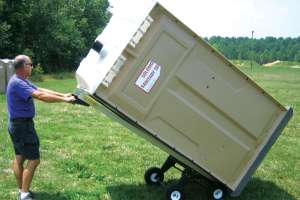
In Parma, a Cleveland suburb, officials received complaints about local residents renting their swimming pools out by the hour or day, similar to how homeowners rent out rooms for lodgers on the website Airbnb. And some of the complaints were triggered by the pool owners placing a portable restroom in their yards to serve the visiting swimmers.
A member of the city council objected to the pool rentals.
“The councilman wanted to regulate in residential neighborhoods the use of portable restrooms for these short-term rentals, and also wanted to clarify Parma’s short-term rental ordinance to disallow the short-term rental of swimming pools,” Tim Dobeck, Parma law director, told the news outlet Cleveland.com.
Part of an effort to discourage short-term rentals is a proposal to add a hefty $35 portable restroom permit fee to be paid by the homeowner. In the news story, city officials skirted the question about how broadly this fee should be applied to portable sanitation customers in general. However, they said response to the proposed fee has been positive.
Neighbor objections to the sight of portable restrooms, regrettably, is quite common for any number of uses, especially construction and remodeling or parties where residents want to provide extra facilities for visitors. I have to admit I’ve never understood those cases where restrooms — including those stationed in neighborhood parks — are called unsightly. They are typically clean, serviced regularly and placed only temporarily or seasonally. They are placed on site for a reason and provide an important sanitary service.
In this case, raising the specter of a restroom fee is a concern. It’s difficult enough as it is to convince customers of the importance of providing portable sanitation services. PROs tell me it’s challenging to sustain prices for their products and services that will ensure profitability and fair wages and benefits for their employees.
What impact will adding a $35 permit fee have on the industry encouraging adequate use of portable sanitation to protect public safety and the environment? It won’t make it any easier, I can assure you of that. Rather than throwing up financial roadblocks, local governments should be encouraging greater use of portable restrooms for the safety and comfort of the public.
Illegal dumping in Florida
We don’t need this kind of lawlessness in the portable sanitation industry. Reported recently by FirstCoastNews.com, a route driver for a portable restroom company dumped 700 gallons of wastewater in an environmentally sensitive area. And the illegal dumping was captured on surveillance video during a government sting operation.
According to the news account, the restroom company involved fired the driver immediately, condemned his actions, and spent $100,000 in fines and cleaning up the site, near protected wetlands in the Timucuan Preserve and the Clapboard Creek. It was good to see these steps were taken, but no amount of positive action will make up for the ill will this situation created.
“Too many polluters just consider these fines and penalties as a cost of doing business instead of a deterrent to prevent the pollution, which is the intent,” said Lisa Rinaman, the St. Johns Riverkeeper.
I believe Rinaman is wrong where it concerns the portable sanitation industry. By and large, restroom companies respect the laws and want to be good stewards of land and water. In fact they play an important role in promoting a cleaner environment in Florida and worldwide. Let’s not allow this egregious headline color the public perception of our industry.
Deer District disaster
The Milwaukee Bucks winning the NBA title was a cause for celebration in my home state in 2021. But one fan on hand for the festivities wasn’t applauding the portable sanitation efforts put forth in the Deer District, a public space outside the Bucks’ arena where throngs of fans gathered during games. Devin Willems’ account of the scene was published at the WFRV-TV website.
“I cannot stress this enough, the bathrooms were a disaster,” Willems explained. “However, when you have 65,000 people in a confined space and what seemed like 30 (at most) port-a-potties, there are bound to be issues. We initially waited in line for about 45 minutes and barely moved at all. Sometimes there would even be three to four people using the port-a-potty together.” Willems said the area emanated a “putrid” odor and that some of the units overflowed onto the pavement.
PROs don’t want or need to hear about nightmare service scenarios like this. Someone clearly dropped the ball, and the result is that more people will criticize the restroom contractor rather than place blame where it belongs, with event planners. I’m sorry that something like this in my backyard gave a black eye to the portable sanitation industry and I hope it never happens again.
Bring your own power supply?
A recent story out of Dewitt, New York, offers a good reminder about planning for your electricity needs before setting up your restroom trailers or other equipment for an outdoor event. According to the Syracuse.com website, the technician servicing a restroom trailer rented for a wedding used multiple extension cords running into a former factory building. He experienced several tripped circuit breakers, the last one igniting a fire inside the building. Firefighters put out the blaze in 30 minutes and the restroom trailer was moved out of harm’s way.
The lesson is that you don’t just need to provide adequate restroom stalls for the number of people attending an event. You also must ensure the grid-connected power supply is adequate for safe use of your equipment or bring generators. I’m curious to learn if PROs are hesitant to rely on their customers’ power grid and typically bid on jobs with the understanding they will supply generators when restroom trailers are requested.
From portable restrooms to professional Hockey
I think hockey players and portable restroom operators have a lot of common traits. Both are unafraid of hard work. They’re willing to fight to reach their goals. And they bring a no-nonsense, blue-collar approach to getting their jobs done. So it’s really no surprise that a scrappy former player and current successful general manager of the National Hockey League’s Carolina Hurricanes, Don Waddell, previously owned a portable sanitation business.
If you run a restroom route in Toledo, Ohio, you might remember Waddell, who in a break between playing minor league hockey and becoming an NHL front office star owned a portable restroom business there. Waddell’s connection between restrooms and professional hockey was part of a recent feature story posted on the league’s NHL.com website.
Waddell toiled away in the minor leagues of hockey for a few years until, in the mid-1980s, he started the restroom business. It was while he was running a restroom route that a friend summoned him to return to the game as a player/coach, and one thing led to another until Waddell worked his way into the high-profile position with the Carolina team.
“Come Wednesday, I’m out doing my toilet business. I show up in Fort Wayne at the arena in my rubber boots. I got my jeans on with my truck with the big tank on it. I drove that to the rink,” Waddell told NHL.com. After his first game, other players noticed his vacuum truck parked next to the team bus. “The boys were just dying, dying laughing.”
According to the story, the restroom industry’s loss was professional hockey’s gain. I know I’ll think about former PRO Don Waddell the next time I see an NHL game on television.
Continue reading for free