The Team
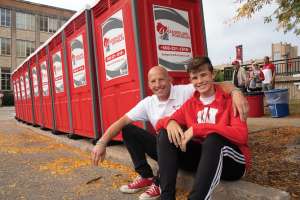
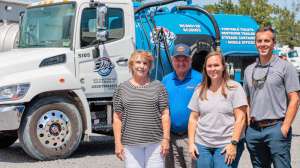
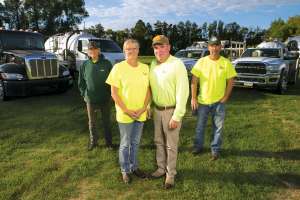
To service portable restrooms at football games at the University of Wisconsin, Thomas Ward and employees at Badgerland Portables must execute a precision game plan with the same kind of teamwork the Badgers display on the field at Camp Randall Stadium. Ward is the operations manager at Badgerland Portables, located in a suburb of the state capital, Madison. (The company is a division of Illinois-based Lakeshore Recycling Systems). For three years, Ward and four to five employees have worked amid the festive party atmosphere of Camp Randall on seven Saturdays in fall. The technicians for the 2021 season were Austin Dobron, Dylan Cleaveland, Troy Tischler, Josh Messinger and Buddy Bills.
COMPANY HISTORY
Badgerland is four years old. It rents and services portable restrooms throughout southern Wisconsin. The company was started by Dustin Reynolds, who’s the vice president of business development at Lakeshore Recycling. The company primarily serves the construction industry as well as special events. It employs seven people and operates out of headquarters in Monona, Wisconsin, and a facility in Janesville, about 45 miles to the southeast. “We’ve grown quickly, primarily by acquiring seven or eight companies,” Ward says. “It’s very exciting. We’re a company on the move.”
EQUIPMENT MATTERS
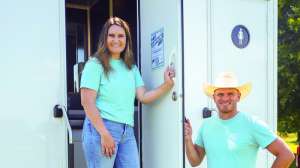
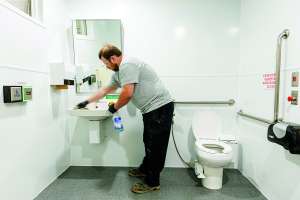
Badgerland owns approximately 1,400 standard restrooms and roughly 40 ADA-compliant restrooms, all from Satellite Industries. In addition, the company has four luxury restroom trailers (one with 10 stalls, two with eight and one with four), 75 hand-wash stations and about 75 sanitizer stations, all from Satellite and Satellite Suites.
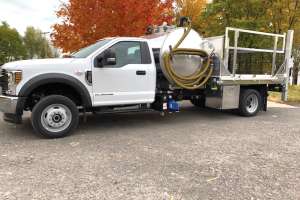
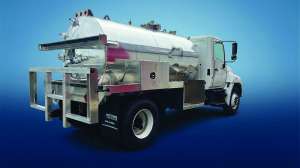
The company runs five service vehicles in Monona, built on Freightliner, Kenworth, Hino and Dodge chassis. They’re equipped with stainless-steel tanks that range in size from 650 to 750 gallons for waste and 350 to 400 gallons for freshwater tanks, all from Satellite Vacuum Trucks. The Janesville facility relies on three Ford F-450s equipped with aluminum and stainless steel tanks ranging from 650 to 750 gallons for waste and 350 to 400 gallons for freshwater, also from Satellite Vacuum Trucks. Trucks utilize Masport and National Vacuum Equipment pumps.
FORE!
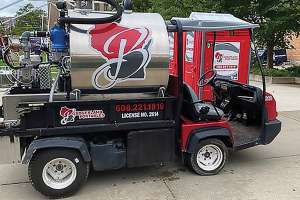
To service restrooms located on the hard-to-access upper level of the stadium, Scott Crawford, the company’s maintenance manager, and his team converted a Toro golf cart into a mini-vacuum truck about two years ago. It features a 200-gallon waste/100-gallon freshwater stainless steel tank made by Brenner (owned by Wabash National) and a small self-fabricated hoist that raises the tank about 30 degrees for easier dumping, Ward says. “It’s a neat little invention,” he says. “It works very well.”
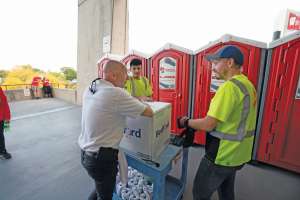
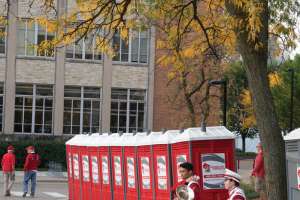
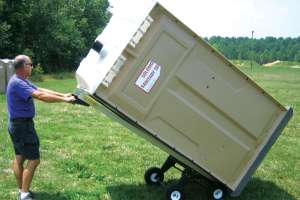
Because there aren’t enough permanent bathroom facilities on the upper level, stadium officials asked Badgerland to station seven restrooms on the north end and seven more on the south end. But that area is accessible only via a long, multi-tiered ramp with just 7 feet of clearance. To transport the restrooms to the upper level at the start of the season and remove them when the season concludes, Badgerland employees use a Mongo Mover from Deal Assoc.
THE MAIN EVENT
The Badgers have been playing games at Camp Randall since 1917. With a seating capacity of 80,321, the double-deck stadium is one of the largest school-owned college stadiums in the country. It’s named after a Union army camp that used to occupy the site where the stadium now stands. The camp was named after Alexander W. Randall, who was the state’s governor at the start of the Civil War. The Badgers play seven homes games a year, usually on Saturdays.
“I’m always amazed at how well-organized everything is,” Ward says. “And there’s no restroom abuse or graffiti. I figured the restrooms would be damaged during games, but they never are. It’s just a great overall experience.” Ward says the event runs so smoothly because of great communication with Shane Burgess, director of events for the UW-Madison Athletic Department. “Shane and I are on the phone every game day to be sure everything is good,” he says.
BY THE NUMBERS
To service the games, Badgerland deploys four vacuum trucks and six employees (including Ward) to service 120 standard restrooms and three ADA units. All the restrooms are delivered before the start of the season and placed in roughly 40 different locations in parking lots and within the stadium, where they remain for the entire season. The largest cluster consists of about 10 restrooms, Ward says.
EXECUTING THE GAME PLAN
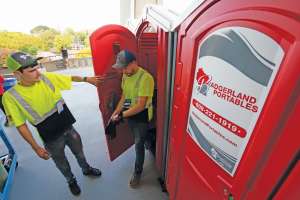
Game-day preparations begin between 4 and 5 a.m. because the crew has to be finished by 7 a.m. Job one is unlocking all the restrooms, adding deodorizer to the tanks and making sure each unit is fully stocked with hand sanitizer, toilet paper and so forth. “With four guys, it usually doesn’t take that long,” Ward says.
Then the employees go home. But two employees return around kickoff time, which usually is 11 a.m., to be sure the restrooms are sufficiently stocked and there’s no emergency maintenance or repairs required. The two employees follow the same routine around the third quarter before leaving for the day, he explains.
Between 5 or 6 a.m. on Sunday, the crew returns and spends two or three hours pumping out the restroom tanks and cleaning the units. “With four guys, four trucks and the golf cart, they make pretty short work of it,” Ward says.
GREAT ATMOSPHERE
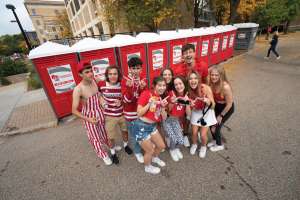
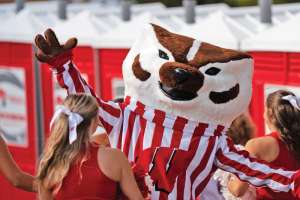
While servicing the event is hard work, Ward says employees enjoy the game-day experience, which is like a giant block party, featuring a sea of fans sporting the school’s red and white colors. “There’s a great sense of camaraderie,” Ward says. “While we’re working, fans at tailgate parties offer us free beers and brats. While we have to decline, it makes us feel very appreciated. We have a couple of younger drivers this year who had never experienced a Badgers football game before and really enjoyed the experience,” he adds. “They said, ‘Wow, this is really great!’ And it is.”