In 2016 Coleen Flood-Geary’s mother, Carol Flood, bought 224 portable restrooms and a vacuum truck with the idea of starting a business she and her three daughters could run. The new company would augment her husband’s Chicago-area trash business, Flood Brothers Disposal.
By 2017 everything was in place and they opened their doors. But things did not go according to plan. Two of the daughters dropped out and Carol became seriously ill and passed away in 2019. Flood-Geary was unexpectedly on her own. With skills she had developed managing her brother’s podiatric practice for 17 years, knowledge picked up from a mentor in the industry, and support from her husband Jay, she chose to forge ahead.
At first she continued to work for her brother but hired a driver and also got a lot of help and support from family, including her father William, brother Bill and nephews Michael, Billy and Thomas Flood who all worked for the garbage company.
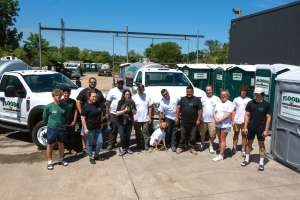
Today Flood-Geary has a staff of 10 — Emily Sivert and manager Drue Mathesius in the office; Jorge Davalos, Bernie Davalos, Paris Mayfield, Damion Flowers and Jose Vega in the field; and her children, Cullen (23), Luke (19) and Brody (18) who work part time and fill in wherever needed. They work within a 100-mile radius in the northern part of the state up to the borders of Wisconsin, Indiana and Lake Michigan.
She originally ran the company, Floods Royal Flush, from her home, storing equipment at her father’s facilities, but in November 2021 she was thrilled to get out of their way and move everything into a 13,000-square-foot office/warehouse and an acre of land in Aurora, Illinois.
“The trucks had been parked outside and in the winter it’s rough, so we needed to be able to put them inside,” she says. “This was the first time we were all under one roof — and it was nice to get my house back.”
PREPARING FOR SUCCESS
Because she knew nothing about the portable sanitation industry before getting started, Flood-Geary spent a year working for another vendor, Karen Carlson, owner of AREA Restroom Solutions, learning the ins and outs, including how to operate the vacuum truck, a skill she uses only occasionally these days. She also picked up knowledge at the Water & Wastewater Equipment, Treatment & Transport Show, Portable Sanitation Association International conferences and other classes.
“Then you just learn along the way,” she says.
While Flood-Geary may not have known much about portable sanitation when she started, she did know a lot about customer service. And with well-established competitors in the area, she made service the foundation of the business. Among other things, phones are answered 24 hours a day by a company employee, portable restrooms are serviced using a 20-point process, and invoices are clear cut and never include unexpected or previously hidden charges.
RISK MANAGEMENT
Flood-Geary believes it’s important to protect the company from potential vendor difficulties. “I don’t like to strictly use one vendor,” she says. “I don’t like to put all my eggs in one basket, so pretty much we have two vendors for everything.”
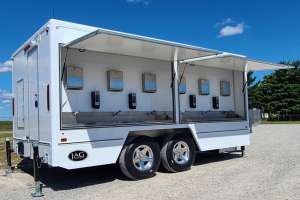
Equipment is from PolyJohn Enterprises and Satellite Industries. PolyJohn inventory includes 500 PJN3 standard units (most in some combination of green, orange and white as a nod to their Irish heritage), 175 flushable units, 210 wheelchair-accessible units including 10 flushables, 150 ADA-compliant units, 350 hand-wash stations, 150 four-station hand sanitizer stands, 70 150- and 250-gallon holding tanks, and 20 PolyLift units and 12 single-unit trailers for construction sites. About 300 Satellite units are used primarily for long-term accounts and park districts. Their 11 restroom trailers are from Lang Specialty Trailers, Black Tie Products and Optimus Industries and range in size from one stall (ADA-compliant) to 10 stalls.
Transport trailers are from Liquid Waste Industries (two 14-unit) and McKee Technologies (a six-unit and 16-unit). “For big events we’ll utilize all the trailers but we also have the luxury of using my dad’s equipment,” Flood-Geary says. They get their cleaning and deodorizing products from Walex Products and J&J Chemical. Paper supplies and soap come from Emergent Safety Supply and North American.
THIRD-PARTY HAULER
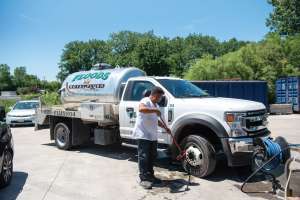
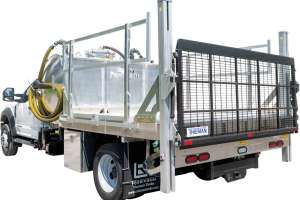
The company has seven vacuum trucks, all with Masport or Pumptec pumps. The 2016 Ford F‑550 was built out by Satellite Vacuum Trucks (Satellite Industries) with a 700-gallon waste/350-gallon freshwater steel tank. The 2019 Ford F‑250 from Imperial Industries has a 300-gallon waste/150-gallon freshwater slide-in aluminum tank. Their three Ford F-550s (2019, 2021) were built out by Imperial with aluminum tanks — 700-gallon waste/385-gallon freshwater, 700-gallon waste/300-gallon freshwater and 900-gallon waste/400-gallon freshwater. And the 2020 and 2022 Internationals were built out by Imperial with 900-gallon waste/400-gallon freshwater aluminum tanks.
Company drivers do not spend time taking their loads to the treatment plant. Instead, the company stores wastewater and has someone else take it. They have three 5,000-gallon plastic tanks in Aurora as well as one 3,000-gallon plastic tank and two 5,500-gallon plastic tanks at two of her father’s trash facilities. Once or twice a week (occasionally three times in the summer), a septic hauler, Jake McKamey from American Septic Service, pumps out the tanks.
“In the beginning we did that because it was cheaper than sending trucks to the dump every day,” Flood-Geary says. “In Illinois we have to be licensed with the dump and that has never been something I’ve pursued.”
CUSTOMER CONTACT
Initial marketing efforts consisted of mailing a letter to the family’s garbage-hauling customers, placing an ad in Money Mailer and attending a construction industry convention. Today the company has a sophisticated online presence. Again, Flood-Geary prefers to use several vendors. Logical Position, a national company with a local office, works on search engine optimization and writes a monthly blog which is emailed to current and potential customers. TechPro, a local company, maintains their website. And consultant Ron Neurauter handles their social media postings.
But Flood-Geary, does not rely solely on the internet for marketing. Other channels include radio advertising, chamber of commerce activities, sponsoring baseball teams, advertising with construction associations and putting their name on golf course score cards.
To ensure anyone can reach a company employee at any time, office phones are transferred to Flood-Geary’s cellphone after hours. “We do get a lot of calls on the weekends and sometimes at night,” she says. “It’s usually someone looking for units at the last minute or wanting a quote. In the winter we get a lot of calls from people who need a unit because their pipes have frozen.”
While construction work continues year round, the company’s event season starts with several St. Patrick’s Day functions including an after-parade fundraiser for Misericordia home for people with developmental disabilities. Other events include the Huntley Fall Fest, Fiesta Back of the Yards street fair, and an air and water show and other functions on the shore of Lake Michigan.
Units are dropped off in June and picked up in January for Neon Summer which sponsors different activities throughout the year — go-karts, miniature golf course, axe throwing, pumpkin patch, ice skating, Christmas tree sales. Units are also set out each growing season at Kuiper’s Family Farm for customers visiting the pumpkin patch, apple orchard and tulip garden.
The company also services a lot of weddings where their flushable units and restroom trailers are popular. If an attendant is requested, they’ll usually bring in a college student.
STAFF MATTERS
Flood-Geary says it’s not always easy to find employees — “But right now we have a really good group of guys.” The best source is a referral from someone in the company but they also have a link on their website and announce job openings on Facebook and Instagram. They do background checks on prospective hires and Flood-Geary meets with them to make sure they know what the job entails.
“We’re upfront with them because it’s not necessarily a job that anybody really wants to do,” she says. She also can tap her father’s business for extra help when needed. “There’s a handful of his full-time drivers that look for extra work on the weekends or when we’re really busy,” she says.
The company buys a lot of clothes for the drivers — boots, shirts, pants, shorts. And if the techs want anything, all they have to do is ask. “We’ll get them anything they ask for on the trucks that will help them to make it easier, to make their days go by quicker,” Flood-Geary says. Requests have included shovels to break up ice, an impact driver and a Milwaukee rivet gun.
New hires are trained by going out with an experienced driver for a week or two. They learn the 20-point servicing process, which includes inspecting units for damage or missing parts, making sure all parts are properly secured, cleaning all interior and exterior surfaces with disinfectant soap and water, pumping the tank dry, repainting blemishes, checking decals and restocking supplies.
“They’re very clean,” Flood-Geary says. “We have higher expectations here.” The process is proudly posted on the company’s website so customers know exactly what they’ll get.
Communication with the team is usually done online. “That’s how they get their daily route,” Flood-Geary says. “For troubleshooting, they’ll Facetime Drue and he’ll help them figure something out.” Drue is also the guy who will occasionally fire up the barbecue for the team on a Friday after work.
WIDE OPEN FUTURE
Flood-Geary knows she couldn’t have gotten where she is without a lot of help, especially from her family who continues to support her. The company may have had a rocky start but she is now on a roll and not afraid to dream. No suggestion is off limits. Ideas currently being tossed around include geographic expansion in the state, adding septic work, and becoming licensed in nearby Wisconsin and Indiana.
“There’s all kinds of stuff that’s talked about here that we’ll get into one day,” Flood-Geary says. “But we’re not going to be too crazy. Just growing at the right pace.”