“I think that if you run a really good client-based business, competition isn’t that big a deal because there’s plenty of work to go around,” he continues. “There’s a lot of construction going on in the Seattle area.”
The company’s financial metrics speak for themselves. In 2016, Niccolls’ first full year in business, he estimates the company generated about $90,000 in sales. In 2024, he expects to top $5 million in sales — not bad for a guy who didn’t hire his first full-time employee until 2017 and then added another one in 2018.
His secret for success? Creating a solid marketing program that monitors what does and doesn’t work, developing a network of fellow operators that help each other out when needed and getting business coaching from groups like CEO Warriors. An unexpected boost from the pandemic also helped, he says.
Monthly restroom rentals — primarily to construction companies — produce about 60% of the company’s revenue, while the balance comes from special events, he says.
Sports background
In his previous career, Niccolls refereed National Collegiate Athletic Association Division I soccer games and also served as program director for the Washington State Soccer Referees organization for four years.
In addition, he served as development director for Outdoors for All, a nonprofit group that provides therapeutic recreational opportunities for disabled people, and worked for Sports in Schools, a nonprofit group that works to improve access to and provide support for local athletic programs at low-income, underserved middle and high schools.
But after seven years, he was ready to try something different. And when his brother, Sam, said he had a friend that owned a successful portable-sanitation company in Canada, Niccolls was intrigued.
So he and Sam spent a week in Calgary, Alberta in the fall of 2015, essentially getting a crash course in Portable Restroom Operations 101.
“I came away from Calgary excited about starting a company in Seattle,” he explains. “It looked like a great opportunity.”
Catchy name
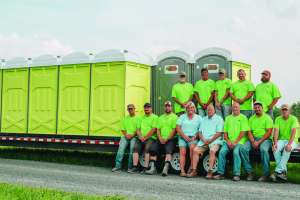
Sam Niccolls, who initially was involved in establishing the company, came up with the name Green Latrine. It made sense from a marketing standpoint because all of the company’s restrooms were green. Moreover, the company uses environmentally friendly products like formaldehyde-free liquid deodorizer from Walex Products Co., so the name is a play on the “green” aspect, he says.
“It checked two boxes,” Niccolls says. “We expected the environmental angle would help drive sales, but we’ve found it’s a nice add-on for some clients, not a big business driver.
“All things being equal in terms of price and service, I do think clients choose us because of smaller things like the environmental commitment, plus the fact that we’re a family-owned business.”
With just Niccolls and a part-time helper on weekends for employees, it was slow going early on. It took three to four years to gain traction, aided by an unexpected source: COVID-19.
“We were super fortunate to realize there’d be a need for hand-wash stations,” he says. “We saw a huge spike in business in 2020 from renting single-unit sinks. We deployed 200 to 300 sinks when construction resumed.
“It was a huge win for us because most other companies didn’t have them.”
As a bonus, customers who rented the sinks also started renting restrooms too, Niccolls notes.
Emphasis on marketing
Learning the ins and outs of marketing, especially on the internet, also boosted sales.
“So many business owners don’t take the time to learn about things like pay-for-click marketing and search-engine optimization,” Niccolls says. “I’m not saying I’m a world-class expert in each. But I’ve taken the time to learn from experts. And learning about marketing has allowed me to pick good people and vendors.
“I also know about the metrics that can show whether marketing is successful or not,” Niccolls adds. “I think I’ve learned more about marketing than the typical small-business owner.”
Two groups were instrumental in providing the marketing training: the 1-Page Marketing Plan, an online marketing-certification course developed by serial entrepreneur Allan Dib, and CEO Warrior, a business training and strategies organization that Niccolls joined for two or three years.
The emphasis on effective internet marketing paid dividends. For several years, starting in 2016, the company’s sales doubled every year.
“But that growth later slowed down,” Niccolls points out. “First of all, it’s hard to keep doubling your revenue when it’s in the millions. Second, profitability doesn’t always mirror your revenue growth because you’ve had to invest a lot of money in trucks, people and equipment.”
Now the company strives for no more than 20% annual sales growth, he says.
Business investments
Investments in technology also aided growth. A good example is ServiceCore, a field management software platform designed specifically for professionals in fields such as portable sanitation and septic and grease tank pumping. It handles everything from customer database management and billing to tracking inventory and routing/dispatching, he says.
“It used to be that all billings and rentals were on a spreadsheet or in my head,” Niccolls explains. “That’s fine when it’s just one person, but if you really want to grow, you can’t operate like that. ServiceCore got all the things I had on sticky notes and scraps of paper — or in my head — and into a customer-relationship management platform.”
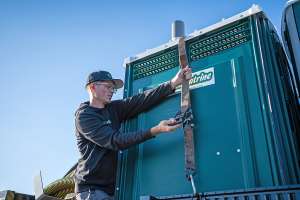
The company also invested heavily in new equipment. It now owns about 3,000 single restroom units, mostly from Satellite; approximately 800 hand-wash stations, also from Satellite; and four flatbed trailers from Liquid Waste Industries.
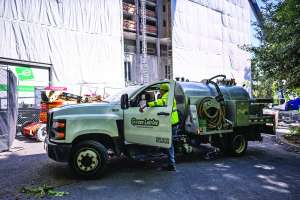
In addition, the company relies on 15 service vehicles, all with aluminum tanks: three Workmate trucks from FMI Truck Sales & Service, built on Isuzu chassis and equipped with 600-gallon waste/350-gallon freshwater tanks and vacuum pumps from Masport; three Ford F-550s and one F-600 outfitted with slide-in tanks from KeeVac Industries, ranging in size from 200-gallon waste/100-gallon freshwater to 900-gallon waste/300-gallon freshwater and featuring Conde pumps from Westmoor Ltd.; two Ford F-550s with 200-gallon waste/100-gallon freshwater tanks built by FMI and pumps from Masport; a Ford F-600 with a 300-gallon waste/150-gallon freshwater tank from FMI and a pump from Masport; a Ram 3500 outfitted with a 400-gallon waste/150-gallon freshwater tanks from Amthor International and pumps from Masport; and four International trucks, three equipped with 700-gallon waste/300-gallon freshwater tanks from Amthor and pumps from Masport and one with a 900-gallon waste/300-gallon freshwater tank from Imperial Industries and a vacuum pump from Masport. The company also owns a Ford F-350 and a RAM 2500.
“We’re honing in on standardizing our fleet,” Niccolls says. “It makes it easier because we can stock common parts for repairs and drivers can seamlessly and fluidly flex into a different truck when the need arises.”
Partnering with competitors
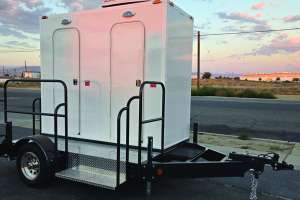
The company also owns three restroom trailers made by UltraLav (part of the American Cargo Group).
“We’ve come to learn that restroom trailers are kind of a different business because you serve different clients with different needs — different levels of details and expectations,” Niccolls says. “They’re good to have, but they’re not a big part of our business.
“When we need more trailers than we have in stock, we work with a good competitor and we also collaborate with three other companies that rent restroom trailers,” he continues. “They have more trailers and they service them better than we can.”
Niccolls says he also works with three other competitors with whom he’s developed a friendship over the years. He says the cooperation sprang from the common experience of being “smaller fish” competing against national brands.
There’s so much demand for construction restrooms that Niccolls doesn’t feel like he competes against other smaller companies like his.
“After years of being in business, I’ve gotten to know these other operators and after you work together one or two times, you gain confidence that you’re dealing with ethical and honest actors and personal connections grow,” he explains. “It’s not a formal arrangement, just some networking we’ve done over the years.
“The more we get along, the better it is for everyone’s business because if one of us runs out of inventory, maybe for a new client, we can help out. It’s a win-win situation.”
Isn’t it risky to help out competitors? Not really, given the high demand for restroom rentals. And in the end, the ability to meet customers’ needs trumps any such concerns, he says.
“If we get a call for service outside our territory, for instance, we want to be viewed by that customer as someone who helps out, even if we don’t benefit from doing so,” Niccolls says. “I’d much rather funnel that lead to a trusted colleague.”
In the end, it still benefits Green Latrine because that potential client then views the company in a positive light.
“It positions us as a trusted source of information, so if that customer ever does an event in our service area, they might call us in the future,” he says.
Further growth expected
Looking ahead five years or so, Niccolls says he expects to remain in growth mode, but in a slow-but-steady, manageable manner.
“One of our core values is growth,” he notes. “It’s central to what we do.”
The company has strategically put in place a lot of infrastructure that will hopefully allow it to absorb more growth without stressing operations, Niccolls adds.
“I’ve found it’s stressful to not grow and it’s stressful to grow too much because you start running out of restrooms, your drivers do too many service stops, there are too many phone calls coming in and you’re stretching employees to work well beyond 40 hours a week,” he says. “We don’t want to operate like that.
“In our market, there’ll be more opportunities for us to grow — and we’ll be ready for it.”