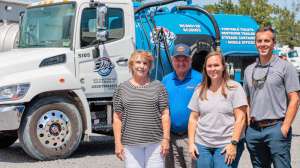
Ten years later Chad and his wife, Melissa, owned the company. After weathering COVID their first year, they wasted no time putting their mark on the business. They modernized operations, added technology and expanded the inventory to include a restroom trailer.
The business, Best Kept Portables, provides portable sanitation in a mostly rural five-county area in western Wisconsin. Work is done from their main shop in Bangor and a supplemental yard 28 miles away in Tomah, while Melissa handles administrative work out of their home in another nearby small town, Melrose. They employ six full-time technicians and one part-time office person.
PASSING THE TORCH
Chuck and Wendy Kaiser started the company in 2001. When they realized Chad had a knack for the business and enjoyed the work, they saw an opportunity. “It was always in the talking that when they were ready to retire we would be able to purchase the business,” Melissa says. “So, Chad worked his way up and got his master certification from the Wisconsin Department of Natural Resources, and put in all the hours he needed.”
Melissa had business experience, having owned a hair salon. Between her business skills and his field experience, they were set to go when the Kaisers were ready to step away.
The Kaisers had planned to get out in 2020, but when COVID hit, they put their plans on hold due to the uncertainty of everything. As it happened, they were unusually busy during the pandemic, with all 750 of their units out most of the time. Chad and Melissa took over in January 2021.
TRANSITION CHALLENGES
In some respects, the turnover was seamless. The existing three employees stayed on. Customers were notified but no one was alarmed, as they were already familiar with Chad. But it was surprisingly difficult, the couple admits.
“It was a lot more than we thought,” Melissa says. “The first year was very intense, very busy. There were a lot of times we were like, ‘Oh, my gosh, what did we get ourselves into?’ But each year has gotten easier.”
The main glitch — and a big surprise even to Chad, who had been the Kaisers’ right-hand man — was the recordkeeping system. “I had an idea what was going on after helping Chuck for 10 years,” he says, “but it was eye-opening to see how much he did by memory and a notebook. It was old-school pencil and paper. I don’t know how he did it that way for 20 years.”
In their second year Chad and Melissa moved to a computerized records system. But it was a rocky start. They did a lot of research, chose a program, installed it — then hated it and got rid of it. So, it was back to the drawing board. But this time they had a better idea of what they needed.
“We went with ServiceCore and we love it,” Chad says. “It’s user-friendly, not too hard to figure out what you need to do at each stop. The one complication is when we get into spots where there’s limited or no internet reception so you have to go up a hill.”
Melissa is also happy with the system, although she says it was initially a lot of work entering everything. “But our guys now have tablets, whereas before they literally had a little binder with index cards for their routes.”
The company uses the program for routing, inventory control and billing, “And you get reports,” Chad says. “It logs what you’re pumping out, how much you dump at each treatment plant. You can break it down by driver, by route. It offers quite a few options.”
GROWING THE INVENTORY
For greater exposure, the couple created a Facebook page which, along with word of mouth, helped grow the business. They also started adding more equipment and trucks.
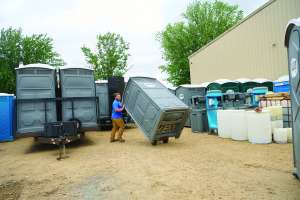
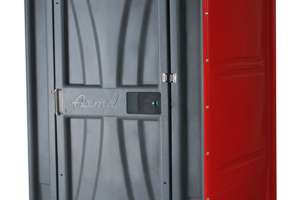
Today they have about 950 restrooms (Satellite Industries and J&J Portable Sanitation Products), 50 hand-wash stations (Satellite), and 10 200- and 300-gallon holding tanks (Satellite, Blain’s Farm & Fleet, Tractor Supply Company).
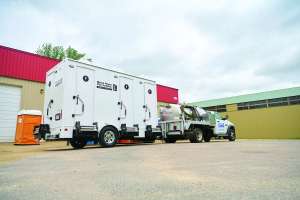
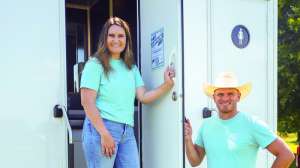
In April 2024, they took a big step and bought their first restroom trailer — a four-door, four-stall unit from Satellite Suites. “We were getting a lot of calls asking if we had one,” Melissa says. “It was always a goal when we bought the business. We promote it for events, weddings, festivals, concerts, corporate events, graduation parties. And we throw in a handicap unit with it as well.”
They ordered the trailer with a winter package so it can be used year-round. “It’s got heaters in it, and the waste tank has a heated part so the waste doesn’t freeze in the tank,” Chad says. “And it’s all enclosed down below to keep as much air out as possible.”
SERVICE FLEET
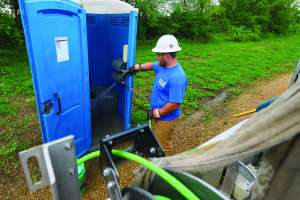
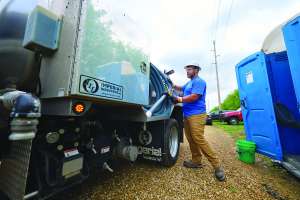
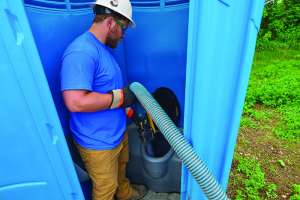
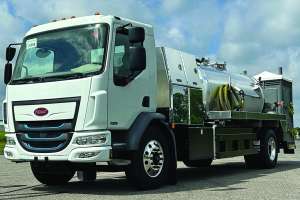
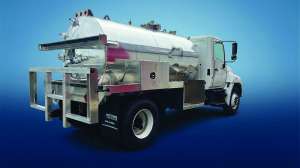
The company has nine vacuum trucks — 2017 and 2020 Ram 3500s from Imperial Industries with 300-gallon waste/150-gallon freshwater tanks (one stainless steel, one aluminum) and Masport pumps, 2015 and 2019 Ram 5500s from Satellite with 600-gallon waste/300-gallon freshwater tanks (one stainless steel, one steel) and Conde pumps (Westmoor Ltd.), 2018 and 2023 Ram 5500s from Imperial with 775-gallon waste/400-gallon freshwater stainless steel tanks and National Vacuum Equipment pumps, 2022 Ram 5500 from Imperial with a 700-gallon waste/300-gallon freshwater aluminum tank and Masport pump, 2016 Chevrolet 3500 from Imperial with a 300-gallon waste/150-gallon freshwater aluminum tank and Masport pump, and a 2008 Ford F-550 from Imperial with a 700-gallon waste/400-gallon freshwater aluminum tank and NVE pump.
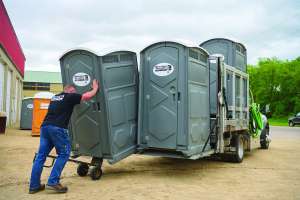
Transport trailers include two from Liquid Waste Industries and three from The Johnny Mover in sizes ranging from eight to 20 units. The company uses formaldehyde-free deodorizers and fragrance sprays from J&J Portable Sanitation Products and urinal mats from Walex Products. Disposal is convenient as they have access to five treatment plants in their service territory.
HOUSEBOATS, TRACTORS AND BOGS
The company services a variety of customers. About 60% of their work is for residential and commercial construction and roadwork.
Events take place most weekends in the summer in one or more of the small towns in their area. Examples include the LaCrosse Marathon, for which they provide 80 units, and the three-day Tomah Tractor Pull requiring 100 units and twice-a-day servicing. “And we do a lot of small town festivals, needing anything from five to 30 units,” Chad says.
The company also provides portable sanitation services for a number of Amish communities where residents do not have indoor plumbing. “A lot of them own their own units and we service those,” Chad says. “Or they rent them for their greenhouses, shops, sawmills or weddings which happen in the fall in the middle of the week. Sometimes for funerals.” The company also pumps out residential holding tanks.
Other projects include pumping out boathouses and houseboats on the Black and Mississippi rivers; providing units at parks and recreational areas; and supplying units at cranberry bogs, blueberry and strawberry fields and apple orchards during harvest season.
TAKING CARE OF THE STAFF
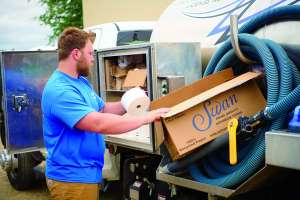
The company uses Facebook and Indeed to advertise for employees. They have a rigorous selection process. “Our insurance is pretty intense, so they have to have a very clean driving record,” Melissa says. “That makes it a little tricky.”
Training generally takes two weeks, riding along with a technician. “After that we hop in with them here and there to give them a hand once they get out on their own,” Chad says. “It’s a little overwhelming at first.”
Once onboard, employees are well cared for. “We provide their work T-shirts and give them an allowance every year of $300 for new boots or a jacket and offer a reimbursement on work clothing,” Melissa says. “We have a retirement plan and give out a nice end-of-the-year bonus. Every quarter we do little incentives and give cash bonuses for working on the weekends. And they get paid vacations and holidays.
“And when we get a break in our servicing, I’ll take them and go get lunch,” Chad adds. “We try to do little things that keep the stress level down.”
A FAMILY OPERATION
While Chad enjoys being out and about, going to places he probably wouldn’t otherwise visit, Melissa loves that she can work at home and be with their kids, Emmett (8) and Brooks (5), who love to help out with anything they can. “They’ve been a huge part of this,” Melissa says. “They love everything about it.”
Both agree the challenging part of the job is that the work never ends. “There’s always something,” Melissa says. “There’s never an off day, never a downtime. There’s always work to be done.” On the other hand, there are rewards, she says. “You get to meet a lot of different people. You take pride in your work. And I like that we have the opportunity to have a business that can give to the community.”
Best Kept Portables, Bangor, Wisconsin
OWNERS: Chad and Melissa Hasz
FOUNDED: 2001
EMPLOYEES: 9
SERVICES: Portable sanitation
SERVICE AREA: 5 counties in western Wisconsin
WEBSITE: bestkeptportables.com