As an editor for PRO, I’ve learned about pump trucks and the vital service that portable sanitation workers provide. As a longtime NASCAR racing fan, I’ve gone flying with Bobby Allison, taken a garage tour with Alan Kulwicki, and shared a cup of coffee with Dick Trickle in Dale Earnhardt’s car hauler.
But until now I’ve never experienced my sanitation-related job and my racing passion together.
So when my brother-in-law Phil Bickley offered me a ticket to the Bristol race this spring, I saw my chance. If I could meet up with a PRO serving the massive motorsports event, this would be my opportunity to see a NASCAR race from a pumper’s perspective.
What I discovered is that you can go almost anywhere with a pump truck.
FINDING A PRO
For the hardworking crew of A & S Portable Toilets and Septic Pumping of Tazewell, Va., that includes the gated, screened and tightly guarded VIP lot reserved for NASCAR Cup drivers and owners at Bristol Motor Speedway.
Home base for my working vacation was Red Barn, one of the numerous campgrounds blanketing the rolling hillsides along the picturesque Blue Ridge Mountains. Fields of campers and RVs swell this Tennessee-Virginia border community of 25,500 to more than six times its normal size. We parked our Chevy conversion van at the foot of a grassy rise, which, except for a Maui Shower trailer at the top and an occasional bank of PolyPortables Inc. restrooms halfway down, was basically unchanged from the pasture land that fed the working farm on which the neighboring speedway complex was built.
Two days of rain had turned the Tennessee hillsides into rivers of red mud. But that didn’t seem to slow the
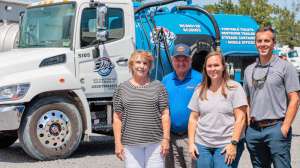
A & S crew of Kenneth Mitchell and Pete Mullins, whom I met Sunday morning on their pre-dawn route.
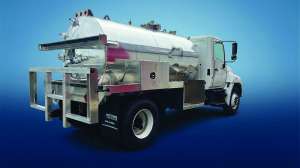
“We do every camper and RV inside the campground and every driver RV for Cup and Nationwide,” Mullins explained as he serviced our campground. Mullins was among a dozen A & S workers manning the seven pump trucks that maintain the company’s 350 restroom units during race week. According to co-owner Arnold Booth, who has had the Bristol contract since 1998, the A & S fleet consists mostly of International S Series trucks (2,000 gallon waste/200 freshwater and 1,500 gallon waste/400 fresh) along with a couple pickups with portable tanks for the really tight spots.
“They’re built by different people,” Booth said of the fleet. He built one himself, with others outfitted by Satellite Industries Inc. and Keith Huber Inc. Waste from the runs is generally hauled to the treatment plant in nearby Bristol each day.
LEFT TURNS ONLY?
Leaving the campground, I headed toward the track in search of a working vacuum truck. Here I found Daryl Smith and Dennis Young pumping restrooms and trailer units in the parking lot. The sun was beginning to rise as they backed their “all access” truck inside the gated and guarded compound that housed Fox, ESPN, SPEEDtv.com, PRN (Performance Racing Network) and other national media. Hand-wash stations and portable restrooms were given a thorough cleaning and RVs were pumped. Nearby, SPEED’s Loyal Williams and Robyn Green were going through their morning sound check.
I strongly recommend hiking boots at Bristol, and was glad I had mine as I headed up another steeply banked path to the VIP campground reserved for Cup drivers and other dignitaries. There I met A & S drivers Rodney Baldwin and Wert Harris, who often find themselves among racing’s elite.
“We meet some of the drivers in here,” said Baldwin, who told me about a fellow PRO who gave new meaning to the popular term, “Bristol Experience.”
“One of the guys said that he was pumping an RV and the driver came out and said he was using the bathroom at the time,” Baldwin said. “It liked to have pulled him through.”
No, Baldwin and Harris may not be as fast as NASCAR Sprint Cup driver Brian Vickers — barely recognizable with a stocking cap pulled tightly over his head this 40-degree morning — but when it comes to weaving a pump truck past racing legend Darrell Waltrip’s black, pearl and blue motor home, they take a backseat to no one.
“Getting through all the traffic, that’s the hardest part,” said Baldwin, looking to avoid a cart chauffeuring car owner Roger Penske. At Bristol, space is at a premium, and inside the VIP campground, pit row speed is barely above a crawl.
For the A & S crew, work at Bristol begins approximately three weeks before the green flag falls and continues about a week beyond the final lap.
“We usually get up at four and are going until nine at night,” Baldwin said. Everything inside the VIP compound gets pumped twice a day — 10 a.m. and 5 p.m. — and earlier on race day, ensuring the RVs are ready to roll long before the event is done.
START YOUR ENGINES
By now, it’s nearly noon, and throngs of fans have filled the earlier vacant parking lot, filtering among the village of tents and trailers that give the World’s Fastest Half Mile a county fair-like atmosphere.
Built in 1961 at a cost of $600,000, the original speedway covered 100 acres and provided seating for 18,000 fans. Today this fully enclosed, recently remodeled three-story amphitheater seats 165,000 for the spring Food City 500 and August “night race,” often referred to as the “toughest ticket in NASCAR.”
On this Sunday in March there wasn’t an empty seat to be found.
Pre-race ceremonies included an emotional tribute to veteran driver Dale Jarrett, starting his final Sprint Cup race before calling it a career. Overhead, a trio of fighter jets provides a thunderous crescendo to the National Anthem that ends amid fireworks.
The call for drivers to “start your engines” — the last audible sound for the next several hours, brings fans to their feet. “Boogety, boogety, boogety,” shouts Waltrip from his broadcast booth. Tony Stewart is dominant throughout the day, but it’s Jeff Burton who gets the win in a green-white-checkered finish.
A final jog down one path and an exhausting hike up another, we began our trip home — still 18 hours of hard driving away after what has been a unique portable sanitation “Bristol Experience.”
Continue reading for free