When Josh Campbell started working his first portable restroom route at age 11, his burning ambition was to own a Western Flyer bicycle he spied in a store window. He didn’t know cleaning those restrooms would start him becoming a fourth-generation liquid waste entrepreneur.
“That bike was $275,” says Campbell. “I wanted it bad, and Mom and Dad told me I had to work for it. After school let out for the summer, I got in the truck with the driver at 4 a.m. to clean out restrooms and restock paper at 10 cents per unit.”
Campbell got his bike in time for school to start again in the fall, and had his first taste of success in the portable sanitation industry.
That was 1991, and he was working for his parents’ business, a franchise office of his aunt and uncle’s St. Louis-based company, Johnny on the Spot. After the family business went through several incarnations, it was time for Campbell to make it his own. In February 2005, he bought 120 Taurus units and five World Care ADA restrooms from Synergy World, and a 12-unit trailer from Lane’s Vacuum Tank to launch Fresh and Clean Restrooms.
A NICHE IN PORTABLES
Currently, portable sanitation accounts for a majority of Fresh and Clean’s business. Of that, 30 percent is construction, 40 percent is heavy industry (mines, quarries and rail yards), 30 percent is special events. Septic pumping, a service started in 2006, accounts for 10 to 15 percent of revenues, about 90 percent of that is residential. About 5 percent of the revenues come from water hauling, jetting and septic system installation.
Fresh and Clean fields 500 restrooms, mostly from Satellite Industries Inc. and Synergy World. The company also carries 15 300-gallon and 1,000-gallon Synergy World combination waste and freshwater holding tanks, 15 Satellite Wave sinks and 10 PolyPortables Inc. Super Twin sinks. There are also 10 PolyJohn Enterprises Corp. PJN3 single-unit trailers carrying orange restrooms.
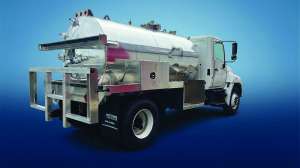
The well-utilized fleet includes a 2001 Chevrolet 3500 1-ton supervisor/support services flatbed with 300-gallon waste/110-gallon freshwater tank and a Conde Super 6 pump from Westmoor Ltd. It also has a Deuce restroom carrier from FM Manufacturing. There are two Chevrolet C5500 vacuum trucks, a 2004 with homemade 500-gallon waste/250-gallon freshwater tank and Conde Super 6 pump and a 2005 from Keith Huber Inc., with a 600-gallon waste/250-gallon freshwater steel tank and a Masport HXL4V pump.
Campbell also runs a 2007 Interna-tional 4300 service truck from Satellite Industries Inc. with 1,600-gallon waste/ 600-gallon freshwater tank and Jurop R260 pump. The company’s water hauler is a 2001 Ford F-650 with a 2,000-gallon poly tank. All trucks are equipped with the Masport Pumper/ Scent system for what Campbell calls “improved public perception of the profession.”
DISASTER SPURS BUSINESS GROWTH
“We travel an average of 250 miles on a daily route,” says Campbell, servicing 40-50 units. They cover 80-90 miles, north to south, of clay soil territory in the Ozark Mountains. The highest point in the state is in Campbell’s service area, next to the Taum Sauk Reservoir, about 110 miles south of St. Louis. This was the site of the company’s first major job.
In December 2005, the reservoir collapsed, flooding a state park. “We were contracted by an engineering company to serve the cleanup,” recalls Campbell. “At the high point, we fielded 35 units with three-times-a-week service. That job is still going on, now in the reconstruction phase. In the meantime, they’ve opened the park back up June through Labor Day. We pump the 10,000-gallon holding tanks at the store and offices on the state park grounds. We still have 16 units there now, and they expect project completion by summer 2009.”
On the reservoir reconstruction site itself, Campbell has 75 units spread over a work zone of about 10 acres, which receive three-times-a-week service. He also has eight 1,000-gallon waste and freshwater tank systems hooked to a pump that supplies the engineering company’s office trailer restrooms.
RESPONSIVE SERVICE PAYS
Every three years, the Civil War Battle of Pilot Knob is re-enacted about 90 miles south of St. Louis. The event is put on by the state’s natural resources department, which contracts restrooms from Fresh and Clean. Last year, the company placed 22 standard units, four ADA units and four sinks at the 28-acre site for the Saturday/Sunday event. Setting up on Friday morning, Campbell’s crew serviced both days at 10 a.m. and 4 p.m., picking units up on Monday morning. “We keep one guy on site in a truck during daytime activities for housekeeping,” Campbell says. “He picks up trash out of restrooms, carries deodorizer and disinfectant, and cleans up any messes.”
Campbell bills the maintenance as documented service. “It’s really just a date sticker that says when we were there, but it sounds impressive and is a big selling point with our customers.” He also tries to keep an extra person on staff to do his management job so that if an emergency call comes in, he can respond immediately. “That way, I don’t have to make the customer wait. If they say ‘jump,’ we try to jump as high as we can.”
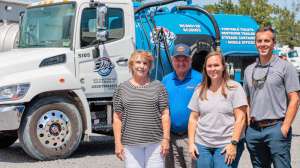
Employees are also a Fresh and Clean selling point. “Employees are your strongest or weakest link in the system. Mine happen to be the strongest link. We receive lots of compliments in the office from our customers on how our (workers) act at the site. I think I can retain and have great cooperation from my employees because I don’t expect them to do any more or less than I do.”
BIG MARKET REACH
Public perception begins with the way a company is represented in the marketplace, and Campbell chose the name Fresh and Clean as a statement about his service philosophy. This is indicative of his understanding of proactive and strategic marketing.
To start, he launched a Web site the day he started the business. “I knew the Internet would be the way to go. I know I hate looking at a phone book for anything, and I figure many of my prospects feel the same way. People are going to the Net for everything.” He drives use of the site by mentioning the Web address on all promotional pieces, including extensive phone book advertising.
Fresh and Clean recently ventured into broadcast advertising with great success. “I just started using radio ads about two months ago,” he says. “Three ads a day for a week. Our call volume went from about a dozen a day to 25 or more. I know it’s working because now people are actually telling us they’re calling off the radio ads.”
As comfortable as he is using technology to promote his firm, Campbell says his most effective approach is time-honored “face time” with current and prospective clients. “I know all my customers by name, the things they enjoy doing, their hobbies. It’s just good, old-fashioned friendship. We’re the highest-priced company around, but we keep our customers because they appreciate the way we do business.”
LOOK SHARP, BE SHARP
Employee appearance is another element that builds a professional image for Fresh and Clean. “I started issuing uniforms in 2007,” says Campbell. “As soon as we started using uniforms, I could tell an immediate difference in the public and customers’ perception. We were no longer a ‘toilet company,’ but had become ‘providers of portable restrooms’ overnight.”
Maintaining this high regard is part of what drives Fresh and Clean’s dedication to customer service. It feeds into Campbell’s strategy of communicating to his customers that their needs are the company’s primary concern. Borrowing this tradition from the family legacy and using modern technology to reinforce the message, Campbell is a member of the new breed of earnest young professionals committed to raising the standards of an industry he’s proud to belong to.
Continue reading for free