For Ken Winter, participation in trade groups and staying on top of product technology has always been a prerequisite to success in business.
“You’re either a leader or a follower,” he once told his son, Roger. “You can get out there and help shape the industry and the regulations that govern it, or you can sit back and be defined by what other people decide.”
Ken and Roger are respectively president and vice president of K. Winter Sanitation Inc. of Innisfil, Ontario, Canada, a portable restroom operator located about 50 miles north of Toronto.
The company has successfully navigated its long history as a supplier to the construction industry and special events market by creating and adopting new technology and engaging the industry head-on through participation in industry associations.
DIVERSIFIED FROM THE START
The portable restroom operation started out as a multi-pronged company in the 1960s as the Ken Winter Co., offering such diverse services as well digging, water pump repair, onsite system installation, and portable restroom and septic tank pumping service. Under another business name, Winter rented ice-fishing huts during the winter months.
In the early days, inspired by seeing portable restrooms at a local event, Winter took out phone book advertising, offering to rent portable sanitation services. “It was a way of feeling out the market,” says Roger Winter. “When a call came through from the Barrie Holiday Inn a few miles away to service someone else’s portable toilets, my dad offered to build and rent his own, with a square-tank design that was easier to service.”
The company soon began to manufacture its own equipment, producing 500 restroom units in five years. As new units were built, the company expanded its territory, about 60 miles west to Owen Sound, 80 miles north to Huntsville, and south to the Greater Toronto Area.
When a 500-gallon tank imploded during a vacuum job, Ken designed his own 600-gallon (400-gallon waste/200-gallon freshwater) tank. By 1974, the company concentrated primarily on the more profitable portable restroom business.
On a 1976 trip to Vancouver, British Columbia, Ken Winter was impressed by the design of a fiberglass portable restroom. The company developed its own model and began the tradition of manufacturing fiberglass units in-house. Seeing the need for a rental flush toilet with traps, he developed a design called Sure Flush, which the company still uses today.
“Dad has always had a passion for the portable toilet industry and for inventing things that will help the company differentiate itself from the competition,” says Roger Winter.
INDUSTRY INVOLVEMENT
The company became involved in regulatory matters in the early 1990s when the Ontario Ministry of Labour proposed plans requiring all portable restrooms on construction sites to be flush models made of porcelain and connected to sewer lines. “That was their original intent,” says Roger Winter. “We worked out the cost at the time to about $10,000 (Canadian) per unit, including the cost of the permit. If the regulations had gone through as originally proposed, that could have been the end of the portable restroom industry in Ontario, as far as the construction market was concerned.”
At the time, Ken Winter was vice president of the Barrie Home Builders Association and sought a position on the association’s health and safety board to be part of the discussion on regulations. He also volunteered to sit on the health and safety committee of the Council of Ontario Construction Associations to represent the interests of portable restroom operators. As eventually written, the regulations allowed construction contractors to specify the type of restroom facilities most appropriate to the site.
Roger Winter has emulated his father in getting involved in industry associations. He’s the past president of the Ontario Association of Sewage Industry Services and is currently vice president of the U.S.-based National Association of Wastewater Transporters Inc.
“If you don’t like the way regulations and important issues are being addressed in your industry, seeking representation on these associations is the best way to help shape them to something you might find more acceptable,” Roger Winter says.
A FIT FLEET
K. Winter currently offers about 2,200 restrooms, most from PolyJohn Enterprises Corp. About 200 of the units were purchased from Armal Inc. and 120 were supplied by Five Peaks Technology. The company also offers 200 fiberglass units and 100 larger modular units built at K. Winter. The modulars are constructed from marine-grade plastic and feature porcelain toilets and sinks, a heater, and GFCI electrical outlet.
The company owns a fleet of 20 trucks. Half the fleet consists of Fords ranging from F-350s to F-550s. Four Dodge trucks are also part of the fleet, with models ranging from the 1500 to the 3500. Five flatbeds carry seven restrooms apiece and are outfitted with 300-gallon waste/150-gallon steel tanks.
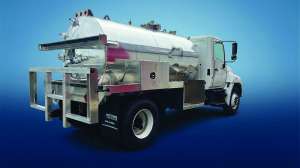
Ten portable sanitation service trucks are equipped with 600-gallon waste/400-gallon freshwater steel tanks, with five of the vehicles also outfitted with 180-gallon mix tanks. Vacutrux manufactured three of the tanks, with the rest built in-house and by local welding shops. The vac systems utilize pumps from Wallenstein and Conde.
An International fitted with a 2,000-gallon steel Vacutrux tank handles septic services.
The company has 18 employees, not including the elder Winter and his wife, Ruthann, who continue to work part time. Growth has been steady over the past five years.
“My dad and I make tough decisions in planning growth,” says the younger Winter. “If we choose not to add an extra 500 units, we might give up one contract, but we won’t have hundreds of units sitting unused in the yard the rest of the year. We finance our growth on success and never borrow money or lease equipment to expand.”
The current economic climate has resulted in a few adjustments to the established business plan. Unlike past years, the company took on new customers during the busy season.
Regulatory challenges also continue to dog the Ontario industry.
“In a lot of North American markets, the portable restroom industry has been consolidated under major players,” says Roger Winter. “The regulations in Ontario are so different from America and the rest of Canada that the big players are scared off. So here the industry is still made up of independent operators. In our market, we’re competing with ourselves.”
DISPOSAL CHALLENGES
The current challenge is finding places to dispose of portable restroom waste. In 2003, provincial regulations killed the practice of land-spreading the concentrated waste. Although not directly related, Winter associates the regulation with an E. coli outbreak that killed seven people in Walkerton, Ontario, in 2000. The cause of that outbreak was traced to farm runoff into a well supplying drinking water to the town.
To further back its spreading ban, Winter says government officials also cited concerns such as feminine hygiene products found in the waste. The industry continues to negotiate with the Ontario Ministry of the Environment to allow land-spreading.
At the same time, municipal sewage systems are becoming stricter about the waste they accept from portable sanitation contractors. In a perfect world, the waste would be hauled to nearby Barrie.
“They’re refusing it because they say the waste would mess up their system,” says Winter. “They’re saying they don’t have the proper screening for paper towels. For the past three years they haven’t accepted outside waste from anyone. The problem here is that the engineers are over-engineering. If they talked to us, we could help them to design a system that would work for everyone.”
The company has responded to the problem by setting up a 10,000-gallon tank as a transfer station, then hauling the waste to Orillia, Collingwood and Aurora, towns as much as 25 miles away.
Winter says that the Ministry of Labour also unwittingly favors portable restroom operators who don’t meet provincial regulations for construction sites. “They require warm-water sinks and flush toilets, but the inspectors aren’t enforcing that,” he says. “We’re being undercut in some markets by operators supplying cold-water sinks and non-flush units.”
FORWARD THINKING
The company expects to see more call for its services in the near future as Canadian government infrastructure spending filters through the economy.
“The supers on some of these projects are getting tighter and tighter schedules and that means our service will be under greater pressure,” says Winter. “Many of them call today and want their service yesterday. But with more construction projects, particularly those that tie up roads and major thruways, it will be more difficult to get to those jobsites for service.”
Winter says the company has become more efficient after installing cell phones and Garmin GPS systems in all of its vehicles. Trucks are tracked using a fleet monitoring system from Advanced Tracking Technologies Inc. “We can monitor speeding and aggressive driving, or whether a driver is driving too slowly,” he says. “If we see a driver is spending more than 10 minutes on a site, we can call them and ask what’s wrong — it may be that a pump isn’t working or a problem with a hose and we can send backup support.”
Some drivers have left the company since the tracking began. “On some of the trucks, we’re now saving up to an hour a day,” says Winter. “If we lose an employee who had something to hide, I suspect we’re not losing a good person.”
The company uses custom software developed in-house to keep on top of client contact information, contracts, rental and service schedules, billing and accounting.
As customers become more demanding and schedules become tighter, Winter says that some smaller provincial operators may not have the resources to compete successfully.
“If you can’t afford to keep going at the full pace required in today’s economy, something will have to give,” says Winter. “Service will be the deciding factor, and we will continue to provide the best service we can.”
Continue reading for free