THE TEAM
Having grown up in the family business, Biffs Inc., in Shakopee, Minn., a suburb of Minneapolis, Derek Pauling has done just about every job there is, and now serves as the company’s CFO. His father, Mike Pauling, is the CEO, his mother, Diana, is the president, and his sister Heather is the COO. They have 58 employees.
Key workers on the Minnesota Twins baseball stadium project include Greg Downer, logistics manager, who oversees the drivers. Ben Schnackenberg works with the project manager on customer and employee relations. Derek Schultz, quality assurance manager, confirms that units are being serviced correctly, employees are performing properly and dressed to company and construction site standards, and also decides when units need to be changed out. When the labor foreman has requests, he calls Mary Walentiny in customer service. And Mary Lou Denker handles the specialized billing process.
Jim Frisch, winner of the 2008 Portable Sanitation Association International Service Technician of the Year award, is the lead technician, with supplemental help provided by Troy Krueger.
HISTORY
In 1986, Mike and Diana Pauling bought a small portable restroom company called Biff’s. They started with 200 units and two trucks and now serve a 50-mile radius of Minneapolis with over 40 vehicles and several thousand units. Construction accounts are 45 percent of their business.
MAKING CONNECTIONS
When the company learned Mortenson Construction would be the general contractor for the new Minnesota Twins stadium project, Mike Pauling and Schnackenberg began meeting with them in an effort to win the contract. They emphasized service. “It’s not all about price on projects like this,” says Pauling.
“Sanitation is very important. And when things come up — and they always do — they know when they call they’ll get something done.” Mortenson had worked with Biff’s on other projects so they were familiar with the company’s work ethic.
THE MAIN EVENT
For 27 years, baseball in Minnesota has been an indoor sport. That’s about to change with the construction of Target Field, a one-million-square-foot ballpark in the historic warehouse district of Minneapolis. Groundbreaking was in August 2007, and construction is scheduled to be completed in April 2010. Over $500 million will be spent on the 40,000-seat stadium, which will also house a Minnesota Baseball Hall of Fame and Museum, retail stores, bars, restaurants, and an interactive area for kids. There will be heated viewing areas and a full roof canopy, one of the largest in baseball. Despite potential weather challenges, fans are excited that the Twins will finally be playing outdoors and on real grass.
BY THE NUMBERS
On May 14, 2007, the company placed two units, one for women, one for men, as construction got under way. Two weeks later, they delivered two more units, and two weeks after that another two. As the project ramped up, so did the number of units in a rule-of-thumb ratio of one restroom per 10 workers on a 40-hour workweek.
At its peak this year, there were over 1,000 construction workers on the site for which the company provided 49 tan Satellite Industries Inc. Tufways, 25 rollaway high-rise units from PolyJohn Enterprises Corp., and four lift units from Satellite. All have hand sanitizers as well as 7- by 12-inch baked enamel steel electric heaters, corner-mounted and connected to a power source.
Deliveries were done using various vehicles in the company’s fleet, most of which are Internationals.
KEEPIN’ IT CLEAN
Biff’s posts detailed service procedures on its Web site so clients know exactly what to expect every time. Consistency is very important, says Pauling.
During the peak of construction, the company performed 203 services per week at six locations. The Tufways were cleaned five days a week. The rollaway high-rise and lift units were brought down twice a week for servicing. Cleaning starts at 3:30 a.m. and must be finished by 7 a.m.
The technicians wear company uniforms as well as full safety gear — hard hat, boots, safety glasses, safety vest. They are thoroughly versed on the proper service certified by PSAI. “Our drivers work so hard to make sure things are right,” says Pauling.
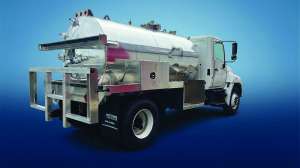
The service vehicle is a 2004 International 4300 built by Satellite Industries with a Masport pump and a three-compartment steel tank — 750 gallons of waste, 300 gallons of premixed deodorizer, and 200 gallons of freshwater.
Because units get heavy usage, they are frequently switched out with fresh ones and taken back to the shop to be power washed, repaired and checked over.
IT’S A PARTNERSHIP
A long-term, high profile job like this takes a lot of planning, work and service by all parties, says Pauling. The company finds that Mortenson is very organized and gives clear direction. “Our goal is to provide clean sanitation. And our motto is to protect the health, welfare and dignity of our customers,” says Pauling. “We treat everybody like that. We respond in an over-the-top manner, even if they just have one unit.”
VIDEO MARKETING
In November 2008, Derek Pauling and Schnackenberg attended an all-workforce catered luncheon at the stadium site, celebrating completion of the concrete work. Pauling took the opportunity to make a bold request. “Ben and I asked the project manager to do a video at home plate.”
Using nothing more than his 11 megapixel digital camera with video capability, Pauling captured a heartfelt testimonial from the project manager, describing how satisfied they’ve been with Biff’s. Originally posted on YouTube, it can now be viewed directly from the company’s Web site, www.biffsinc.com.
“There’s no better testimonial than a live one, and no better live testimonial than from the highest-profile project in the Twin Cities in the last 10 years,” says Pauling. “You can’t get much more real than that.” The video testimonial has been a great success, and the company plans on doing more in the future.
“We’re trying always to take things to the next level. It’s easy to stick in a groove, but to rise above that and be innovative is a different ballgame.”
Continue reading for free