

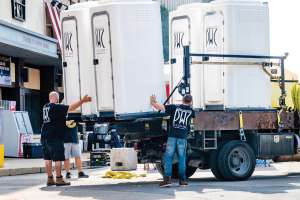

THE TEAM
Doug Marshall celebrated his four-month anniversary of owning the Portable Water Closet in St. Louis, Missouri, with a party, a big party — America’s Biggest Birthday Party, July 2-4 at Fair Saint Louis near the iconic Gateway Arch. It was his third big event, but the earlier Kenny Chesney concert and Pride Parade were just warmups compared to the Fourth celebration. Fortunately, a few of the employees on his team had worked the big event with Portable Water Closet’s previous owner, Kate Barcom.
Marshall attended several meetings with organizers to analyze and coordinate how to work with the “footprint” — the layout of performance stages, vendors, etc. The problem was the footprint kept moving and changing with new activities each day, including a parade.
“Everything had changed — the size, location and quantity (of restrooms) all changed and they put a parade in the middle of it so I bid (and won) for the parade too,” he says. “Kate gave me suggestions, but we had to be so flexible. We just had to accommodate on the fly.”
He and his team members put in long days, then met in the evenings to plan for the next day.
“Coordination and collaboration are key. Every driver had their own meticulous file where to pick up and drop off units. Due to the changes we went old school with maps,” Marshall says.
COMPANY HISTORY
Kate and Jeff Barcom recognized a need for quality portable restroom service in the area so they started Portable Water Closet in 2011. Marshall, who had worked in cybersecurity and lived in St. Louis since 1998, was ready for a change when the chance to buy the PRO business came up earlier this year. The son of a Navy test pilot, he had grown up traveling all over the world before the family landed in St. Louis. He recalls talking about sustainable business models, and portable sanitation was high on the list as something that will always be needed.
The business also fits Marshall’s philanthropic desires to use part of the profits to support a couple of his favorite veteran causes — Honor Flights to Washington, D.C. and the St. Louis Songs for Soldiers concert that benefits veterans.
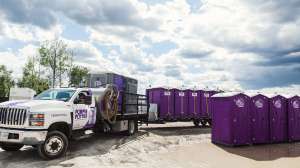
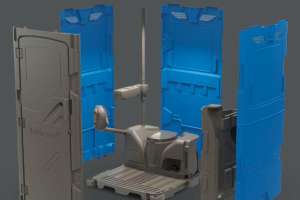
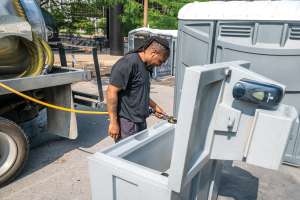
With the purchase of Portable Water Closet, he acquired 700 standard Tuff-Jon (T.S.F. Company) restrooms and Satellite ADA units, five trailer units (including Ameri-Can Engineering), 73 T.S.F. sinks, three trailers that haul 12-16 units and Ram 3/4-ton trucks with stainless steel 250-gallon waste/200-gallon freshwater tanks
THE MAIN EVENT
Fair Saint Louis, held July 2-4, 2022, has been the city’s premiere and free event since it started in 1981, only taking a break during the COVID pandemic. Crowds exceeded expectations the 41st year, with tens of thousands of people visiting the seven square block area near the Gateway Arch to listen to live music, participate in STEM and family attractions, eat and shop and watch fireworks over the Mississippi River framed by the Arch. On Saturday, the 139th America’s Birthday Parade took center stage.
BY THE NUMBERS
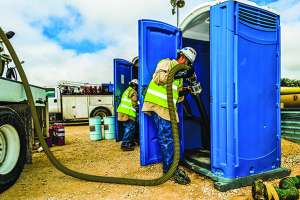
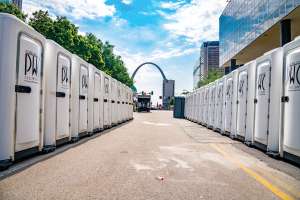
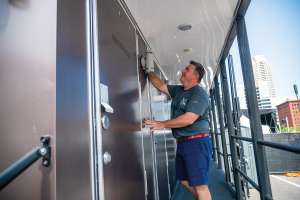
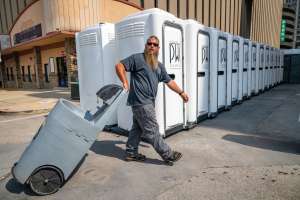
Servicing the event required 200 portable restrooms, including standard and ADA units, and 64 sinks. The five trailer units were set up for entertainers, VIPs, law enforcement and first aid workers. The Water Closet team used five Ram trucks with 250-gallon waste/200-gallon freshwater tanks to service the restrooms. It took eight daily trips to remove waste and refill water tanks to accommodate all the restroom units and sinks.
LET’S ROLL
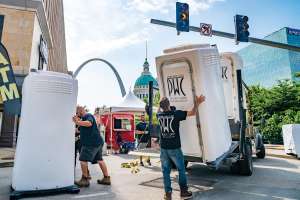
Setup started on Thursday using all three trailers to haul the restrooms. It took a dozen loads, but fortunately the Water Closet site is less than seven miles away. Since the window for setup was narrow, all vendors were moving in at the same time.
“I got to meet everyone. We worked side by side, and I ran into people I haven’t seen for years,” Marshall notes.
Most of the units were set up in four banks with one or two scattered to serve specific areas for medical, fire department and other volunteers. Trailers were also scattered to serve different venues.
Each morning seven drivers worked from 5 to 10:45 a.m. servicing and moving units as needed before events started at 11 a.m. It was challenging as they had to work around vendors’ vehicles that often blocked restroom access. The same crew worked as attendants from 6-11 p.m. driving a golf cart to carry supplies to clean and restock units with toilet paper, paper towels and other supplies stowed in locked rolling totes hidden throughout the grounds.
Between all that, drivers serviced regular customers and met late at night to plan for the next day.
“Many restrooms had to be moved for the parade because it went down the middle of the footprint,” Marshall says, noting units were moved to accommodate parade participants including 1,200 band members. “Then, they had the fireworks by the Arch so we had to have 80 units on the federal grounds on Monday.”
Because they couldn’t unload at the wastewater facility that was closed on Sunday and Monday (the Fourth), Marshall had a truck from the facility parked at his business for drivers to unload those days.
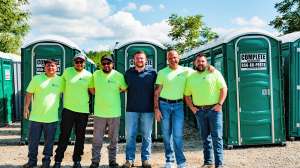
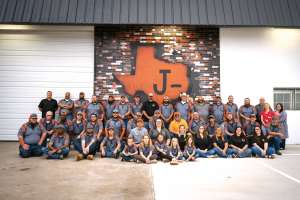
With 12-hour-plus days and temperatures exceeding 100 degrees, Marshall was proud of how his team maintained the standards of cleanliness the company is known for. Part of that was due to diligent preparation, from having the right amount of chemicals and supplies to wearing gray uniforms instead of black uniforms and emphasizing the need for constant hydration.
WRAPPING IT UP
The hot, humid weather continued into Tuesday and Wednesday as the team reversed the process to bring everything back to Water Closet’s yard. The last trailer of units pulled in around 10 a.m. Wednesday and drivers were given time to catch their breath before jumping into regular runs and planning for the next weekend’s events.
The experience was rewarding and educational for Marshall, who plans to make adjustments for future years. Instead of hauling the waste to the plant 14 miles away, it was more efficient to unload into the truck at his yard, less than 7 miles away. And instead of hauling water, he will talk to the city about using its hydrants to fill tanks for wash stations and restrooms.
Oddly enough, the biggest lesson he learned was not to spend a lot of time planning.
“Plans are wonderful, but things change dramatically,” he notes. “It was great having a nimble team.”
Continue reading for free