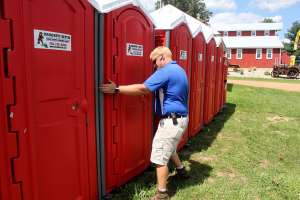
“We just want to continue to grow our presence in the area,” Rogers says. “Our goal is that when you hear Smooth Move, you don’t think of a moving company. You think of a portable restroom company.”
LEARNING CURVE
Smooth Move’s origins go back to 2012 when Rogers, Card and Haines joined forces to form a roll-off container business, Houston Waste Solutions, after a noncompete clause expired from the sale of a prior roll-off business Card had owned. Haines worked for that company in a sales capacity and just prior to the sale had introduced her friend Rogers to Card.
“After I interviewed with him he ended up selling that company, so I never officially worked with either of them, but that’s how I got into this industry,” Rogers says.
Rogers worked for the purchasing company for a while, but after Card’s noncompete clause ended, the three decided that they wanted to team up to start their own venture. As they started to grow Houston Waste Solutions, it quickly became apparent that it would be wise to get into the portable restroom business as well.
“We were constantly getting asked by customers if we had portable toilets,” Rogers recalls. “We realized that portable toilets were like your marker on a job site because they’re the very first thing that gets put on a site. We had competitors who had both roll-off containers and portable restrooms and started noticing when we’d go out to different sites that they’d already have a portable restroom there. It was a foregone conclusion that they were going to get the trash side of the business too.”
In May 2016, the three partners decided to officially launch the portable sanitation subsidiary Smooth Move Services. With no prior portable sanitation experience, they studied competitors to figure out the necessary details — what manufacturer to use for the restrooms, what kind of service trucks were most common. Through a sales rep from Satellite Industries, Rogers coordinated a ride-along with an Austin-based restroom company.
“I went out on a full route with one of their drivers, just so I could see what they did and how the whole business worked,” Rogers says. “I came away with a binder full of information — all the good and the bad, what to do and what not to do. It was kind of a starter pack for starting a portable restroom company.”
The company name, Smooth Move, was inspired by a brand of tea, and Rogers says they thought it provided a good balance of being funny and catchy, but it in a tasteful way that didn’t undercut professionalism. Early on though, they didn’t do a lot to build up Smooth Move’s own identity.
“Everything was attached to Houston Waste Solutions. Most of our customers would even get their invoices from Houston Waste Solutions,” Rogers says.
But that began to change a couple of years ago.
SALES SPECIALIST
One of the biggest changes that led to Smooth Move’s strong recent growth was bringing on a dedicated sales rep for the company.
“We’ve been in business for six years, but until two years ago, we didn’t have a sales rep focusing only on portable restrooms,” Rogers says. “We’ve had incredible growth since that point.”
Smooth Move is now up to two sales reps, with another coming on about a year ago. They maintain different focuses. One targets the construction market. The other’s focus is event work and bringing on new industrial/municipal customers. Rogers says there is a lot of opportunity in Houston with event work and industrial customers, but it would be difficult to access without a dedicated sales rep.
“There’s a lot of cold calling; seeing which companies are using portable restrooms and figuring out how we can get through the door,” Rogers says. “And with events, this is a giant city. There are so many diverse things happening. Any given week during event season, you might have 40 different things going on. It’s hard to find all of them and figure out who is the right person to talk to.”
Plus, the pandemic created a unique situation when it came to events. After shutting down operations for a year or two, many events had new people in charge once they returned, Rogers says. It was the right time to be bringing sales reps on board.
“A particular event may have had a 20-year relationship with a restroom company. But over the course of the pandemic a lot of people with event companies have moved on to other things,” Rogers says. “There are new people in charge and previous relationships are not necessarily still around. It’s a nice time for our sales reps to get in and build relationships from scratch; get some opportunities that may have not been there prior to COVID.”
Rogers says the goal is to find consistent balance in Smooth Move’s workload, and not have construction make up such a large portion of it. Depending on the time of year, construction can be as much as 90% of the business. The efforts of the sales reps are gradually paying off though, and Smooth Move has been gaining new municipal/industrial customers and event work.
“Customers need to have a contact person they can call and depend on. Giving us a shot is hard because they may not have heard of us before, but a sales rep can give them face-to-face contact and convince them that we’re good and capable of handling their job,” Rogers explains. “Once you get a few of those, you’re able to offer them to others as a reference and it kind of snowballs.”
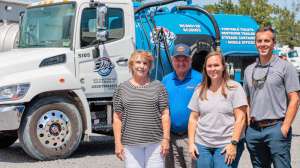
In addition to sales reps, Smooth Move now has 17 other employees including route drivers, delivery drivers, yard workers and office staff. All of the companies under the Houston Waste Solutions umbrella share a management team.
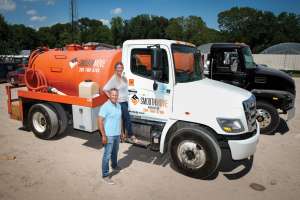
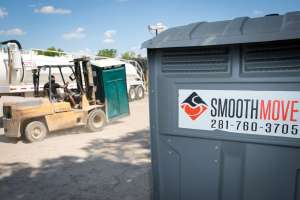
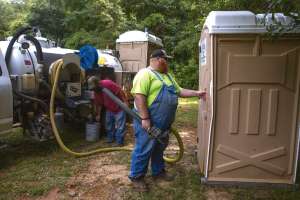
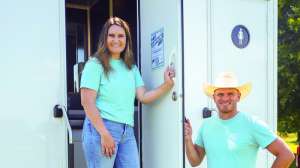
The equipment fleet includes nine Hino and two Mack vacuum trucks, covering 10 service routes. All the trucks have 1,100-gallon waste/450-gallon freshwater steel tanks, National Vacuum Equipment 304 pumps and Burks DC-10 water pumps from American Tank. The restroom inventory includes 2,300 standard units and 40 ADA units, largely from Satellite Industries, and 100 hand-wash stations from Satellite.
GETTING EFFICIENT
While growing the company by finding new business and diversifying the customer base, Smooth Move has also increased focus of late on streamlining and fine-tuning the operational side. Despite largely sticking to the greater Houston area, Smooth Move still maintains a large footprint, which has been challenging over the years.
“We have routes that are 250 miles in a day, and 50 restrooms get cleaned during that time,” Rogers says. “Maybe it’s the burden of having three owners who come from a sales background. We’re always like, ‘Sure, we can do it,’ even if it doesn’t make logistical sense. It’s not ideal, but it at least has helped us build strong relationships with customers.
“We’ve had tremendous growth in recent years and it doesn’t happen in only one area at a time,” she continues. “If you want to be that company that is growing with the city and getting recognized everywhere, you just have to expand with it.”
One thing recently done to build efficiency while serving a large area was hiring Shane Linnell as operations manager. He started last spring and immediately had ideas for changes. One of the first tasks was doing a full reroute to help with the large service footprint.
“A lot of it was just condensing areas, making the routes denser. Like if someone wanted one restroom serviced two times a week, we instead maybe changed it to two restrooms serviced once a week,” Rogers explains. “We used to look at logistical things like that every now and then, but it was great having someone actually sit there for two weeks and really dig into every route and make sure everything was being done in the right order and grouped together correctly.
“In the end we only ended up not servicing one customer who was just really far out. It was one restroom, and it was 45 minutes to go out and do it once a week,” she says.
Beyond handling Smooth Move’s reroute, Rogers says Linnell has brought up the company’s standard of service and made it more consistent across the board.
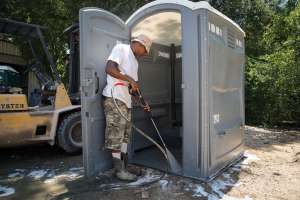
“Just quality control, making sure the units going out look perfect. Stickers are on, inventory is done correctly. Checking all the boxes,” Rogers says. “You have to make sure things go perfect when you set up new deliveries or do events. That first impression is important because it’s such a personal experience with a restroom. You don’t want to go out and something goes wrong right off the bat.”
A SOLID FOUNDATION
Successful implementation of the changes of the past couple of years has been the solid business framework Smooth Move aimed to establish from the get-go.
“As we’ve grown and brought in new people, we always had the technology and policies we needed already in place,” Rogers says.
GPS on trucks, routing software (TRUX) and drivers regularly using tablets for a variety of tasks have been standard practice for the company from the beginning. “It allows us to stay skinny from an office standpoint,” Rogers says. “We try to use that technology where we can to make things efficient and easier.”
For example, say a driver can’t access a restroom because the job site is locked. They immediately take a photo on the tablet. It goes back to the office, which can then quickly alert the customer. Many times, the customer can pass along the security code or go to the site, Rogers says, but in the event a restroom service doesn’t work out that day, there’s at least photographic evidence.
“It’s time and date stamped with the GPS coordinates, which can help from a cost standpoint,” Rogers says. “We don’t have people arguing, saying, ‘Hey, you didn’t show up this week.’ It’s less time for our accounting people, trying to track down a driver to see if they remember what happened at a particular job. We have that information right there on the tablet.”
MOVING FORWARD
Going forward, Rogers says the plan is to continue to pursue what the past couple of years have brought — a larger presence in the industrial and municipal markets, more events work. Essentially to become the kind of bigger restroom company it has always aspired to.
“We just want to continue to grow and build on the great team we already have and add more trucks and restroom units,” Rogers says. “We’re going to keep getting our name out there. We want to see our portable restrooms everywhere.”