In 2006 Mike Krepfl and his brother Phil stepped into roles they had been groomed for their whole lives. After 34 years, their parents were ready to hand off their portable sanitation and septic pumping business to their sons. Krepfl’s father had inherited the business from his father who started doing septic pumping in the mid-1950s as sideline work to supplement his income.
Phil eventually went on to do other things, but Mike was well-prepared to run the company. Not only had he grown up in the business, but he had supplemented his on-the-ground experience with a college degree in business administration.
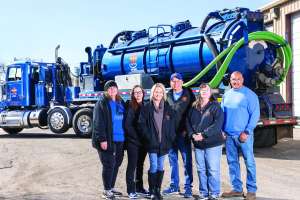
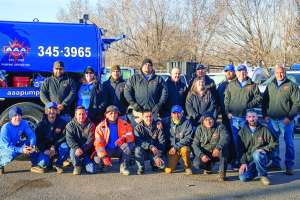
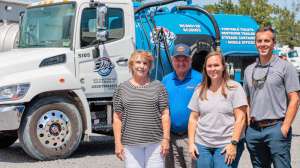
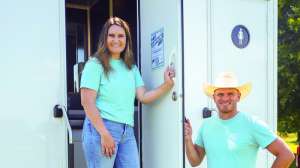
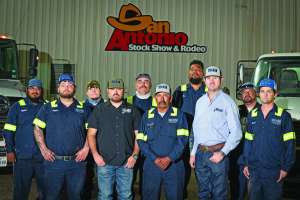
The company, AAA Pumping Service, operates out of an office and nearby storage yard in Albuquerque, New Mexico. Mike runs the business along with his wife Shelley, the office manager, and Raul Rivera, the general manager. The rest of the crew includes three dispatchers; 12 employees on the portable sanitation side and eight technicians on the septic side.
Their service territory covers a 70-mile radius which includes Albuquerque, Sante Fe, surrounding towns and several Native American reservations. About 60% of their work is portable sanitation and about 70% of that is for construction.
THIRD GENERATION
Mike’s parents, Tip and Joyce, took over the business from Carl Krepfl in the early 1970s and expanded it. “They made it more of an actual business,” Mike says. “It was still out of their home, but they were doing septic pumping and then they started doing installations.”
Mike’s parents, Tip and Joyce, took over the business from Carl Krepfl in the early 1970s and expanded it. “They made it more of an actual business,” Mike says. “It was still out of their home but they were doing septic pumping and then they started doing installations.” The couple eventually moved the company out of the house. By 1991, the family added portable restrooms.
After a brief stint working outside the wastewater industry after graduation from New Mexico State University, Mike returned to the family business and took over management of the portable sanitation work, while his brother took on the septic side. Phil later sold his part of the business to Mike. “At that point we only had a few employees,” Mike says. “But then the company really began to grow from there.”
Mike says his business degree has been helpful in his day-to-day operations working with the budgeting, finance and banking aspects of the business. He continues to learn and keep up to date on the industry as a member of Portable Sanitation Association International and often attends the WWETT Show in Indianapolis.
TRAILERS ARE POPULAR
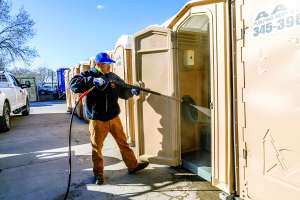
The company has about 2,000 portable restrooms (Tufways and Maxims from Satellite Industries), including 100 ADA-compliant and wheelchair-accessible units. Most are sand-colored, but the company is transitioning to gray units for events. They have 150 Satellite hand-wash stations and also provide holding tanks and freshwater tank setup and delivery.
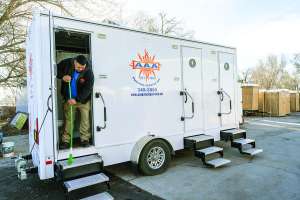
The company bought its first restroom trailer in 1991 and now has 35 (JAG Mobile Solutions and Satellite Suites). They’re used for weddings, special events, movie sets and commercial remodeling projects for companies including Home Depot, Lowe’s, Walmart and car dealerships. AAA will provide attendants at events, if requested, but they recommend their retail customers keep one of their own people on site to prevent problems, provide basic cleaning and report vandalism.
Mike says they have to be selective with placement of the trailers where vandalism can be an issue such as at gas stations and rest areas. “We’ve learned to use an extensive damage clause and waiver,” he says. “And if it’s too challenging of a site, we just won’t take it.”
He says they’re starting to see large construction sites ask for restroom trailers — and not just for the office staff, but for everyone working on a project.
The company also has several shower trailers (JAG and Satellite) in two-, three- and four-station configurations.
“We started getting calls for them,” Mike says. “So I bought one and within a few years we had five, and now seven.” The units are typically used for bathroom remodels, special event campgrounds and disaster relief situations. During COVID, they were also used to supplement sanitation facilities on reservations.
THE SERVICE FLEET
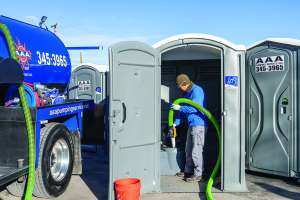
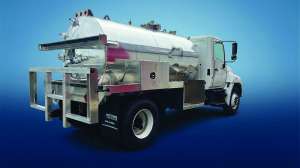
On the portable sanitation side, the company has 12 International and four Ford F‑550 vacuum trucks built out by Tank World, most with 1,100-gallon waste/400-gallon freshwater steel tanks, and a few with 1,500-gallon waste/500-gallon freshwater aluminum tanks. They use Moro and National Vacuum Equipment pumps. Mike likes newer trucks. “Anything that’s a daily route truck, we try not to have it be more than five to seven years old,” he says.
The company has more trucks than drivers, so backup rigs are available. “You have to nowadays,” Mike says. “Now when you send a truck to the shop, the service times are so much longer, sometimes as long as a month or two.”
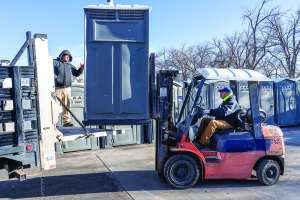
For pickup and delivery, the company has eight transport trailers — 12-, 16- and 20 unit haulers — from F.M. Manufacturing, and also uses their four Ford F‑550s and Isuzu trucks.
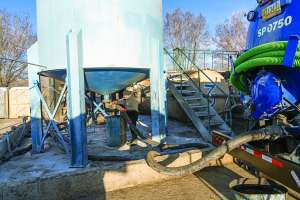
On the septic side, the company has 14 International, Western Star and Freightliner vacuum trucks, most from Tank World. They are equipped with NVE pumps and steel and aluminum tanks. Most are 3,600-gallon waste/400-gallon freshwater, some carry 2,500-gallon waste tanks. All are equipped with pressure washers and jetters from Cat Pumps.
Mike likes to have identical trucks for several reasons. One is ease of maintenance. “And when we bring a truck in for service, we can put the driver into a backup truck and it’s identical to the truck he’s been driving so he’s completely familiar with it. It’ll fit in the same spots he’s used to driving to. He knows where everything is. We found that to be very beneficial. And it looks nice too — it’s a good image.”
The company also has three Peterbilt tractor trailers from Keith Huber and Dragon outfitted with 6,300-gallon tanks to handle large septic and grease jobs and for long-haul runs.
Since 2021, the company has been using ServiceCore software for fleet management and routing. “Drivers carry tablets,” Mike says. “They can see all their jobs and can be dispatched on the fly without having to come in and get paperwork.”
A VARIETY OF CUSTOMERS
The company maintains a presence on social media. “It’s really important,” Mike says. “It’s a good way to reach people. You also get people who like to complain but we have excellent Google reviews. We’ve made it a point to reach out to people to give us good reviews.”
The company serves many special events, including wine festivals, concerts and summer festivals. They also provide portable sanitation for the New Mexico State Fair in Albuquerque, feasts and ceremonial functions on the Native American reservations and charity events such as Make-A-Wish Foundation fundraisers.
The company’s biggest event is Balloon Fiesta in Albuquerque attended by a million people over 10 days in October, which they’ve handled for 22 years. Current requirements call for 450 portable restrooms and 20 restroom trailers. They also provide RV pumpouts and freshwater fill-ups. Equipment is serviced late nights and early mornings once a day, or twice when there are night events. Mike has had the opportunity to take a balloon ride and thoroughly enjoyed the experience.
As happens at many events, the company receives calls from people who lost something in the restrooms — glasses, wallets, cellphones. “We always find it funny that they want them back,” Mike says. “We don’t promise anything but if they can tell us which toilet it was in, we’ll look. But they have to wait until we service them, not during the event.”
Mike says there has been a recent uptick in construction, everything from homebuilding to commercial projects. They’ve also provided units for a number of solar farms built in the area. Those sites usually require about 30 units, trailer-mounted so the customer can move them around where needed during various phases of construction. The sites are large and remote so, for servicing, the driver either goes to a check-in station and is given a map and directed where to go, or the customer brings everything to a central servicing area.
STAFFING IS KEY
Mike says the company has some very good long-term employees, and those people have contributed greatly to the growth of the business. The company works hard to keep them. “As a starting point, we try to provide them with the best equipment we can to do the job,” he says. “We’re really big on newer equipment. And we’ve gone to automatic transmissions because it’s much easier on the drivers.”
They also provide steady employment — no big fluctuations in hours or winter layoffs. “And in recent years, people seem to want more time off for personal things as well as vacation time, so we try to do that if we have enough people,” Mike says.
Bonuses are given out at Christmas, and the staff enjoys monthly potlucks. Drivers meet regularly to discuss safety guidelines, service issues and possible improvements.
Mike says it’s still hard to find good employees but thinks the situation has been improving the last couple years. “It’s one of those jobs that people either like it or they just don’t,” he says.
CHALLENGES AND REWARDS
Mike says a big concern these days is rising costs for equipment. “The diesel emission stuff is expensive and sometimes unreliable,” he says. “After 16 years, they haven’t completely figured it out.”
Electric trucks are the next big unknown. “That could be a complete nightmare for everybody, so I’m a little concerned about that,” he says. “Nobody knows how that’s going to work with hauling weight and going long distances.”
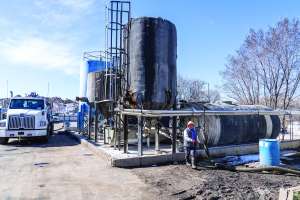
To address the rising cost situation the company is working on operating more efficiently through technology, buying equipment and supplies in bulk, and looking at disposal options such as dewatering and land application. They are also experimenting with smaller, more fuel-efficient trucks for long-distance routes.
Despite the challenges, Mike is still enthusiastic about the business. “I have really enjoyed watching the progression of our company, being involved in it so long and seeing it go from a one-man operation out of my grandfather’s house to what it is today. That’s been very rewarding.”