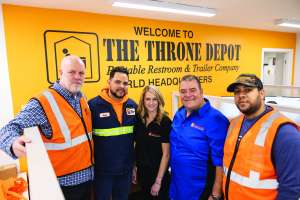
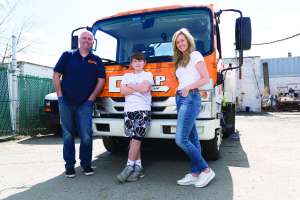
In 2005, Steve Brodeur was handling sales for a dot-com company and Mike Cormier was a truck dealer. But when they heard a friend at FMI Truck Sales & Service say there were few portable sanitation companies in Massachusetts, they saw an opportunity and jumped on it.
They ordered 26 portable restrooms, bought a vacuum truck and started a business, calling it The Throne Depot. Growth was steady over the years — all organic — and they now have 35 full-time employees including 21 drivers, office staff, salespeople, mechanics and operations personnel.
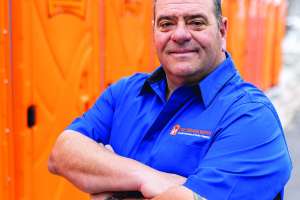
Brodeur attributes their success to the company’s commitment to take care of customers and employees. They also maintain flexibility in meeting whatever challenges or opportunities come their way, whether it’s an economic downturn, a global pandemic, new technology or millennial customers who want to do things a little differently.
The company operates out of a 20,000-square-foot office/garage in Billerica, Massachusetts, about 20 miles north of Boston. They work within a 100-mile radius in parts of eastern Massachusetts, eastern Rhode Island and southern New Hampshire.
UNIFORMITY
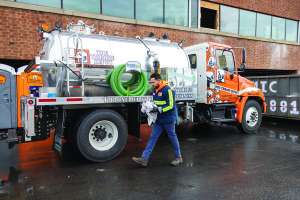
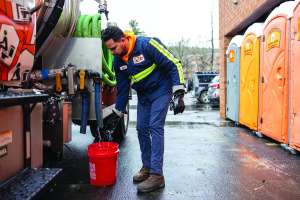
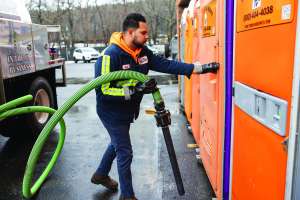
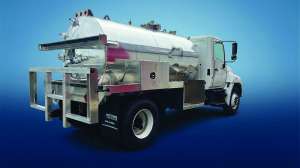
The company currently runs a fleet of 28 Hino trucks built out by FlowMark, most with 1,300-gallon waste/300-gallon freshwater aluminum tanks and Masport pumps. Brodeur says the standardization provides consistent branding, easier maintenance and fewer parts to stock.
Their transport trailers are from Liquid Waste Industries in sizes ranging from two-unit haulers to 20. Their deodorizer products are from Walex Products and J&J Portable Sanitation Products, all formaldehyde-free.
The company manages the fleet using software from Motive Technologies. And they use route optimization and inventory management software from ServiceCore.
“We do everything we can to embrace technology,” Brodeur says. “We are paperless. Everything is done with phones now and an app. All our trucks are tracked by GPS, pictures are taken of all deliveries and pickups, and customers can pay their bill online.”
Brodeur says disposal is difficult in their area because treatment plants are aging and yet the population is growing, causing overuse of the facilities.
“We have [municipal] and private-run plants,” he says. “We need more private plants that we have the opportunity to build ourselves because the treatment plants that were built in the 1960s and 1970s have not been adequately updated.”
COLOR COUNTS
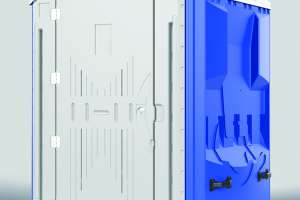
The company has 5,000 portable restrooms including about 200 flushable units and 200 wheelchair-accessible units, 100 hand-wash stations and a few dozen hand sanitizer stands (all from PolyJohn and Satellite Industries).
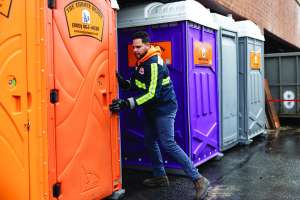
Color helps identify units used for different purposes. Construction units are orange and gray and event units are orange and purple. The company also stocks solid gray units for use in towns that require a solid color. And they now have a supply of lockable pink units.
“In Massachusetts, women have to have their own restrooms on construction sites,” Brodeur explains. “So we color-code those pink so they can be identified as a female restroom. The job supers like it and they’re easy for us to know where they’re at. We implemented that several years ago and it’s been very well received.”
The company has 30 restroom trailers, most from JAG Mobile Solutions in sizes ranging from two-stall to 10, including one with an ADA-compatible stall. They also have one shower trailer from JAG.
SERVING THE COMMUNITY
In the summer about 30% of the company’s work is for events — local fairs, festivals and weddings. One of their bigger events, which they have serviced since 2011, is the Revere Beach International Sand Sculpting Festival, attended by nearly a million visitors over three days. Other events include the Boston Pride for the People parade and festival, Boston’s Wounded Vet Run and American Cancer Society activities.
The restroom trailers are mainly used for weddings, high-end events and commercial remodels. “But we’ve also introduced them to the construction companies as a great alternative to plastic toilets so they can provide their employees with a nice, climate-controlled place,” Brodeur says. “That’s becoming more popular.”
The company’s shower trailer is used for temporary housing camps and disaster situations such as gas explosions, fires, hurricanes and landslides. “We deal with the Massachusetts Emergency Management Agency and we’re a subcontractor under the Federal Emergency Management Agency,” Brodeur says. “We also work with third-party companies.”
Construction accounts for about 90% of their work in the winter. “We’ve got road work, residential housing, commercial buildings, bridges, power plant substations — everything,” Brodeur says. In 2019 they were involved in the renovation of the TD Garden arena.
TRAINING AND SAFETY
To find employees, the company relies on referrals, social media, internet sites such as Monster and Indeed, and recruiters. Candidates go through a vigorous interviewing process with several people, including general manager Mark Maynard and one of the senior drivers who would be training them.
“We want to make sure it’s going to be a good fit for them and for us because when we bring somebody on we’re going to invest in them, we want them to invest in us and we want them to stay,” Brodeur says.
New hires are put through a three-week training process on everything from equipment and software to driving and safety. Safety is a top priority at the company, Brodeur says. “All our drivers are going out on these big, expensive trucks. So the trucks are all kept up to date on maintenance and service. And we have drive cams and driver cams.”
Drivers must wear uniforms. “You cannot go to work here without a uniform and safety gear on,” Brodeur says. “Before you even punch in, there’s an operations person there to make sure you came prepared to work — uniform, work boots, everything.”
The company holds weekly departmental meetings. And, although it’s harder to do as they’ve grown, once or twice a year they try to have a companywide meeting.
They are active members of Portable Sanitation Association International and go to the shows each year. “I take my drivers,” Brodeur says. “They all get certified on the correct way to service a toilet to industry standards. All my operations managers go to either the Nuts and Bolts in the fall or the trade show and continuing education in the winter. We take three to five people to each show to continuously invest in PSAI and in our people.”
CUSTOMER CONTACT
Brodeur was the company’s original salesperson but by 2013 they hired someone for the job. They now have five salespeople, including customer service reps, working both in-house and in the field.
The company’s logo appears on everything from marketing materials to vinyl-wrapped trucks. Restrooms have Monster Stick decals from Dynamic Decal & Displays (Flywheel Brands) on all sides.
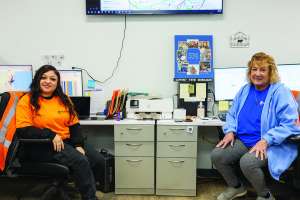
With the hiring of Mariah Mazerski in 2021, the company deepened its commitment to social media and its online presence. Mazerski says they engage on social media multiple times per week and their number of followers has grown.
The company asks customers to leave reviews on Google. Mazerski says they maintain a 4.9 rating. If they get a negative review, they address it immediately.
“There are very few negative reviews,” she says. “But when we do receive that kind of feedback, our operations director engages with the customer to learn more about what happened and offers a solution. And if there’s coaching needed for the driver, he does that. Or sometimes it’s going back to our sales team.”
The company has recently embraced e-commerce, allowing customers who wish to do so to handle the whole process online. “It’s really focused around the millennials who don’t like to talk to people,” Brodeur says. “It gives them the opportunity to go right online, order a toilet and pay for it. It’s open 24 hours a day.”
By no means has the company abandoned other methods of interfacing with customers, whether it’s on the phone, social media, attending building council meetings or participating in local chambers of commerce.
PLANNING FOR EXPANSION
One of the challenges the company currently faces is increasing expenses for fuel, general liability insurance and health insurance. “We can’t draw good employees without offering good benefits and the cost of health care is a massive undertaking, especially for a small company,” Brodeur says.
Forecasting is another challenge, especially coming off of a pandemic. “We had an almost two-year pause of events so now customers are trying to get back,” Brodeur says. “The fundraisers are trying to raise money. We drop our price to work with them so they can have their event. But getting back to normalcy is the hardest thing, and forecasting equipment needs since the pandemic is our biggest battle.”
But Brodeur still gets excited about the industry. Future plans include opening up locations in southeastern Massachusetts and southeastern Maine. He also enjoys new technology and the advances being made in the industry.
“Our industry is still new,” he says. “The technology is constantly evolving. We’re more and more needed in society now. When I started in this, people shunned what we did but now people get excited about using a luxury trailer at a wedding or a brewery event. Customers want a better experience. Our industry is changing and the products are evolving.”