THE COMPANY
American Grease and Septic was founded in 2017 in Evansville, Indiana, by two plumbing companies — sister company Hydromax and a competitor. Hydromax had already invested in portable restrooms as a free offering to clients to generate plumbing work, and these became part of the new company’s inventory.
As grease and cooking oil collection contracts increased, American Grease and Septic purchased several routes from the company that employed Chris Musack, who had extensive experience in the field. He joined the company in 2018 as a sales representative and is now president. The company employs 10 people and provides service to clients in central and southern Indiana and Kentucky.
About 80% of the company’s business includes grease, septic and nonhazardous industrial pumping. The remaining 20% involves restroom rentals and service.
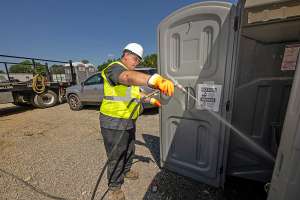
Portable restroom clients include construction and agriculture, particularly farms around Vincennes, the watermelon capital of Indiana. The company’s biggest event is the PGA Korn Ferry Tour Championship held annually at the Victoria National Golf Club in Newburgh, Indiana. The event requires three restroom trailers, 40 portable restrooms, 10 ADA units, and 10 portable hand-wash stations.
BY THE NUMBERS
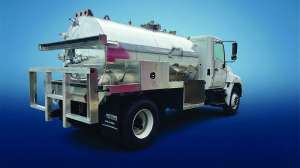
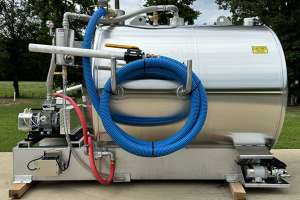
AG&S operates seven vacuum trucks, all with National Vacuum Equipment pumps. These include a 2016 Peterbilt with a 6,300-gallon aluminum waste tank and a separate 300-gallon steel freshwater tank; a 2018 Peterbilt with a 3,800-gallon waste/150-gallon freshwater steel tank; a 2020 Hino with an 1,800-gallon waste/400-gallon freshwater aluminum tank; a 2021 Peterbilt with an 800-gallon waste/400-gallon freshwater aluminum tank; a 2023 Western Star with a 4,700-gallon waste/300-gallon freshwater steel tank); and a pair of 2023 Freightliners with 3,500-gallon waste/100-gallon freshwater steel tanks. The trucks were built by a range of suppliers that includes National Truck Center, TSI Tank Services Inc. and Iron-Vac/LMT.
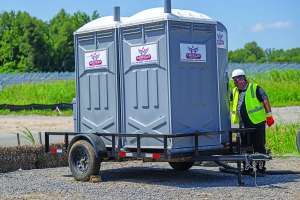
The company rents and services: 400 portable restrooms from Satellite Industries and Armal. It operates six VIP restroom trailers: a 10-station trailer from JAG Mobile Solutions; two Satellite Selfie SLIM two-station restroom trailers; two from Lang Specialty Trailers — a Pro Series five-station and nine-station; and one custom four-station unit built in-house.
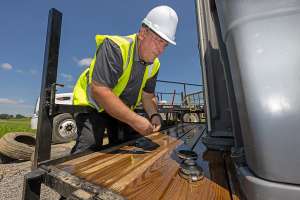
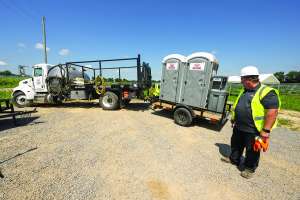
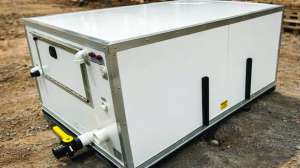
AG&S also operates 40 mobile agriculture units carried by locally fabricated utility trailers. The units utilize two restrooms and a hand-wash station from Satellite. The trailers are assembled in-house. “We treat them as blanks, and bolt down our construction portables and sinks,” says Musack. “We then add stabilizer bars or perform any additional fabrication as required.”
In addition, the company offers 75 Satellite hand-wash stations, a mixture of Tag 2 and Super Twin models.
THE JOB SITES
The company is completing contracts for two solar farms being built in the Evansville area, both jobs launched in February.
The first is a 15-month contract for the 1,500-acre Unbridled Solar Project. The sprawling site is located near Robards, Kentucky, about 40 miles south of American Grease and Septic. The project is expected to generate up to 160 MW of electricity, enough to meet the energy needs of 44,400 households.
The second is a 19-month contract for the Posey Solar Project located 25 miles due west in Posey County, Indiana. The project also covers 1,500 acres and is designed to produce 190 MW of electricity.
KEEPIN’ IT CLEAN
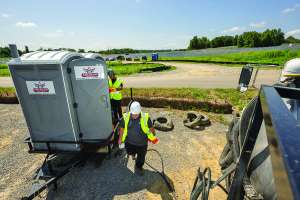
The Unbridled Solar Farm project is currently being supplied with seven field trailers, a Satellite Super Twin hand-wash station and four Satellite Axxis portable restrooms. In addition, they’re using several portable holding tanks for waste collection.
The Posey Solar Project uses 11 double field trailers, a JAG 10-unit restroom trailer, a Satellite Selfie-Slim two-unit restroom trailer, a mix of 29 Satellite Axxis and Armal portable restrooms, and a dozen Satellite Tag 4 hand-wash stations.
Unlike many traditional vertical construction sites, both solar farms spread across a massive acreage. The sites feature a laydown yard for delivery of construction materials. Construction crews begin by preparing the site, then installing the supporting infrastructure for the photovoltaic panels, and finally by installing the panels themselves, with work activity shifting from location to location, day to day.
However, the terrain is rugged, undeveloped land and the construction site is often bogged down in mud.
“A service understanding originally written into these contracts stated that they needed to move the restroom trailers where it isn’t feasible for us,” Musack says. “We couldn’t see ourselves being towed out of the mud each day. They would hook them up to ATVs or construction trucks and take them out to the different sites where they’re working, then take them back to the main base alongside the road so we could service them.”
Musack hired a new employee to ensure that he had the coverage required to service both contracts.
“Our original plan was to start out with that employee going out once a week and completing both service contracts in one day,” Musack says. “We were looking at a peak of two days a week on each farm, and then just staggering them out.”
However, the clients for both projects have since requested more frequent service and have made it easier to access many of the restrooms. At Unbridled, AG&S provides service Monday and Thursday.
The company hired a new employee half-time to increase the service frequency at Posey, where the construction site has been divided into zones, each with its own entrance.
“We’ve placed some of the units there,” Musack says. “Our new employee now services half the units each day from Monday through Saturday. At the same time, the solar project is using John Deere Gator carts to make it easier for employees to reach the restrooms.”
FUTURE SOLAR
Musack notes that more solar farm development is planned for the area.
“The push for electricity generation is part of a new shift in energy,” he says. “It’s exciting for us to be part of it. We’re already being approached about additional contracts of this nature.”