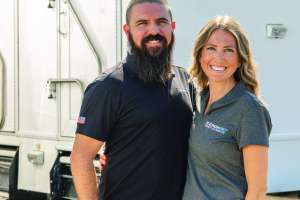
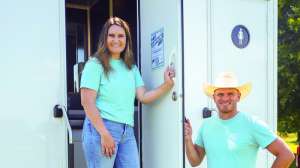
When Brandon and Kasey Dutcher started a portable sanitation business in 2016, it eventually became an all-consuming occupation. But compared to Brandon’s prior job as a journeyman lineman building power lines, where he was often away from home and typically worked 80-hour weeks, it’s been a dream job. They love working for themselves, their schedules are more flexible and they’re both home every night with their five young children.
The Dutchers started Platinum PRO Portables with the idea of offering restroom trailers for high-end events. They had big plans for the business which specifically did not include offering standard portable restrooms or doing work for the construction industry. But eventually they saw an opportunity there and knew that strategically it would be a good move to go in that direction. Providing standard units at construction sites now accounts for about half their business.
They’ve done nothing but grow. The Dutchers’ biggest challenge these days is keeping up with the growth and not turning away customers. Compliance is another issue as they have multiple government jurisdictions to deal with.
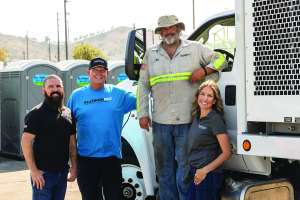
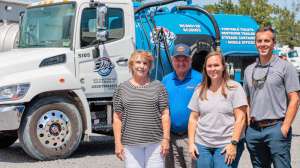
The company is located in Sun Valley, California. In January 2024, they moved into a garage/office facility. They have 18 employees, including nine technicians and nine folks handling operations, billing, customer service and sales. They provide portable sanitation, temporary fencing and occasional septic pumping in six counties in Southern California.
CHANGING COURSE
The Dutchers always wanted to have their own business, but couldn’t agree on what it would be. “Then I came across some restroom trailers and told Kasey, ‘These seem to be a hot ticket. Why don’t we buy one or two?’” Dutcher says. “It was the first thing we agreed on.”
They ordered two trailers, built a website and started marketing to high-end events. But after two years they had to rethink their business model. Despite Dutcher’s concerns about standard portable restrooms — “the price point was too low, they were gross, they got beat up” — they were getting requests, so they decided to give them a try and bought about a dozen.
It was slow at first, but by the following year, they needed more units, more trailers and another truck. And when construction clients asked about temporary fencing and residential customers asked about septic pumping, they added those services as well. And by this time they were hiring help.
Meanwhile Dutcher was still working as a lineman. But 2020 was a breaking point. “Toward the end of the year, I traveled to Long Island after a hurricane, then Iowa, then Louisiana for over a month after Hurricane Laura. Just when I got home I got a call to go to Shaver Lake for three months for the wildfires. When I came back, we just said it’s time to go all in on the business and make this thing work.”
THE INVENTORY
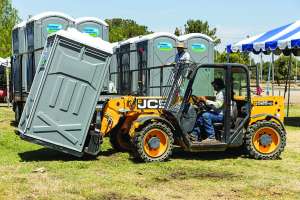
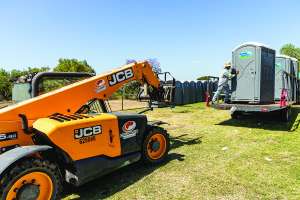
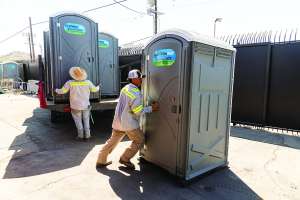
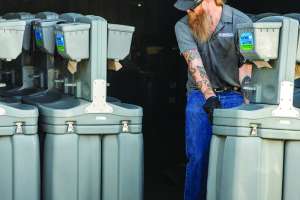
Today the company’s inventory (from PolyJohn and Satellite Industries) includes 1,000 standard and 50 ADA-compliant portable restrooms, many with sinks; 400 hand-wash stations; seven three-compartment stainless steel hot/cold deli sinks, and a large number of holding tanks. They have 17 restroom trailers (Satellite Suites, Comforts of Home Services, Rich Specialty Trailers) in various sizes, three of which have ADA-compliant stalls. And they have 100,000 feet of fence panels and 50,000 feet of chain-link fencing.
They also have 600 containment trays (PolyJohn, Satellite), as required by various jurisdictions, usually if units are placed within 50 feet of storm drains or in parks.
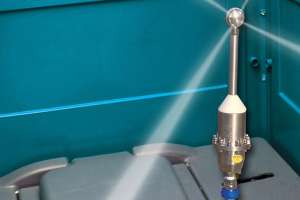
The company uses deodorizers from Walex Products. They have one transport trailer from Diamond C Trailers and a number of custom-built units from a local company.
Some of their larger events include Circus Vargas, the Fountain Valley Crawfish Festival, several Fourth of July activities, the Lakeview Terrace Watermelon Festival, the San Marino Motor Classic auto show, as well as college graduations, weddings and celebrity events. They’ve done work at SoFi Stadium, a number of military bases and multiple solar fields.
They occasionally provide services for movie and TV film sets such as The Voice, Bosch, and The Prom, and have worked for a number of studios, including Disney, Warner Bros. Raleigh, and Netflix. They don’t actively pursue that work as it’s been unstable the last few years with various labor strikes and contract negotiation difficulties.
THE FLEET
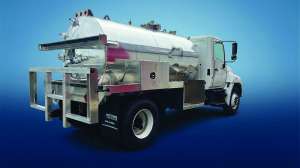
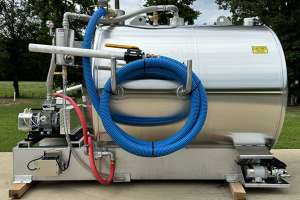
Septic work at this time is a very small part of the company’s business. But their 2020 Peterbilt 337 from FlowMark with a 1,600-gallon waste/400-gallon freshwater tank and National Vacuum Equipment pump carries 3-inch hose for septic work and a 2-inch hose for portable restrooms.
The other vacuum trucks — all with aluminum tanks, most with CAT 12-volt, 900 psi pressure washers — include a 2018 Ram 5500 from FlowMark with a 1,100-gallon waste/400-gallon freshwater tank and a National Vacuum Equipment pump; 2019 Ram 5500 from FlowMark with a 900-gallon waste/350-gallon freshwater tank and NVE pump; 2020 Ford F-550 from PortaLogix with an 800-gallon waste tank, a 350-gallon water tank and a Jurop pump; 2021 Ram 3500 with a Satellite 300-gallon waste/150-gallon freshwater slide-in tank; two 2021 Ram 5500s from Imperial Industries with 950-gallon waste/350-gallon freshwater tanks and Masport pumps; 2021 Ram 4500 from FlowMark with a 699-gallon waste/300-gallon freshwater tank and Masport pump; and two gas-fueled 2024 Ram 5500s from FlowMark with 699-gallon waste/300-gallon freshwater tanks and NVE pumps.
Dutcher went with gas engines on his last two purchases because California is implementing tighter diesel regulations, making it difficult to get smaller diesel trucks.
“The manufacturers are holding a lot of the engines back to go into larger trucks,” he says. “There will also be an additional tax on diesels at purchase and they’re going to start implementing a smog check for diesels. And used trucks have to be in the compliant years.”
Vehicles are outfitted with GPS units and dashcams and the company uses ServiceCore for scheduling, routing, billing, customer management and report generation.
COMPLIANCE
Kasey, a former manager for a program that oversaw preschool children at risk of being diagnosed with autism or Down syndrome, is in charge of the company’s compliance requirements. That includes everything from obtaining vehicle permits to registering the business in all relevant jurisdictions, maintaining their minority/women-owned business certifications, as well as ensuring employees are following policies and procedures and calls and emails are answered.
There is a lot of paperwork involved as each county and city has its own rules, regulations and governing body.
“For instance, in [Los Angeles] County, there is not a blanket business license that covers all of the county,” Dutcher says. “There are unincorporated areas that do not require a license, but there are multiple smaller cities within the county that have a specific business license for our type of business. And the dump stations each have their own entity set up that we have to get permitted with.” And, of course, the state has its own rules and regulations as well.
“So it’s knowing who requires what and going down a checklist,” Dutcher says. “Does this apply to this area — yes or no? We go down that list and make sure we’ve asked and gotten a direct answer, and then we mark whether it’s been done, needs to be done or not applicable.”
CONCERN FOR WORKERS
The company has used Indeed and Facebook to find new hires, but has also had good luck just hanging a “hiring” sign on their building. They get walk-ins almost daily.
Dutcher says the company is known for having competitive pay, good benefits (including medical, dental and vision insurance), an IRA-type plan, high standards — and not running the employees ragged. “Some companies expect their service tech to get 100 services done in a day. It’s not fair to push that much work on them and expect a quality product.”
Instilling the company’s values and standards into the team comes down to training, communicating expectations, having regular discussions and reviews, and constant reminders, Dutcher says.
“Employees will make or break a company. It’s been very important to us to do our best to interview and onboard the right people and identify our bad choices as soon as possible and make changes accordingly. We’re very grateful for the staff we have. Without them we wouldn’t be able to continue growing.”
REWARDING CAREER
Dutcher says these days his job involves customer service and sales, purchasing, finance, providing guidance, and looking for expansion opportunities. Some days it’s just putting out fires. “And when needed, I’ll be in the yard cleaning toilets or delivering equipment,” he says.
He appreciates not only what the business has given him, but that he now has the opportunity to provide a good workplace for others so they can provide for themselves and their families. He also values his relationships with customers and being able to provide a quality product and service they appreciate.
“There’s nothing like talking to somebody who is happy with the service you’ve provided them,” he says. “There’s just something about a happy customer that puts you on such a high level of energy and happiness.”