Ever since he was a youth working in the shop of his family’s business, Bob Drayton was a tinkerer. As a curious teen, the third-generation owner of Mr. Bob Portable Toilet Rentals in Southampton, N.J., a division of Bob Drayton Inc., took apart any machine he could get his hands on.
But, much to the chagrin of his father and grandfather, young Bob, now 36, usually moved on to the next teardown before putting the previous project back together. Though his incessant wrench-turning might have been the source of frustration at times, it continued a long-established interest in the mechanical side of the business that has served the Drayton family well for more than 50 years.
Knowing the ins and outs of vacuum trucks has helped Drayton, his father, Bob Drayton Jr., and late grandfather, Bob Drayton Sr., design and build service vehicles that perform their pumping tasks with greater convenience and longevity. Their skills and understanding of what makes a good pump truck is a source of pride for the younger Drayton and contributes greatly to the company’s success.
A LONG HISTORY
Bob Drayton Sr. began digging cesspools in 1955 and built his first vacuum truck in 1968. In 1971 he added 16 Phil Carter fiberglass restrooms. Today, Mr. Bob has approximately 3,000 restrooms, many Satellite Industries Tufway models, Hampel Corp. Country Classic units, along with a fleet of locally made 10- to 30-foot restroom trailers.
When health problems forced the senior Drayton to retire, he turned the business over to his son, Bob Drayton Jr., who, in time, did the same. The third Bob took over the family business nine years ago, he recalls. A legacy of truck-building has been instrumental to the company’s success.
A self-taught welder, fabricator and mechanic — he also races modified stock cars at the local half-mile dirt track on weekends, an 800-hp, big-block Chevy — the younger Drayton built his first vacuum truck about 10 years ago, following in the footsteps of his father and grandfather. The company’s first service vehicle was a used truck that Drayton’s grandfather built. Not uncommon in those days, the intake manifold from the engine was used to build vacuum.
Today, Drayton’s fleet includes more than 30 vehicles, from pickups and vacuum trucks to a 5,000-gallon Mack septic service truck with NVE 506 blower built by Transway Systems Inc. There’s also a 2009 Peterbilt with 5,000-gallon tank and NVE 506 blower currently being built by Transway. Other vacuum trucks include two Internationals with 2,500-gallon tanks and Jurop pumps and a 1989 Mack Super Liner with 3,500-gallon tank.
His restroom fleet includes five flatbeds — two Internationals and an Isuzu built by Crescent Tank Mfg. and two Mitsubishis built by Drayton — 14 service vehicles — all Internationals, except for a GMC mini truck used on golf courses. Four of the trucks are spares and most have 1,350-gallon tanks (950 waste/400 freshwater) and Jurop pumps. Two trucks have 2,000-gallon aluminum tanks (1,500 waste/500 freshwater) and Masport pumps. There also are three roll-off trucks — a Peterbilt, a Mack and an International. Some of the trucks Drayton purchased and some he built.
PRIZE PROJECT
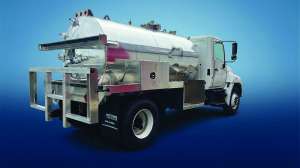
His prize project is a 2007 International 4400 service vehicle with 2,300-gallon stainless steel tank (1,600 waste/700 freshwater) and a Jurop pump. “We talked about everything you needed to service a toilet as fast as you possibly could, and we put it into this truck,” Drayton says. “It’s got two jumbo toolboxes on the driver’s side — one 6 feet long that holds all your paper products. The other toolbox on the driver’s side holds everything you might need — service stickers, graffiti remover, ratchet straps and things like that.”
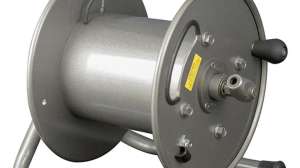
Between the two toolboxes is a drop-down box for storing hoses, hose reels, deodorant, spray cleaners and disinfectants. “Everything’s right on the driver’s side as soon as you pop out the door,” Drayton says. In the rear is a fold-down restroom carrier. It also has LED lights and washdown pump with hose reel.
The truck was built specifically for route driver David Phillips, whose 62-year-old father, Charlie, has been with Mr. Bob for more than 20 years.
“Usually the older guys get the new trucks and the younger ones get the hand-me-downs. David always got the hand-me-downs, but he took real good care of the equipment,” Drayton says of his 26-year-old driver. The truck took three months to build, working off and on during the winter months. Most work was done at Drayton’s shop, including the painting and vinyl lettering.
EYE FOR DETAIL
Drayton used to send his trucks out to be lettered, but each would come back looking a little different and the trucks would be away from the shop for a week or two at a time. So he bought a lettering machine and taught himself how to use it.
“The good part about it is I can have that truck in the shop and be doing stuff to it, or have my mechanic doing stuff to it while I’m doing the lettering at my own pace.” The only problem, Drayton says, is finding the time to create the computer-generated lettering.
Drayton chose the International chassis for consistency and ease of repairs. “There might be nicer trucks out there, but once you’ve got a fleet (of one brand), it’s tough to make the switch,” he says. He chooses non-corrosive stainless steel for his tanks, and bolts them directly to the frame in the rear and uses race car valve springs for cushion in the front.
Drayton prefers a slightly larger hydraulic-drive vacuum pump than necessary for timesaving convenience. “You can’t be waiting for a minute or two for the vacuum to build up,’’ he explains. “If you’ve got a 60-toilet route, for every minute you add to that route, you’re an hour longer doing the route. So you’ve got to make everything as quickly as possible.”
The hydraulic drive adds dependability, Drayton says. “You could miss a worn U-joint during routine maintenance and be left down on a route. It’s more expense in the beginning, but there’s less maintenance.”
Creature comforts on the prized International include air-ride seats and air conditioning. You might also include the automatic transmission on that list.
DEPENDABILITY AND WORKABILITY
“I’d say 90 percent of my trucks now are automatic transmission, where eight or 10 years ago they were almost all stick.” Drayton says the automatics are as much for dependability as for driver ease. “We’ve got less driveshaft problems, snapping axles, anything to do with transmission gears. Anything to do with shifting the truck is taken out of the equation now. They do burn a little more fuel, but I think it also has a lot to do with driver comfort. I know driving a septic truck and doing hard septic work or driving a potty truck doing a 10-hour route, as the day wears on, shifting those gears gets real tiring.”
Typically, Drayton starts with a 24-foot box truck, shortens the frame using a magnetic drill, makes the tank mounts and has the tank fitted within two days. A local fabricating company bends the sides and hose trays. Drayton makes the light brackets and hose hangers. Then starts the time-consuming finish work that gives the truck its personality and functionality.
“All of our original (restroom service) trucks were hand-built,” Drayton says. His grandfather would take a cab and chassis and add a 500-gallon oil tank for waste and a 275-gallon oil tank for water. “They were all used trucks, gasoline,” Drayton recalls. “When an engine went bad, he’d buy a used school bus, take the motor out and keep on running the truck until it didn’t run any more.”
More recently, Mr. Bob started buying many of its trucks. “We still buy a lot of our trucks,” Drayton says. “But each winter we see if we can build a truck or rebuild a couple trucks.”
In addition to his own expertise, Drayton has a part-time employee and a full-time mechanic trained in engine diagnostics. Together they see that Mr. Bob’s trucks receive regular maintenance, including oil changes at 5,000 or 8,000 miles. Transmission and front-end work are also done on site.
The two things Drayton looks for in his fleet are longevity and workability.
“The truck’s got to make sense to you,” he explains. Building trucks gives Drayton a sense of satisfaction and independence.
“The only person who’s going to be disappointed is me if it doesn’t turn out the way I want it to.”
Continue reading for free