With portable sanitation service trucks being a home-away-from-office for most PROs, the way they’re set up tends to be a personal thing. We talked here last year about the considerations operators make for the interior of their rigs, from productivity tools and comfort amenities down to personalized fuzzy dice on the rearview mirror.
But what about the working end of things, what the truck is actually all about to begin with? Turns out that not only is truck size an issue, but tank and pump pairings are also a matter of rather strongly held personal taste.
Sure, the main considerations in these decisions is the type of job each rig is responsible for handling. But there are also matters of more refinement that determine what drivers really look for in their big rig configurations.
Lead driver James Daniel’s routes for Ben Thompson Porta Johns take him over a wide range of roads from metro Atlanta to far-flung rural Georgia, just east of the Alabama state line.
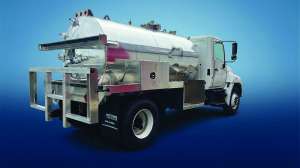
He needs a strong tank that can take the abuse of backroad driving, while being lightweight enough to allow him over small country bridges. A medium-sized (750 gallon waste/300 gallon fresh) aluminum tank paired with a Masport HXL75V pump does the job for Daniel’s workload.
Another vehicle of choice is a 1996 Ford F-550 with an old Alexander 1,100-gallon waste/300-gallon fresh aluminum tank. Power comes from a Masport W44 pump. And jobs in tight spaces — say, between buildings or trees — get serviced with a GMC 3500 flatbed with a small slide-in unit, also aluminum.
“I prefer aluminum,” says Daniel, “It helps stay within weight limits on the bridges.”
Sean Farrell keeps his rigs small for the septic pumping and portables business he runs with his father, Dominic Farrell. They service their home island of Newfoundland at the mouth of the St. Lawrence River. Their territory also encompasses Labrador, the mainland peninsula of this rugged Maritime Province.
“You don’t want to go too big, because then you can’t get into driveways and tight areas,” he says. Still, they need a big enough tank to accommodate the longer rural routes. “An ideal tank (for all-around use) for us would be about 2,500 gallons, with 400-500 gallons of freshwater.”
The Farrells purchase high-displacement pumps to handle these larger tanks, and they prefer the Moro brand. “The last truck we just bought was built out by Transway (Systems Inc.),” Sean Farrell says. “We’re quite happy with that.” That new setup is mounted on a GMC tandem axle. Their other new rig is a Peterbilt single axle.
There are no road or bridge weight restrictions in their territory, but lots of hills make the Farrells want a rig that can climb steadily and tanks that can take a bump or two. Their answer is carbon steel, built to last and save money. “Especially in this economy,” the younger Farrell says. “You want to save where you can.”.
Shawn Loveless likes to keep his rigs light and maneuverable for working the roads of south central Kentucky, where he pumps septic tanks and grease traps in addition to renting portable restrooms. “We stay small with the small Isuzu trucks. I like the new flat tank and hope to have one of those soon. I like the design of it, so you can haul units or whatever on top of the tank.”
His current tank is a 500-gallon waste/200-gallon fresh aluminum model, powered by a Masport HXL4V pump. The electric start, belt-driven engine of this compact pump suits Loveless for size, productivity and durability, which all add up to value. “When we first went into business, we bought two of these pumps with the Honda engines in them, and they just lasted and lasted,” he says. “We’ve had to redo the vanes in them a time or two, but they’ve just been really great pumps.”
The compact rigs do the job for Loveless, providing necessary maneuverability and lighter weight. “We’re on a lot of country roads,” he says, and need to be able to negotiate switchbacks and narrow roadways without much shoulder. “The Isuzus turn easily, and we have to think about weight on the bridges.”
Continue reading for free