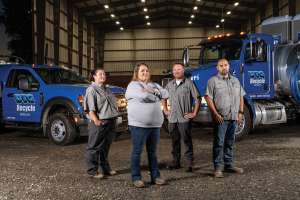
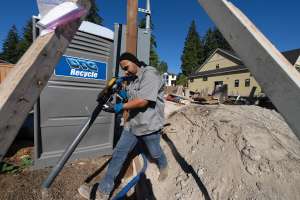
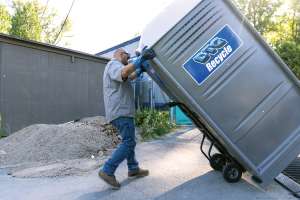
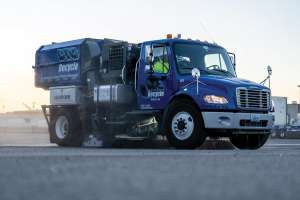
DTG’s core services are waste collection and recycling of construction, demolition, commercial and industrial materials. But about a year ago, the company diversified by entering two new markets: portable restroom rentals and street-sweeping service.
“We’ve also talked about fencing, which we currently don’t offer,” Jackman says. “But right now, we want to focus on markets that either are underserved or where customers think they just have to live with poor service.
“We like to take those markets and go the extra mile by providing top-notch service, clean gear and trucks and uniformed technicians with good attitudes,” he continues. “Our motto is, ‘Customer-focused, planet obsessed,’ and we want to do more than just pay lip service to that.”
CROSS-MARKETING
There’s another benefit to multiple services: effective and inexpensive cross-marketing. Any one of the three services can open a door to the others, Jackman notes.
“We realized that any one of these services can get us in the door at any construction company,” he explains. “For example, we ask people who use our (containers) if they know we also offer restrooms and street sweepers, and they sign on as an account.
“It can work the other way around, too, if they need restrooms or street sweeping,” he adds. “We’re finding that we’re developing relationships with lots of new customers that maybe wouldn’t have given us the time of day before.
Of course, adding services is one thing. Performing them well is another. To boost the odds of success, DTG invests in good equipment, including restrooms from Armal and Satellite Industries and street sweepers from
Elgin Sweeper.
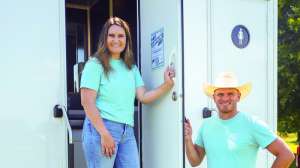
The company also made key hires, including Kristina Joseph to manage the portable restroom division and Sheldon Barnes to manage the street-sweeping division, Jackman says.
The company also continually emphasizes customer service.
“We tell our employees all the time that they have to take care of customers, no matter what,” he says. “I like to say that we don’t want to turn today’s customers into tomorrow’s competitors.”
A FAMILIAR ORIGIN STORY
Jackman knows about that firsthand. DTG now rents restrooms and sweeps streets not only to diversify its business base, but also because it used to hire out for those services — and found the customer service lacking.
DTG used to rent restrooms for employees at its roughly one dozen recycling drop-off sites, as well as for truck drivers from companies that drop off recyclables. And DTG is required by local and state regulations to keep the streets around those facilities clear of dust, dirt and other materials that might get washed into storm sewers.
“You have trucks coming in and out of those materials recovery facilities, so the yards and nearby streets would get dusty and messy,” Jackman
explains. “So we had to hire street sweepers to come by three days a week to stay on top of that
“But we weren’t happy with the restroom or street-sweeping services, much less the pricing,” he says. “So we saw an opportunity and ran with it.”
THE RIGHT STUFF
To service restroom customers, DTG has invested in nearly 700 restrooms from Armal and around 300 pieces of equipment from Satellite, including Americans with Disabilities Act-compliant restrooms and “flyer” restrooms for use in high-rise construction projects.
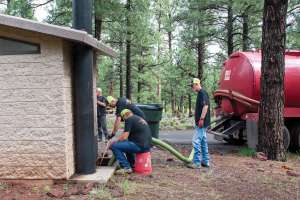
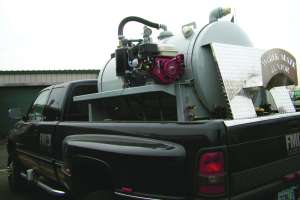
To service restrooms, the company relies on a 2021 Ford F-350 with a slide-in unit from KeeVac Industries that features a 300-gallon waste/150-gallon freshwater aluminum tank and a Masport vacuum pump; and a 2021 Ford F-550 outfitted by Vacuum Sales with a 680-gallon waste/300-gallon freshwater steel tank built by Imperial Industries and a Masport pump.
The company also owns two 2022 Peterbilt 337s built out by Satellite Vacuum Trucks with 625-gallon waste/275-gallon freshwater aluminum tanks and Masport pumps; and a 2021 Ford F-550 with a 600-gallon waste/350-gallon freshwater steel tank built by Satellite with a Conde pump (Westmoor Ltd.).
Other investments include Satellite holding and water tanks and two eight-unit restroom transport trailers made by Eagle Mfg.
REMEMBER THE CUSTOMER
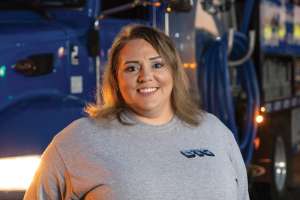
Joseph, 35, was hired about a year ago as operations supervisor of DTG’s portable restroom division. She previously worked for another restroom contractor as an inside salesperson; DTG was one of her accounts.
“DTG called me and wanted to meet to talk about starting a restroom division,” Joseph says. “I was extremely surprised, even shocked.”
Joseph says her previous experience informs how the division operates, as well as her expectations for customer service.
“I had different ideas about customer service — not necessarily reinventing the wheel, but just ensuring customers are taken care of on time,” she explains. “Too many companies worry more about hitting financial goals and milestones than actually providing customer service. Then technicians get too much work put on them, so they can’t always finish on time.
“We emphasize running smaller routes so technicians can complete service when they’re supposed to.”
ROSY OUTLOOK
Starting from scratch was an inviting prospect for Joseph.
“It was exciting and daunting at the same time,” she says. “There were plenty of times when I was awake at nights, wondering if I could do this. But one way or another, we seem to figure it out.”
The numbers back that up. She and Jackman developed a three-year revenue goal, which included hitting $63,000 in gross revenue per month. The division, which started operating in January, hit that benchmark in May, she says. Furthermore, in June, 425 of the company’s 680 restrooms were rented out.
“We’re growing steadily,” she reports.
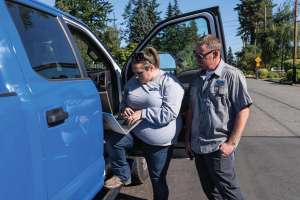
Joseph says she did her own research regarding equipment, obtained all necessary permits, ordered chemicals and paper products, picked a uniform vendor and selected a business management software, AMCS, a platform for the waste collection industry that she tailored to suit the portable sanitation industry.
“I received a lot of helpful information last October when I attended the Satellite Women’s Conference in Nashville,” Joseph notes.
Monthly construction rentals generate most of the restroom rentals. To market the new service, Joseph put up a few “rent me” flags and banners on restrooms at the company’s recycling yards.
“We have eight salespeople, too, and they’re instructed to ask customers who call to rent (containers) if they’d also like to rent some portable restrooms,” Joseph says. “We’re also really big on social media, particularly LinkedIn.”
In addition, the company selectively donates restrooms to local special events.
“It’s a good way to help out the community and get the word out at the same time,” Joseph says. “We just donated eight restrooms for the Kirkland Downtown Association Fireworks — and now a lot of people know we rent restrooms.”
PRICING STRATEGY
The Seattle restroom market is competitive, so strategic pricing was important to a successful business launch. Joseph decided on what might be considered a counterintuitive approach; she opted to set prices higher than what most competitors charge.
The reason was twofold: From an ethics standpoint, she didn’t want to undercut competitors. Furthermore, she also thinks portable sanitation services are underpriced, which further hurts the image of an industry that already doesn’t garner enough respect.
“I believe portable sanitation is seriously undervalued, considering the amount of work it takes to get the jobs done,” she says. “Customers haven’t been negative about our prices. I think they recognize that we provide a needed service.
“Sure, there are some customers that only want the lowest price,” she continues. “But other people just want a clean restroom. And as long as you provide that, they aren’t as price-conscious, within reason.”
Joseph also points out that new, well-maintained service vehicles and restrooms coupled with uniformed technicians helps to ease price objections. People also seem to treat new restrooms better, she adds.
In addition, higher prices allows DTG to pay technicians more, which improves employee retention in an industry — like many others — where turnover has been an issue.
“We want to be able to keep paying technicians a livable wage,” she says.
ATTRACTING EMPLOYEES
All of the division’s five route drivers came from other restroom companies. Joseph said she didn’t “poach” them; they came to DTG unsolicited.
“It could be the wages we pay and our company culture — DTG has a nice family feel,” she says. “Plus our work schedules are less daunting than most. We try to keep our routes to 50 restrooms a day so drivers can maximize their time with their families. … They shouldn’t need to work six or seven days a week to make a livable wage.
“Our key performance indicators (used to track drivers’ performance) aren’t time-based, either,” she continues. “We just want clean units — that’s the biggest thing.”
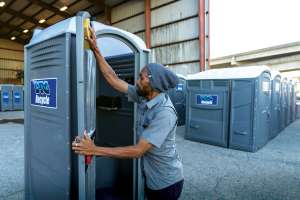
Route drivers are taught to follow a strict cleaning regimen — a 10-point process that includes thoroughly cleaning walls, roofs, floors, tanks, ledges, plus removing any graffiti. The company performs random spot checks to ensure technicians follow the process.
“We swap out broken units right away,” she notes. “We bring them back to the yard rather than just drilling another random hole into a restroom to make a repair.”
MORE GROWTH EXPECTED
Joseph expects the business to keep growing. One of her goals is 12,000 services a week within three years, up from around 450 currently.
“I know that’s a huge jump, but I have it mapped out,” she says. “It’s a big goal, but the market is there. I think western Washington is growing enough that there’ll be even more need for portable sanitation — and we’ll be here to meet that need.”