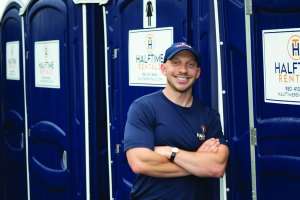
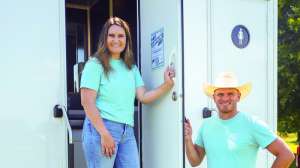
Chad Howard made a huge decision leaving a successful career to start his own business, but you can tell by the smile that his new career is off to a great start (restrooms from PolyJohn).
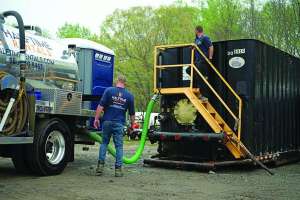
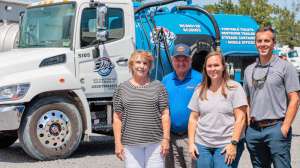
The company uses storage tanks like this Geneva Equipment unit to hold waste until it can go out for permanent disposal. After a day of pumping, Cox (left) mans the truck controls while Whisnant monitors waste level in the holding tank.
Chad Howard went to work for Procter & Gamble right out of college, eventually becoming sales director. P&G moved him around a lot and during a stay in Charlotte, North Carolina, he made friends with Austin Helms. He didn’t know it at the time, but that was the beginning of his portable restroom career.
“Austin worked for a makeshift search fund for a guy who wanted to invest in blue-collar businesses and he kept coming across portable toilet businesses,” Howard says. “He saw their finances and how they operated.”
Helms tried to convince Howard to get into that line of work, thinking his white-collar skills would be beneficial. After five years, Howard was ready to consider the suggestion. “I was sick of moving, sick of corporate BS, and when I asked myself, ‘Do I really want to do this for another 30 years?’ the answer was no.”
Howard did a little research, then with financial investments from Helms, family and friends, on July 22, 2024, his new company, Halftime Rentals, had its first unit on the ground.
Today the company has six technicians, an office manager and a sales manager. About 75% of their work is for construction accounts. Inventory includes 750 standard units, 50 ADA-compliant units and 100 hand-wash stations (all from PolyJohn), and two JAG Mobile Solutions restroom trailers.
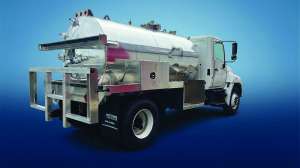
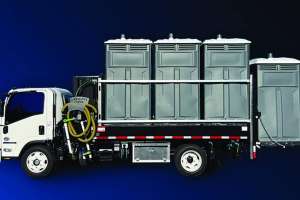
Vacuum trucks were built by Dellinger Fabrication — two 2023 Chevy 5500s with 900-gallon waste/300-gallon freshwater tanks, a 2024 Ford F-550 with a 900-gallon waste/300-gallon freshwater tank, a 2024 Mack MV6 with a 1,500-gallon waste/500-gallon freshwater tank and a 2024 Isuzu with a 400-gallon waste/200-gallon freshwater tank, all with aluminum tanks and Masport pumps.
Before making a final decision, Howard wanted to get an inside look at the industry. With a recommendation from a PolyJohn rep, he and Helms visited two portable sanitation companies and one retired contractor in Florida.
“The first company was built over 30 years,” Howard says. “They had very good people, but their use of technology was minimal. They were very successful — 3,000 toilets — and he treated his people very well.”
The second company was also successful. They were up-to-speed with technology, but treated their people poorly and did not pay well.
The retired contractor, who previously owned a large sanitation company in Maryland, gave detailed advice — what truck to buy, what portable restrooms to get, how to clean them, how to deal with freezing temperatures. He continues to be Howard’s mentor.
From November 2023 to February 2024 Howard wrote a business plan, figured out what to charge, how much equipment to buy, and how much money he needed to grow at the rate he wanted to grow.
From February to May, Howard ordered a vacuum truck, a delivery truck and 56 portable restrooms. He set up a limited liability company, got a bank account, created a website, and found a place to operate out of.
In June, Howard hired a full-time driver and a part-time delivery person. Helms helped him connect with potential customers and Howard got commitments from several to give him a try.
In July he opened the doors. And from August to September, he ran routes and concentrated on selling. He quickly needed more units and ordered a second truck.
On Sept. 30, 2024, while attending a Carolina Panthers tailgate party on a Sunday afternoon, Howard received a call from Home Depot in Asheville, North Carolina saying they needed portable restrooms that night. The area had been struck by a hurricane and they were trying to stay open.
At first Howard didn’t want to get involved — it was two hours away, he was still getting established, his inventory was limited — so he quoted an outrageous price. They readily agreed.
Howard quickly changed his tune and got into “let’s do this” mode. He called Helms for help and together they loaded up the trailers and drove to Asheville, receiving a police escort into town.
They saved the day for Home Depot, and as a result were inundated with calls. “Everyone was going to Home Depot because they needed stuff to rebuild,” Howard says. “And my phone number was on these toilets in front of the store. The next day I got 220 voicemails.” Calls came from businesses, private homes, FEMA, United Way and the Salvation Army.
Howard knew what he had to do:
He got police approval to operate out of a community college parking lot
He called PolyJohn and asked for 500 units, which they shipped the next day
He found someone to assemble the units — living in their RV in the parking lot
He found someone to answer the phone and put in orders
He ordered three vacuum trucks
He hired a bunch of people off Facebook Marketplace, doing 15-minute interviews
He rented an RV for himself and stayed on site through October
After the hurricane work, the company got back to their routine — but everything was different. The Asheville experience funded all the company’s assets, built a lot of connections and gave them name recognition. Howard hired a salesperson to help them utilize the greatly expanded inventory and has since ordered another vacuum truck and will soon buy more units.
Howard learned a lot in the company’s first nine months. Some of his insights:
How is your company different: “I have an inside-out philosophy, meaning I focus on our people because they are ultimately the ones building the product,” Howard says. “So I make sure they enjoy their days and feel valued. I encourage them to problem solve and be the customer service rep on site. In turn, we have less attrition and customers keep using us.”
Challenges: “It’s easy to get negative because things go wrong every day, so my challenge is how do I stay positive.” Another challenge is managing diverse personalities — everything from company executives to blue-collar drivers.
Unexpected benefits: Howard is enjoying several welcome changes from the corporate scene. There is a minimum of meetings and small talk, and instead of spending his days in an office, he gets to be outdoors and in the sun, whether doing manual labor or just driving somewhere.
What would you do differently: One of the company’s drivers had a bad accident, which propelled Howard to install dashcams and institute safety protocols and training programs — something he should have done earlier.
What is most rewarding: “This isn’t a sexy business, but it’s mine,” Howard says. “I’m not building it for someone else like I was at P&G. And the impact I can make on other people’s lives has been rewarding. These drivers haven’t always been given a chance. One of them thanked me for being able to buy a house after living in an RV for years.”
Advice: “My sister is a clinical psychologist and says 90% of her clients’ regrets are from something they didn’t do. So, take a chance. It’s hard work but it’s also fulfilling. The hardest part about starting a business is starting.”