When Roberto Zeitlin started his portable restroom business in Americana, Brazil, a decade ago, the country was in the process of recovering from an oppressive and backward 21-year military dictatorship, which ended in 1985 after a popular revolt.
Many things have improved as the country hastens to become a 21st century industrialized democracy, including portable sanitation services. When Zeitlin got started, equipment choices were limited, there was little perceived need for portable restrooms, and waste was often not safely disposed of. Today he can buy trucks and portable restrooms locally and business is booming.
Zeitlin uses his company as a vehicle to educate employees, support social causes, and promote human rights and responsible environmental policies. “I try to keep ahead of history,” he says. “What I do most of the time is future thinking.”
He named his company ECOTEC Tecnologia Ecolagica. It means “Ecological Technology,” reflecting a forward-thinking business philosophy.
RED, WHITE AND BLUE FOUNDATION
Zeitlin spent his first few grade school years in the United States when his father attended Stanford for his Ph.D. in 1971. Besides learning to read and write in English, he says this is where he was educated to think about the environment, a big issue in California schools at the time.
He finished his education in Brazil, and in 1995 bumped into an old friend who owned a portable restroom business. Zeitlin began helping him find clients, and in 1998 they became partners. In 2002, when his partner tired of the business, Zeitlin bought him out.
The early solo years were difficult. He’d be up at 3:30 a.m. doing deliveries and maintenance, then paperwork in the afternoons and special events on weekends. His wife, Marli, helped, but she had a full-time job. To educate himself he attended Satellite Industries’ Special Client Education program as well as the Pumper & Cleaner Environmental Expo over the years.
His first truck had to be imported from the U.S. — a 1998 Ford F-12000 with a steel tank. He took it to a mechanic who disassembled it, then put it back together in a configuration suitable for the local climate, road conditions, and size of operations.
The only available portable restrooms at the time in Brazil were fiberglass units. He said no to those and imported 70 Satellite Industries Tufways, 20 with flush and hand sanitizers. In 2003, PolyJohn Enterprises Corp. began a joint venture operation in Brazil, enabling him to buy locally.
Today, ECOTEC employs 40 people and has an additional three locations within 125 miles of Americana — Bauru to the west, Ribeirao Preto to the north and Jacarei to the southeast. They have 641 units, 120 from Satellite, the rest from PolyJohn South America. These include standard, luxury, super luxury, and VIP units, as well as 18 wheelchair-accessible units.
DOING THE RIGHT THING
“When ECOTEC was established we had two main goals,” says Zeitlin. “One was water conservation, the other social responsibility.”
Protecting the water supply is an important concern for Zeitlin. Raw sewage in Brazil is often buried, which can contaminate the water supply, in particular the Guarani aquifer, one of the largest in the world. ECOTEC began providing a document of proof that the waste it collected was taken to a treatment facility. It’s signed by the customer, ECOTEC, and the treatment plant.
One conservation measure the company employs is collecting and storing rainwater at three of its facilities, which it uses to wash units and dilute deodorizer.
“Conservation means we can use natural resources today in such a way that future generations will be able to do the same,” says Zeitlin. “Growing economically is important, but that would only happen if we are allied with conservationism and the development of future generations.”
ECOTEC is involved in a number of charitable and social projects. Besides offering wheelchair-accessible portable restrooms early on, the company helps sponsor a school for mentally challenged children, and provides money and equipment for the school’s BMX bicycle racing team, as well as food, water, and volunteers to work the races.
ECOTEC belongs to a foundation that fights for the rights of children and youth. The foundation established 10 commitments that corporate members agree to — for example, providing certain rights for pregnant and nursing mothers, not contracting with anyone that employs people under 18. ECOTEC is also working with the legislature for the rights of sugarcane workers, including the right to sanitary facilities in the fields.
BUSINESS BRAZILIAN STYLE
Twenty-six states make up Brazil, the fifth-largest country on Earth by both size and population. The capital is Brasilia, but the largest city is Sao Paulo, with over 18 million people. The climate is tropical, the religion Roman Catholic, and the language Portuguese, as it was a colony of Portugal from 1500 to 1822. Slightly smaller than the U.S., it straddles the equator, the Amazon rainforest, and four time zones.
Carnival is Brazil’s biggest and most lavish festival, and one of ECOTEC’s largest events. The country shuts down for the four days before Ash Wednesday. As with many festivals, maneuvering through crowds is a logistical challenge, but the company has learned how to handle it. “The time to study the situation and define operational procedures is before,” says Zeitlin. “If you don’t know what’s going to happen before you get there, you will have big problems. Managing a business is not magic. It’s organized good sense.”
Another popular pastime is Brazil’s version of soap operas, known as telenovelas. The TV network Rede Globo hires ECOTEC to provide portable restrooms for its on-site shoots.
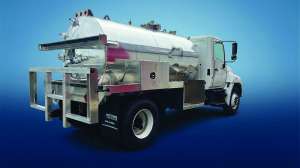
Truck dealers in Brazil, by law, are given a monopoly in their region, and are required to purchase supplies in that region. Zeitlin can choose the brand of truck he wants, but not the dealer. That’s been a problem for him in the past, but now that he has four locations he can get better pricing by forcing the four regions to bid for his work. Besides one Ford F-4000 four-wheel-drive truck to reach difficult areas, the company has nine vacuum trucks, mainly cabover Ford F-1317s.
The tanks and pumps were developed in Brazil. The steel tanks have three compartments — the largest for waste, a smaller one for deodorizer, and the smallest for freshwater. Because of the rainy/humid climate, tank interiors are given an anti-oxidation coating, and exteriors two layers of protective paint. Even with these protective measures, tanks will only last about five years. In fact, Brazilian law forbids the use of trucks older than that when doing work for governmental agencies and construction companies that work for them — big clients for ECOTEC.
Portable restrooms in Brazil are always gender-specific. At big events, mainly for safety reasons, security personnel may be on hand to ensure that there is no mixing. Zeitlin developed and patented a two-unit restroom for use in the sugarcane fields in which the doors for each gender-specific unit are on opposite sides of the trailer. A PolyJohn Bravo sink platform in the middle keeps the two units completely separate.
CAREFUL GROWTH
ECOTEC has two distinct lines of business, each with different requirements and serving different purposes.
“The construction market needs constancy and regularity — every Monday at 8 a.m., you must be there, you must clean it every week the same,” says Zeitlin. “For the event market, you need to have a disposition for unusual hours and flexibility to attend the customer’s needs.”
Zeitlin says the construction business is what gives the company stability (“knowing we can pay the bills”). Special events are the “cherry on my sundae.”
Marketing in the beginning was word-of-mouth and by handing out brochures. Later it was done by advertising in specialty magazines. Trucks and restrooms also provide valuable signage, but the most effective technique has been a well-positioned Internet site.
Zeitlin always has an eye on growth, but is very careful. “I have a commitment with 40 people who depend on the decisions I make to guarantee they’ll have their income and keep their families fed and in school, that they can pay their bills and have leisure time and vacations. I can’t be so selfish just to worry how much profit the company is going to make,” he says.
So, he takes risks, but they’re calculated. “It’s like an elephant — we have three feet on the ground and only one foot in the air at a time.”
Continue reading for free